
The next time I call someone a “bird brain,” it will be a compliment.
“You bird brain!” used to be a common insult when someone did something foolish. It makes sense, right? Birds obviously have small brains. Like your childhood friend who, on a dare, touched a frozen flag pole with his tongue.
Recently I found myself rethinking my assumptions about bird brains.
I was walking along the Lake Michigan shore in Sleeping Bear Dunes National Lakeshore. I was there on a mission: to spot piping plovers during their May nesting season.
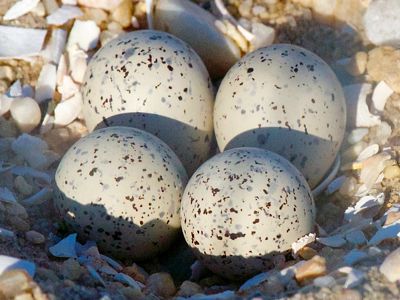
These small, speedwalking shorebirds are an endangered species, and it’s no wonder why. They lay their eggs among rounded stones near the shore of Lake Michigan and other such lakes. Sure, the eggs (and the birds themselves) blend in with the mottled gray stones. But there is a shortage of such environments. And the eggs are on the ground, where foxes, raccoons, and dogs can lunch on them. Oh, and did I mention that inattentive human hikers can step on them?
So, the National Park Service hires wildlife biologists to track the piping plovers and do what they can to protect them. I learned this on a previous trip to the area. The protection includes roping off areas where the birds typically nest—and building wire fences around established nests.
On my walk I noticed one of the enclosures inside the roped-off area, and so I started looking for a piping plover. Sure enough! I spotted one of these adorable little creatures darting out from the stones onto the sandy shore, pecking repeatedly for food, which consists of tiny worms, insects, crustaceans, and mollusks. Then I noticed another. A pair of piping plovers! I was mesmerized.
Soon I spotted someone walking toward me from Sleeping Bear Point. He was wearing a National Park ranger uniform and carrying equipment, which turned out to be a powerful scope on a tripod.
The man, Mark, told me that he is a wildlife biologist for the National Lakeshore, and at this time of the year he spends his days identifying and protecting piping plovers. He explained that every year piping plovers nest along the mainland shore in the park, as well as along the shores of North and South Manitou Islands, which we could see out in Lake Michigan.
What Mark said next is what challenged me to rethink my assumptions about bird brains.
He reported that the two piping plovers near us had recently arrived for the summer and would soon be building a nest. “Arrived from where?” I asked. “Well,” Mark replied, “the female came from the ocean shores of South Carolina, and the male came from Florida. Some of our birds come from the shores of Georgia.”
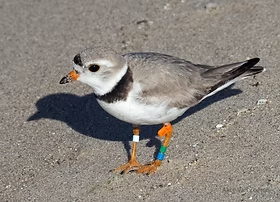
How did he know? The birds have numbered tags on their legs, and wildlife biologists in various locations track the birds and report their findings to each other.
Mark continued, “Our piping plovers return to the same area to nest every year. The male you see there actually had a different mate last year, but that female has not arrived, and she may have died because she was the oldest of the piping plovers in the park. She was actually featured in news stories.”
I had heard similar stories of bird migrations, including reports of hummingbirds migrating between South and North America. But as I was talking with Mark, I found myself amazed in a new way.
Here was a pair of tiny, feathery creatures who appeared to be extremely fragile and vulnerable. And in a way they are! That’s why Mark and others work so hard to protect them, especially during nesting season.
But somehow these delicate little “snowbirds” found their way from this very spot all the way to South Carolina and Florida. And back again. Some piping plovers have made these back-and-forth trips for a number of years.
How do they do that?
These “bird brains” are not so stupid after all. In fact, I would call them brilliant. Not to mention strong and resilient. I couldn’t do what they do!
How is it possible that such little creatures are so smart? I did some research and learned that the neurons in bird brains are packed much more tightly than the neurons in mammal brains. In fact, bird brains have as many neurons as the brains of some medium sized mammals. This explains why birds can navigate so well. It also explains why some birds can use tools, problem-solve, and even mimic human speech.
As I grow older, I find myself, like St. Francis, talking to animals. And like Francis, I address them as my brothers, sisters, siblings. We are all created by God, aren’t we? In a sense, then, we are all God’s children.
When I spoke to the piping plovers, I told them how beautiful they are. The next time I see them I will compliment them on their intelligence, particularly their remarkable navigational skills. And I might apologize for even thinking of “bird brain” as an insult.

20 Responses
Thank you for this delightful piece of information on the piping plovers. I loved the fact about the number of neurons packed in their little skulls. Considering I can lose my car in a parking lot; the size of the brain is obviously not the indicator of intelligence.
I used to live up north and Sleeping Bear National Lakeshore was often a destination for my nature hikes.
You are welcome, Joyce! I really liked learning about the tightly packed neurons and bird brains as well. Amazing, isn’t it?
Thanks, Jim, This blog is soon to fly to several avid (fanatic?) birding friends. Peace. Hope all is well. jcd
You’re welcome, Jim! Good to hear from you. And thanks to you for helping to give the article wings!
Wonderful and amazing!
Check out the book “A World on The Wing: The Global Odyssey of Migratory Birds”, Scott Weidensaul
Thanks for your affirmation, Gloria! And thanks for the book recommendation.
For a number of years we lived in Northern Virginia. Each year I would put up a hummingbird feeder on our deck and had many visitors. For some reason, one year I forgot to put up the feeder. As we were eating dinner one evening my wife heard a noise out on the deck and we saw a few hummingbirds darting around right where the feeder should have been. This amazed us, since obviously these were the same birds from a previous year(s).
What incredible memories those little creatures have! What a delightful follow-up story! Thank you, Bob.
Hello jim, thanks for this delightful walk on the beach with you. You really help us to see what we couldn’t see! One more example of God’s incredibly fascinating creation. Great writing! Ron.
Good to hear from you, Ron! You are most welcome, and thanks for the affirmation. And yes to God’s incredibly fascinating creation! Walks such as the one I described almost always become an experience of worship. The beauty and complexity of God’s work never ceases to amaze me.
Thanks, Jim…loved your article! 12 new chicks spotted so far this year: https://www.mlive.com/life/2026/06/first-piping-plover-hatchlings-spotted-along-great-lakes-shoreline.html
You’re welcome, Kristin! And thanks for the news story about the 12 new piping plover chicks. I had not seen that encouraging story. I look forward to meeting a few of them!
I wonder if you remember your neighbor, my dad, having raised pigeons next door. I often wondered at the abiilty of the homing and carrier pigeons to find their way back home over all those miles. Your article helps me understand my dad’s love for birds. Fascinating and wonder filled stuff. Nice to read this article and to see that you are doing so well. Thank you for sharing.
Wow, Ken! This is a remarkable note from a childhood neighbor. I actually do remember your dad really well, mostly because of his interesting hobby of caring for homing pigeons. I can still picture the pigeons inside their little building in your backyard. I also remember a related story. One day your dad was planting cucumber seeds in his garden and fertilizing them with pigeon dung. As I (probably about 8 years old at the time) was watching, he bet me a nickel that the little cucumber plants would pop through the soil within a certain number of days. I accepted the bet–and lost! I still remember bringing the nickel to your dad!
Thanks, Jim. As an avid birder, I was fascinated by “A Wold on the Wing.” It’s a great read.
You’re welcome, Byron. And with a second recommendation for the book, I just might have to read it!
“snowbirds” is a good one, Jim!
Another book, and don’t let the title scare you: “Looking Up: A Birder’s Guide to Hope Through Grief,” by Courtney Ellis.
Very good to see Jim appear on these pages!
Hi, Cindi! Good to hear from you. Thanks for the book recommendation and for the affirmation.
Jim, I enjoyed reading your article.
PS: We are members at Boston SQ.
Thanks, Bea! Good to hear from you!