
Even the sparrow finds a home,
and the swallow a nest for herself,
where she may lay her young,
at your altars, O God of hosts.
Psalm 84:3
In early June 2026, I had the privilege of participating in a ten-day writing workshop at the Collegeville Institute called Apart and Yet a Part. The participants were a mix of non-fiction and fiction writers, plus a poet, from across the United States.
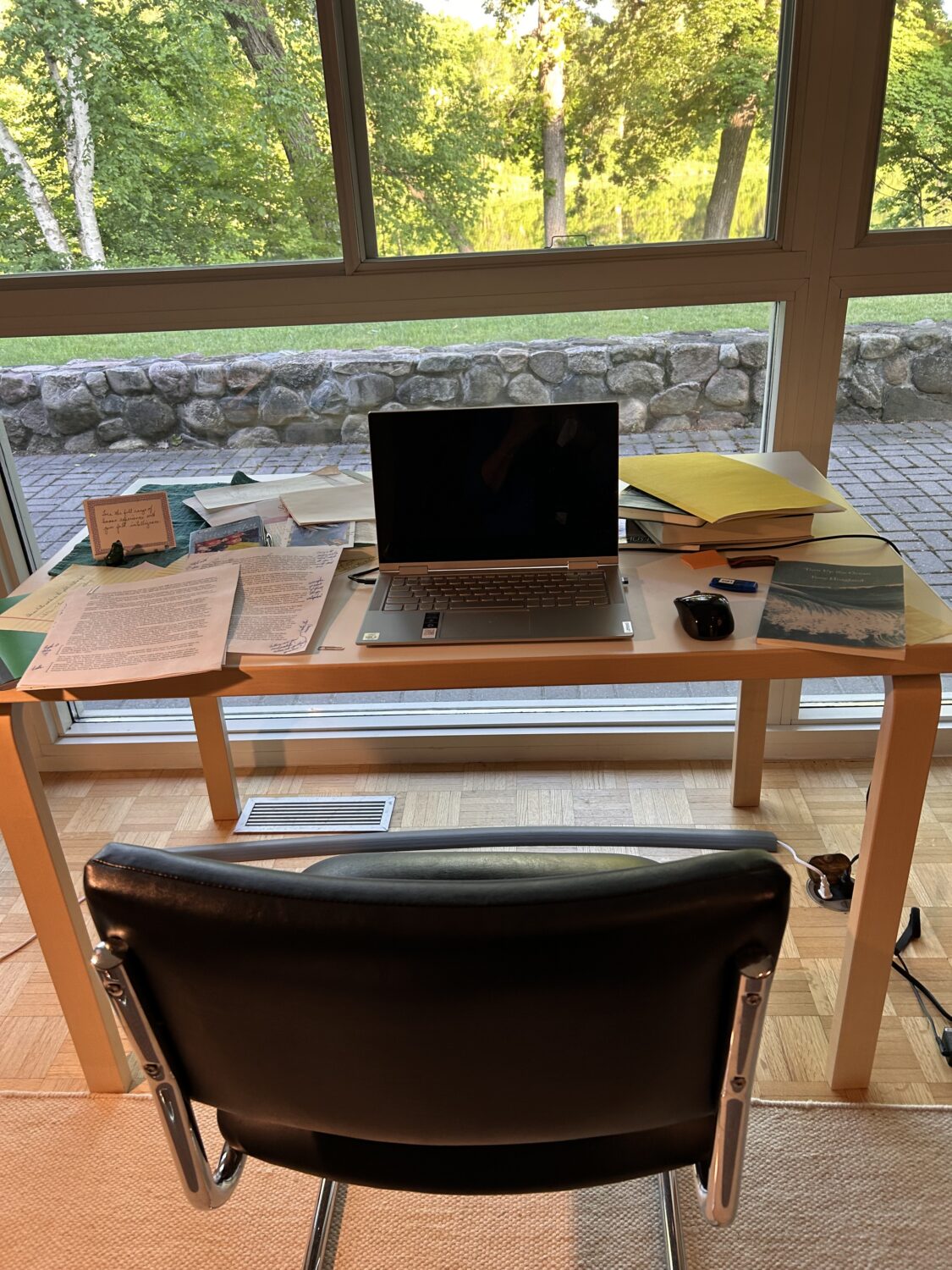
The “apart” aspect of the workshop included hours of unstructured time for working on our varied writing projects. The “a part” aspect consisted of communal dinners and evening group sessions, usually led by our facilitator, Michael N. McGregor, as well as the opportunity to meet daily with Michael to discuss our work-in-progress.

Midway through the workshop, guest facilitator Kim Smolik, Christian leader and painter, guided an evening session on cultivating contemplative creativity. Kim helped us experience a taste of visio divina by focusing on one of her paintings, a portrait that looked like a fusion of a dryad with an ancient Egyptian queen. We were invited to pay openhearted attention, while noting the qualities of our noticing, as she asked us a series of questions: “What do you see? What draws your eye? Where do you want to rest?”
Kim then showed us slides of different stages of a striking diptych she’d painted. My notes from Kim’s talk are rich, but scrappy. One run-on sentence fragment (The gifts of connection, of beauty, of play, of reality checking, of grace.) is followed by a shorter fragment: Permission to be idiosyncratic. Then I wrote a list of questions: What are you drawn to? What speaks to you? What are your practices of noticing? What is here and what wants to emerge? What does this want to become? Then a list of exhortations:
Hold an intention.
Work in layers.
Stay open to what life is offering.
Availability matters more than effort.
Let go of what the work no longer needs.
Kim Smolik’s artist talk fed one of my goals for the workshop. As a philosopher, my natural bent is toward abstraction. One exhortation to myself that I’d written out and brought with me was: Recover your senses. This dovetailed with Michael McGregor’s repeated advice to remember the importance of image, story, and voice.
As we were leaving the institute’s main building after the session, another participant named Laurie and I noticed a turtle at the corner of the lawn. The turtle was using its hind legs to knead the soil of a patch where grass had failed to thrive near the paving-stone patio where we stood.
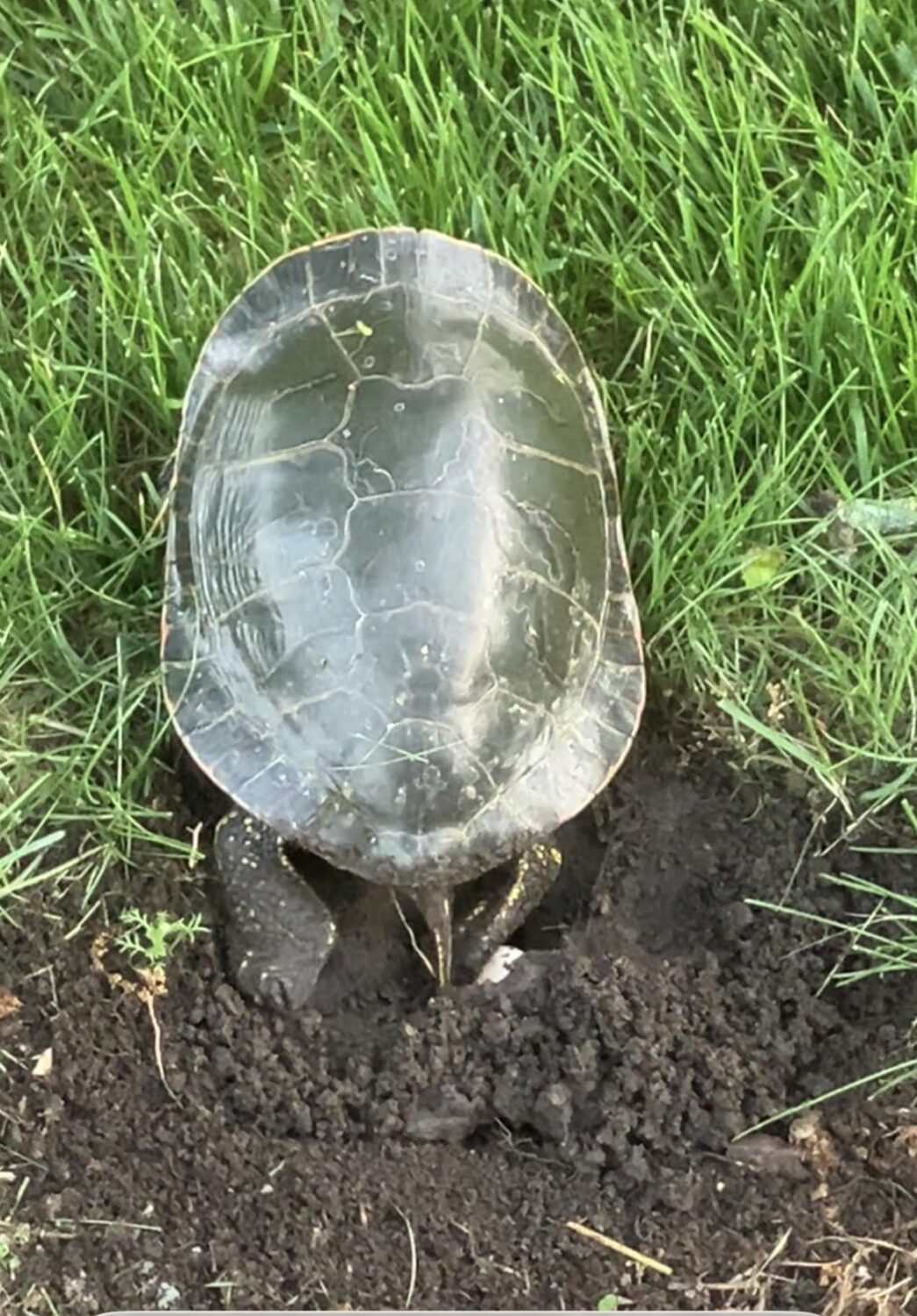
“What do you suppose it’s doing?” Laurie asked.
“Digging?” I said.
“Nesting?” she said.
“Not a very good spot for that, is it?” I responded.
I watched for a while, until the turtle’s persistence surpassed my own. I left my companion standing there and made my way to my apartment. I got out the watercolor pencils and drawing paper that I’d brought to the workshop but hadn’t taken time to use and sat on my patio sketching—not the look, but the feel, of nearby Stumpf Lake, and the varied patterns of birdsongs I could hear.
Later, Laurie sent a text message to the workshop group with a short video of the turtle laying two eggs in the hole it had patiently prepared. Sad, I thought. I assumed that the unpromising location the turtle had picked would become hardpacked by errant foot traffic before her babies could hatch, trapping them underground.
The next morning when I walked over to the main building for breakfast, I saw that someone had placed a tomato cage over the smooth dirt that hid the turtle’s carefully prepared nest. That tomato cage moved me. Had the turtle sensed the Benedictine spirit of hospitality that the Collegeville Institute embodied when she dug a nest for her eggs?
I walked by the tomato cage many times a day, as I went back and forth from my apartment to the Butler Center and other places at St. John’s University. Over those days, its sheltering structure spoke to me.
Many of my fellow Apart and Yet a Part workshop participants were mothers of young children. Two had spouses grappling with major illnesses. One was stressed by the challenges of helping her Ukrainian brother-in-law apply for a green card that would be crucial to keeping his family together if worsening conditions in Ukraine forced them to leave. One participant pastors a Minneanapolis congregation whose members were among those whom Bruce Springsteen praised for taking their stand for this land and the stranger in their midst. These busy caregivers were giddy over the ample provision given to their creativity by Michael McGregor and the institute staff. I have no doubt that works will be born that would not have seen the light of day without protected time for creativity.
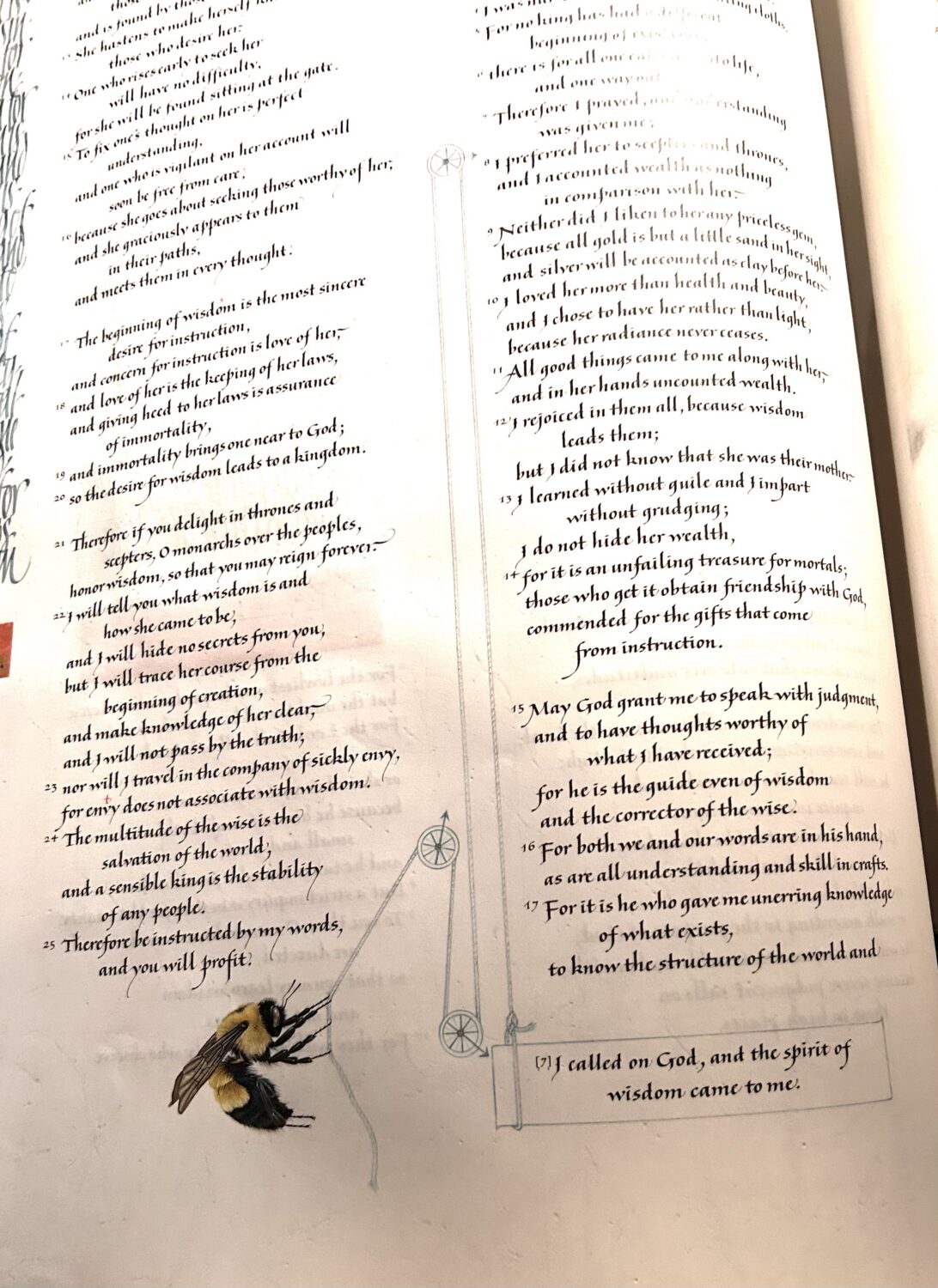
For me, the tomato cage sheltering the turtle’s nest is a metaphor for spiritually-inspired structures safeguarding precarious fecundity: the Collegeville Institute but also the Reformed Journal, the Calvin Center for Faith and Writing, the Lilly Network of Church-Related Colleges and Universities, Image Journal’s Glen Workshop, and the Belmont Creative Arts Collective, among others.
The altars of God’s creative energies are varied and expansive. Let us pray with grateful hearts for their founders, funders, and protectors.

3 Responses
Thank you for that image of a tomato cage sheltering a turtle nest!
You’ve captured our time together well. Thank you, Carol!
Dear Caroline, your piece spoke to me, variously: the permission to be idiosyncratic; the exhortation to—Recover your senses. Yes… to the wonder ongoing… to be found in image, story & voice. Thank you for putting your voice on the page, uplifting all the details you did. I send my appreciation.