
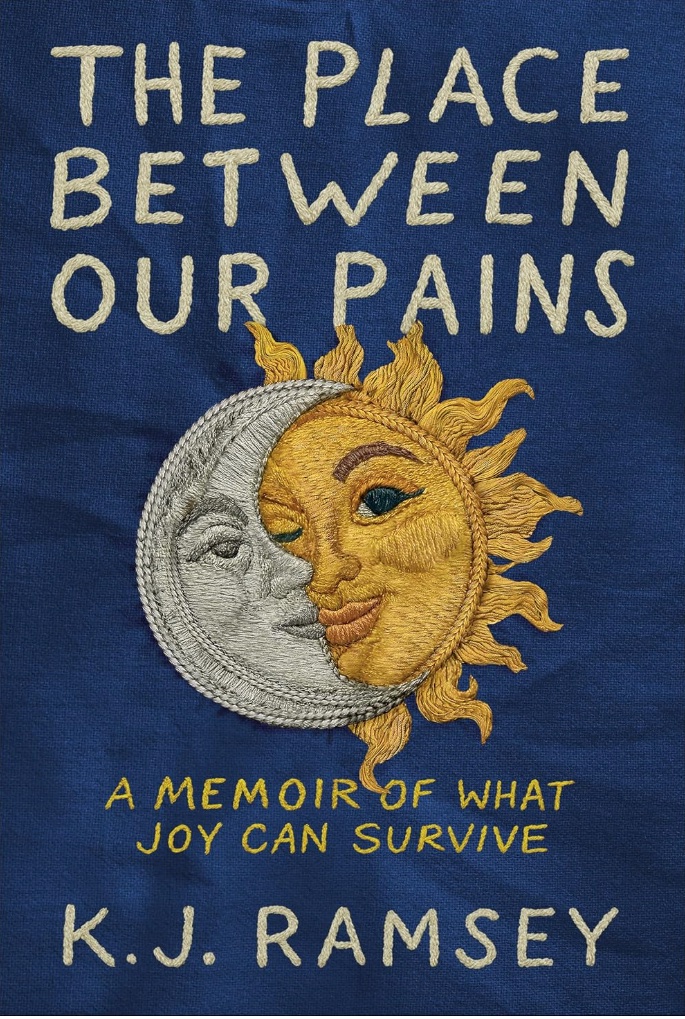
“When you almost lose your life, you no longer want to waste any time being anything but whole” (ix). K. J. Ramsey’s opening salvo minces no words and moves straightaway into the core of her testimony. What follows is a memoir that reckons with acute and chronic illness, complex trauma, church hurt, and the quest for genuine personhood. Her book takes us on a road trip that catalogs both the physical and psychic places she has been, places she is intent to return to and to witness anew. These are usually beautiful locales. But they also tend to be inhabited by ghosts that might tell her she is less than fully human because she inhabits a broken body and a sometimes broken spirit. The book is not so much Ramsey’s chronicle of pains as the inventory of the spaces between suffering where she claims her irreducible humanity—sacred parentheses that play host to the joy that is constitutive of any true and whole life, however acquainted with grief. Ramsey is determined to be the kind of human who will pause for long enough to register the sheer miracle of aliveness and relatedness, the specter of sorrow be damned.
It is quite a thing to read about Ramsey’s raucous road trips full of skinny dipping (and all manner of nakedness, really) and many more shenanigans, knowing that she is offering the world this dispatch of hope while she is—again—reckoning with yet another devastation: a tumor in her face that is destroying her nose and who knows what else. It is all too true, what she says in the preface: “If you ever want to write a book, let me be the first to warn you that your life will test its truth” (xiii).
C. S. Lewis once wrote to an American girl, a fan of his Narnia tales, to let her know about the joy of being a bona fide grown-up: you get to return, unabashedly, to fairy tales and the magic of serious play. Ramsey is dead serious about the play she undertakes in The Place Between Our Pains. In so many ways, her childhood was truncated. Her purpose in the adventures she shares in this book is to be reacquainted with the joyous child she still carries inside her broken, grown-up heart and body. She insists on being “seven again and yet thirty-four” (51). It is as though she insists that Eden and its recovery are possible, but only if we seize the moments available to us to simply be who we are in our own skin—and sometimes only in our own skin. (For Ramsey and her traveling companion, carving out a space to get naked sometimes entails a quest to first find “a penis-free environment” (22). When you’re on a quest to assert your irrepressible wholeness, it seems, you’re more prone to blurt out, and then write down, and then publish, hysterical things. Readers are rewarded with plenty of such in these pages.)
But Ramsey bears witness to more than her own defiant joy. She unflinchingly offers us the truth of her variegated pain. “Complex trauma,” she says, “is not primarily living with a library of terrifying memories; it’s living with the felt sense, held in our bodies, that at any moment, love and goodness can and will hurt us” (10). Like the once-sacral and ultimately colonized western landscapes she traverses in the early chapters of her chronicle, she recognizes that her own body has stories that have been silenced, and that these tectonic forces will eventually make themselves heard on their own volition if they are not given voice by a faithful witness. This is a book about the defiant invocation of joy—a mirth still managing to be fully itself even while emerging in the margins, nearly squeezed out by suffering and sorrow.
Alongside the ravages of lupus, plenty of church hurt is present in this narrative. There’s the risk that the story could follow an overworn trope: the church hurt me, and so nature, safe and less populated, is henceforth my sanctuary. Ramsey even suggests that the redwood forest is the platonic form of the truest church, devoid as it is of power structures and volatile, unintegrated psyches. There’s also the risk of cliché when Ramsey enumerates the ways nature metabolizes our pollution but still seems to give us gifts in exchange—how creation keeps exhaling oxygen, and continues to marshal decay to produce clusters of delicious mushrooms. The salmon bring death from the ocean a thousand miles inland to complete the circle of life in a magical spawn, and all that. Everything could quickly become a metaphor and meanwhile make our very real pain into an abstraction that ends up alienating more than healing. But Ramsey does not even flirt with such sentimentality. She recognizes that insistence upon joy is a gutsy stance: “God, it’s wild to want,” she confesses (56). What she insists upon is the space to declare, to whomever will hear, that “no pain can change the core” of who one truly is. Despite her tribulations, “delight has always decomposed discouragement” (51).
None of this is theoretical or merely metaphorical for this memoirist. There was a time in the not-so-distant past when Ramsey feared she may never walk or even stand again. So when she abruptly decides that it’s time to traipse through a landscape thick with wildflowers, her husband, Ryan, for one, is wisely not inclined to demur. The author stakes her claim, over and over again, through her defiant choice in favor of joy when joy happens to be there for the taking: she is alive and she is utterly human. Lupus could come roaring back, confining her to a hospital bed. Or it could be something new, like this tumor she and her medical team must now reckon with. Honestly, it’s always going to be something, whether or not our illnesses and heartbreaks are acute or chronic. Our disappointments, betrayals, and pains—of body or soul—are inevitable, and they arrive on the regular. The wildness that wells up in us when we find ourselves wanting far more than pain to shape our story, and the desire to experience the magic of being a human person in this treacherous but beautiful world of ours, are indications that the humanity we instantiate in our every breath is finally impossible to betray.
Without coming right out and saying it, Ramsey’s testament seems to put the question to each of her readers: will we heed the humanity that insists on being expressed, in these places, however narrow or brief, between our pains? Or will we retreat, allowing sorrow to crowd out this witness that even our broken bodies and bruised souls seem to want to bear? Maybe the place between our pains is just enough space to impose ourselves, in all our naked-and-now-less-ashamed hereness, for long enough to reclaim what we bear more fundamentally than anything else that may befall us. Maybe the summons implicit in the witness Ramsey bears in this book is that we must give voice and shape to the irrepressible humanity we always carry with us.
Ramsey and I share a few overlapping fields of pain, but mostly I am acquainted with sorrows which are somewhat other and my own. In the past month alone, for instance, I was fired from my pastoral role and cut off from the church community I was serving, even while my son was hospitalized by a terrifying mental health crisis. I suppose none of this—this quest to stake a claim to true personhood—is theoretical for me, either. This memoir suggests that it is time I nevertheless take up a certain amount of space and speak a pair of holy parentheses into being—a tract of land and a sliver of time just wide enough to hold forth something of my own indelible and naked humanity, and for just long enough to know something of the joy that best bears witness to the truth of my own irreducible personhood. That’s the vocation, should I have the gumption to enact it.
3 Responses
SOLD! And thank you for your ending vulnerability.
Andy I just read your poem previously posted here on RJ “When Appetite Returns”. That last line:“Whatever else remains, we know
we’re on the mend when we are hungry again.” May you be hungry again.
Thanks for your kind words, Joyce! 🙏🏼