
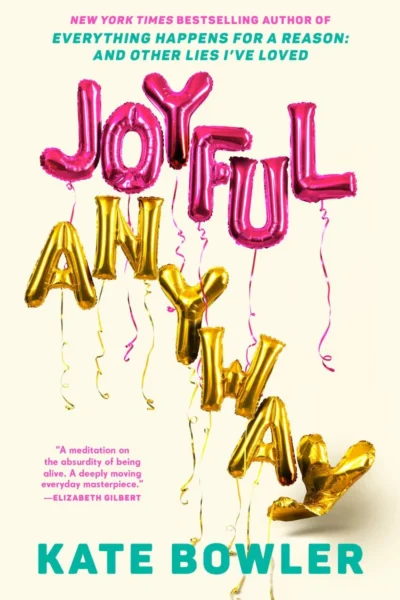
Kate Bowler’s new book Joyful, Anyway has got me thinking about the joyful moments in my life.
On the day I married my wife, I sat alone in the sanctuary before the wedding party arrived and cried with joy for the first time. Five years later, I teared up as I held our one-day-old child. Those were mountain-top moments, for sure.
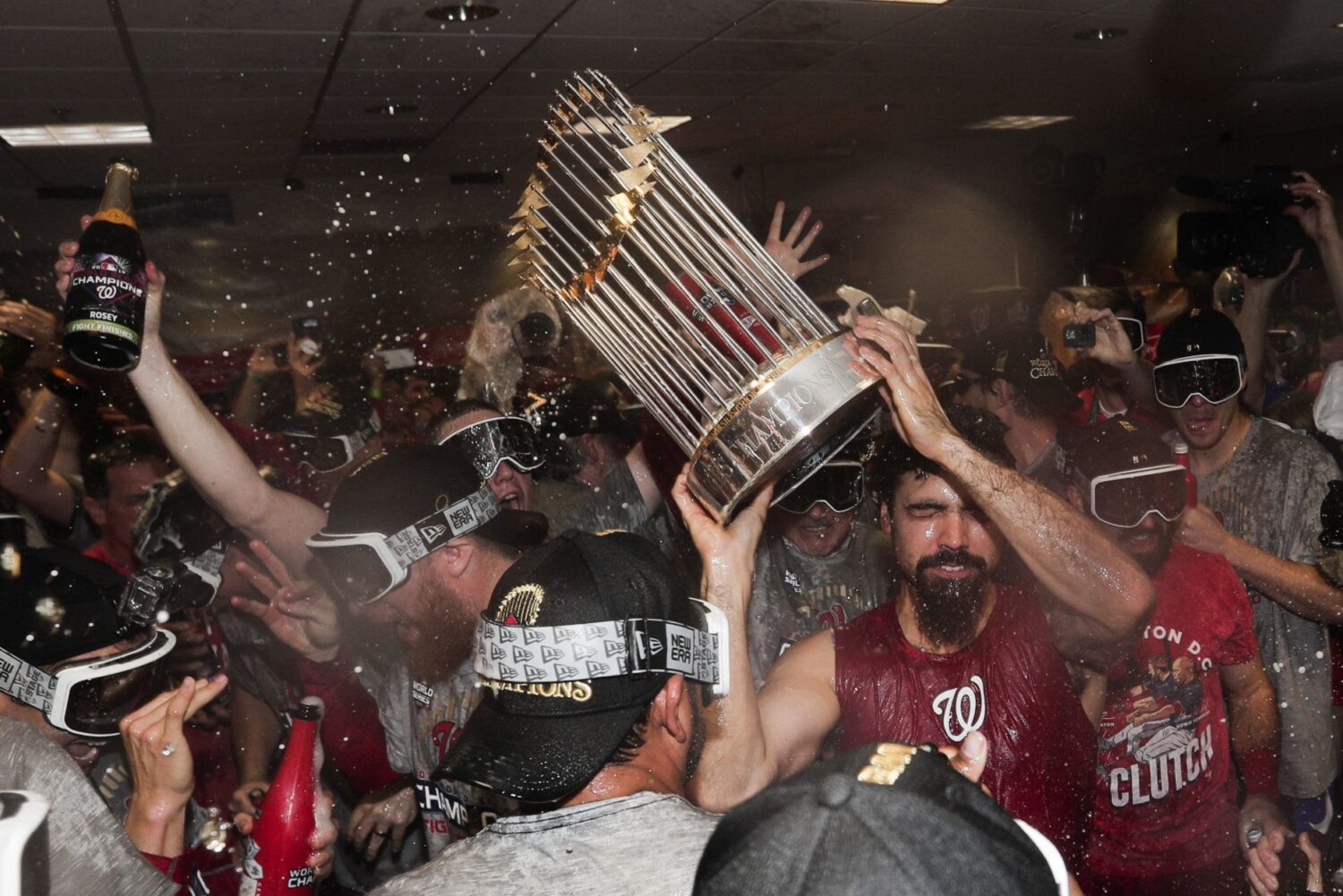
However, I’ve decided that the night in 2019 when the Washington Nationals won the World Series was my most joyful moment. After the final out, unbidden exclamations came out of my mouth, almost like the apostles when they spoke new languages in Acts.
I hesitate to admit that I can’t identify that exhilaration of joy in a church setting. I am the son of a pastor, the nephew of two pastors, and the grandson of a pastor. I was baptized as an infant, made my profession of faith at 14, and became an elder at 33. You’d think my most joyful moments would be some epiphany in a worship, at a retreat, or on a mission project.
But, no, it happened after a baseball game.
The year of our Lord 2019 was a difficult one for me.
As Memorial Day weekend approached, the Nationals had the second-worst record in the National League. I stayed late in the office that Thursday to tie up loose ends because I took leave to create a four-day weekend.
Then, my sister Mary called. She had been at the Zeeland hospital all week, where our dad had been hospitalized with an infection. The doctors told her that he would be discharged to Freedom Village the next day and said she could go back home to Chicago. Then the doctors called before she got to Sauguatuck. They had found internal bleeding.
I rushed home, booked a morning flight, and arrived by early afternoon Friday. At the hospital, the doctors said they didn’t have the equipment to do surgery and offered to airlift our dad to Grand Rapids. He had been unconscious for 24 hours with little hope he would return. Without the surgery, he wouldn’t recover. My sister said his medical directives said he wouldn’t want that. We decided to disconnect him from the machines which were assisting him to live.
I went into his room and told him, “I have to learn how to live without a father.” I hoped he could hear me and understand how much I would miss him.
Our uncles and aunts arrived, along with a cousin and his wife. We spent the evening telling family stories, and waiting for my dad to die.
He was a stubborn man, and he refused to leave us that night, much to the doctors’ surprise. That night, the Nationals beat the Miami Marlins.
We kept vigil again on Saturday, and the Nats won again. Our dad passed away at 2 a.m. Sunday. The Nats won that afternoon.
That marked the start of their unlikely turnaround in the summer. As I went through the roller coaster ride of grief, my team started to win. They acquired Gerardo Parra when they were in the doldrums, and he added a spark to the team. He went into a hitting slump, and his children suggested he change his walk-up song to “Baby Shark.” Soon, team members would mimic a shark-chomping with their arms after getting a hit, small ones for singles and extra-large ones for home runs. As the team’s record improved, they started having extended dance parties in the locker room after they won.
In my everyday life, grief kept finding me. In June, our beloved pastor preached his final sermon before he retired. He picked my dad’s favorite hymn, “Amazing Grace,” for the first hymn. Tears rolled down my face as I sang. In July, close friends sent a card, saying they wanted to remind me they were thinking of me. I sat on the sofa crying tears of grief for my loss and of joy for all those who supported me.

I went to three Nats games in September as they tried to secure a wild-card playoff berth. My sister Jean and I spent an evening talking about baseball and missing our father. Church friends invited my wife and me to join them in their season tickets in the club seats. In the last week of the season, my friend Robert and I used my company’s tickets for a game against the Phillies.
The Nats beat the Phillies that night, starting an eight-game winning streak to end the season. They earned home-field advantage in the wild-card game. The winner would advance, and the loser’s season would end.
Over the past seven years, the Nats had lost in the playoffs by making avoidable mistakes or errors. I’d been disappointed before, and I expected that 2019 would be the same.
In the wild-card game, I sat at home and watched as they loaded the bases in the bottom of the eighth, down by two runs. Juan Soto, their wunderkind, hit a line drive that dropped in front of the right fielder. “This will tie the game,” I thought. But the Brewers’ rookie right fielder let the ball go under his glove. I jumped up and danced across the room. Finally, the other team made the decisive error.
The Nats won that game and then eliminated the Dodgers with an extra-inning grand slam in the final game. Next, they vanquished the St. Louis Cardinals in four games. My friend Alan and I cheered from the right field seats as the Cardinals’ second baseman and right fielder let a fly ball drop to extend a first-inning rally that cinched the game and series.
Fast forward to Game 7 of the World Series. The Astros went ahead early by a run and then added another in the fifth. The Nats hadn’t mounted a rally. I paced around the house, listening to the radio (watching was too stressful), and then found myself lying face down on the floor. I couldn’t handle the stress. I decided taking the dog for a walk might help.
It was a cold, rainy night. I listened through my earbuds. In the seventh, Anthony Rendon hit a home run. After Soto walked, Howie Kendrick hit a two-run homer to take the lead. I started skipping for joy like a child.
When the final Astro struck out, I was sitting at home in a comfortable chair. I fell on the floor and rolled around laughing at the absurdity that a team that started so badly and had a history of ill-timed blunders had finally won the World Series. My joy was so unexpected.
The next morning, I read the front-page story in The Washington Post, where Thomas Boswell wrote eloquently about the series of unexpected comebacks the Nationals completed to become champions.
A couple of paragraphs in, I choked up, and tears rolled down my face. It wasn’t for joy, but for sorrow. I knew my father would have called after the last out to talk about the game.
In that moment, I realized that the biggest joy includes sorrow. Like the Nationals, I had experienced the depths and the peaks, and I learned that sometimes you can’t have one without the other.

7 Responses
I cry too easily, and it happened as I read your story. I too am a baseball guy, a fan from the other Washington, thus the Seattle Mariners. They have given us much to cry over in their 50 years, but great joy as well. As my Dad was dying, he got some solace in watching the Mariners, though I have claimed a particular reliever took a month off his life. Having lost my wife in 2012 to glioblastoma, still grieving, my friend and I went to an afternoon Mariner game, and in God’s good providence, Felix pitched his perfect game–no, our perfect game. So much more to say, but I love this line about life, from the Fiddler, “One Season following another, ladened with happiness, and tears.”
I was happy to contribute to the long line of baseball writing on the Reformed Journal. A long time ago, I read an essay by Donald Hall entitled, “Baseball if Fathers Playing Catch with Sons,” which explained how the game connects across generations. Your comment has spurred me to read it again.
Somewhere in the late 80s I recall a piece in RJ, I believe, on Grace (Mark) and Law (Vance) holding the corners of the Cubs’ infield. Anyone able to recall the writer?
I remember the players, but I don’t remember the article. If you find it, I’d love to read it.
Great play-by-play of your baseball team and your life. Your last line: “Like the Nationals, I had experienced the depths and the peaks, and I learned that sometimes you can’t have one without the other.”, is so true. Such a hard reality.
It also gives me hope for the Detroit Tigers …and our world.
Maybe someday you’ll have the joy of seeing the Tigers win. One of my cousins was born in 1968 when the Tigers beat the Cardinals, and he died in October 2012. If only they had won that year.
I’m actually old enough to remember ‘68 & ‘84 World Series wins for Tigers.