
A few weeks ago, my Wisconsin suburban family spent a lot of time sheltering in our basement. Repeated tornado warnings and touchdowns drove us underground in the early morning, and the next day, in the middle of a violin lesson. Torrential rains fell and washed into well-worn flood plains. The ground swelled with water. Our sump pump died, and the waters rose. Our handy next-door neighbor saw us checking the yard (which also had standing water) and sprang into action. He had a hand pump and set it up. Another neighbor let us borrow fans and extra dehumidifiers I bought the last shop vac at our neighborhood Ace Hardware. A few weeks later, we were able to lend the new shop vac to another neighbor. We live in the sort of neighborhood where everyone knows your name, and where we can call or text and someone is there to lend a hand, or a pump.
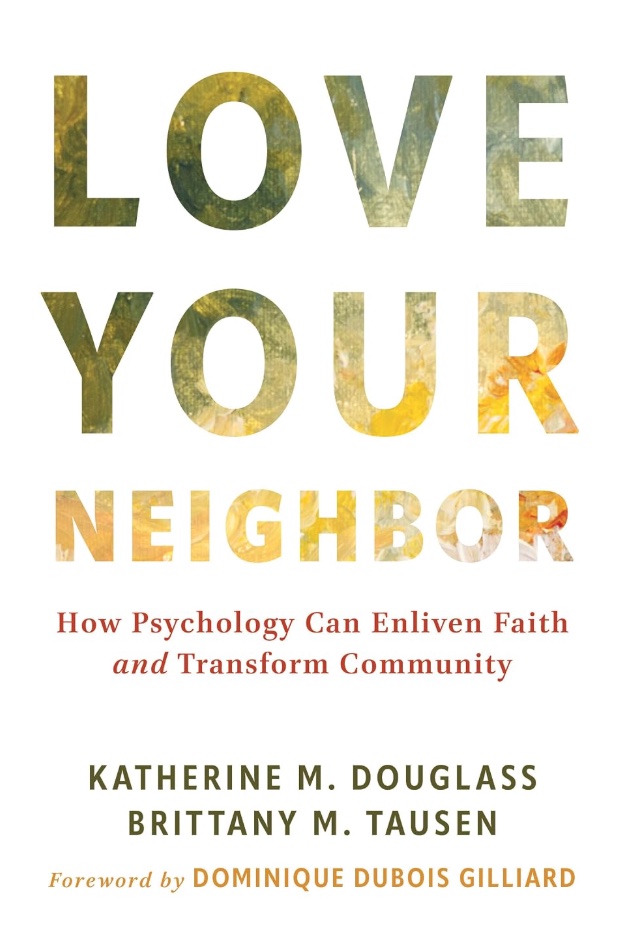
That is not the mainstream experience for many, which Katherine M. Douglass and Brittany Tausen identify as a premise in their new book Love Your Neighbor: How Psychology Can Enliven Faith and Transform Community.
The theme of loving your neighbor and connecting with your neighbor could not be more resonant in our age of polarization and isolation. Douglas and Tausen write not just to name the problem or to deconstruct the problem – something many a book does. What sets their new book apart is that they seek to provide a biblical and psychological framework and spiritual praxis toward transformation.
The book is organized in 3 parts: Part 1–When Circumstances Get in the Way of Loving Your Neighbor, Part 2–When Thoughts and Feelings Get in the Way of Loving Your Neighbor, and Part 3–Choosing to Love Better. Each chapter is undergirded with a biblical foundation and two lenses: a psychological lens and a practical theological lens. This framework encourages the reader to reflect not just on the data and contextual examples raised by the authors, but also on their own life and experience. Many chapters conclude with questions for reflection, making this a great book for discussion groups in a church or community.
I read this book twice in recent months. First, quickly highlighting, underlining, and pondering its insights. Then, during Eastertide–slowly–as this book provides fodder for personal reflection. I read it while the news noise cycles through, daily exposing the questions from the Introduction: “Why do I struggle to love my neighbor? How can I love better?”
Douglas and Tausen take the reader on a journey of personal reflection, providing a hand pump, if you will–and the potential for transformation–at least for this reader.

6 Responses
Thank you for this review – I’ve been curious about this book!
Thanks for reading! It would be wonderful for a church group (Lenten study?) to read.
Susan,
Thanks for this fine review! It sounds like just the book we need these days, and you’re right to point out how unique it is for pointing us to “spiritual praxis toward transformation.”
Thank you for reading. Indeed, it’s a timely book.
Cleaning up branches together with our neighbors after recent storms in Illinois, we all reaffirmed the need for a block party or two—planned, not impromptu, although both reflect love and care. Party music and laughter as well as noise (music?) from chain saws and generators.
Thanks for reading! We’re bound together in joy and sorrow, aren’t we? Our neighborhood pulled together in a similar fashion last August when we had the 100 year flood in Milwaukee. Those block parties and social events weave the social fabric a bit tighter, don’t they? The book would make a great selection for a book club or neighborhood group.