
I have always loved the parables of Jesus.
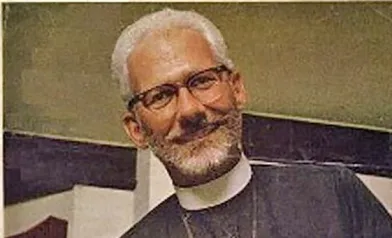
1925-2013
When I noticed that the seven parables of the Kingdom in Matthew 13 are the Gospel readings of the Revised Common Lectionary through July, I decided they would be a good series for these Sunday blogs.
The Parable of the Sower is the first Kingdom parable in all of the synoptic gospels — Matthew, Mark, and Luke. For Robert Farrar Capon, it sets up all the other parables of the kingdom in Matthew 13 and contains the five themes that he finds in all of them: catholicity (or universality), mystery, actuality, hostility, and response.
In the Parable of the Sower, we see
- Catholicity — the gospel seed is sown everywhere.
- Mystery — the seed disappears beneath the soil for a time.
- Actuality — the seeds eventually do grow up.
- Hostility — birds, rocks, and thorns threaten the crop
- Response — we are expected to bear much fruit by God’s grace, fruit worthy of repentance.
It remains both the gift and task of the Church to scatter the gospel seed to as many people and places as possible. Today there are over 10,000 different ethnic groups in the world and many still don’t have any translation of the gospel in their own language.
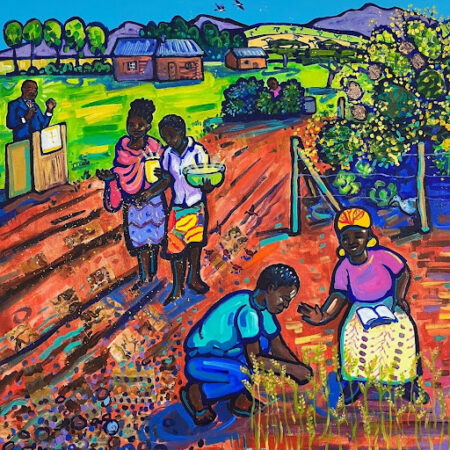
In the painting above, by Joel Schoon-Tanis, assisted by his family and my homiletics students, two people are scattering seed on the ground. A preacher proclaims the gospel from a pulpit. The ground contains birds, rocks, weeds and thorns. On the right side, are wheat and weeds anticipating next week’s parable.
Below, the second painting (and actually the third panel of the series), depicts the final harvest. The crop is mature. People rejoice and sing together. A dove hovers above as a symbol of the Holy Spirit.
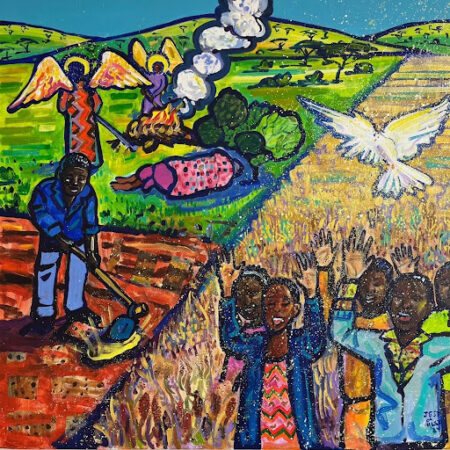
One detail I especially like in Joel’s painting is that at least one of the sowers of the seed is a woman. In most paintings of this parable, the sowers are men. Yet in Africa, women do most of the agricultural work, especially planting and weeding.
When my wife Jane and I went to Malawi in 1990, there were no ordained women pastors in the Church of Central Africa Presbyterian (CCAP) Synod where we served. Sadly, that is still true today. When we came to Kenya in 2004, the Presbyterian Church of East Africa (PCEA) had already ordained women elders since the 1960s and ordained its first woman pastor in 1979. The Reformed Church of East Africa (RCEA), however, had not yet ordained any women.
That changed in 2018 when the RCEA amended its constitution and ordained its first woman pastor (one of my former students). Because it was something new and still controversial, the Moderator of the RCEA wanted to be sure people understood her ordination was fully equal to his own. To symbolize this, instead of giving her a new clerical collar, he took off his own and placed it around her neck. Then he put on hers!
Living in the tension of both/and is creative, but the polarization of either/or stifles creativity and stunts the health of the Church. The counter-cultural message of the gospel already faces enough hostility from the world. We need not add more hostility from within the Church itself. Yet often we Christians are very hostile toward each other. The Church Universal has always been extremely diverse, but in today’s politically charged atmosphere, we seem better at putting each other down and tearing ourselves apart than building up the body.
In Africa, the Church continues to grow and multiply. With 780 million believers, Africa is now the center of world Christianity. Some observers contend the growth is “miles wide, but inches deep.” But there is much good evangelism to celebrate, even as the work of teaching and discipleship remains. The harvest has truly been remarkable: thirty, sixty, and even one hundred fold.
We plow the fields and scatter the good seed on the land,
But it is fed and watered by God’s almighty hand…
All good gifts around us are sent from heaven above;
Then thank the Lord, O thank the Lord, for all his love.
— Matthias Claudius (1740–1815), son of a Lutheran pastor in Germany
Header photo by Annie Spratt on Unsplash
5 Responses
Thanks for this wonderful reminder of what the Holy Spirit is doing in our world. We are blessed to live in the generation when the center of Christianity shifted from the West to the Majority World. Heaven is rejoicing.
In my frequent sojourns in West Africa (four semester study programs in.Ghana) my wife and my students and I were amazed by the depth and steadfastness of Christian witness–and also by the warm and respectful relations between Christians and Muslims. In both respects we in the West have much to learn. But it can be a little disconcerting to find that worship styles we associate with Pentecostal churches (ecstatic speech, exuberant dancing, spontaneous testimonies) are embraced by Calvinists and Wesleyans and Anglicans and Catholics alike.
I think worship in heaven will be quite diverse and more interesting than any of us can imagine, but I too hope there will be some quieter moments for silent reflections.
Thanks for this, I think my favorite year of worship was when we lived in West Africa. We worshipped weekly with folks from diverse backgrounds, ethnic, and denominationally diverse. We did not bother to “strain out gnats” or construct walls to keep out people from different traditions, the “birds” patrolling the path, and the weeds among the rocks and the thorns mixed with the wheat did that. No one had to sign a human made document “without reservation” and the body flourished.
Love this, Dan. Thanks.