
We gather outside the church. It’s an evangelical non-denominational congregation.
We’re there to protest.
Last year it hosted Stewart Rhodes, founder of the Oath Keepers, convicted of seditious conspiracy for his role the violent January 6 attack on the US Capitol. We protested then too.
Now we’re back.
This time the church is honoring Ben Bergquam, a White Christian nationalist influencer who champions immigration raids and mass deportations. His post-Minneapolis rallying cry? “God bless ICE!”
The congregation hosting him: Greater Grace Community Church. Yes! “Greater Grace” spreading lies and hate. You can’t make this stuff up.
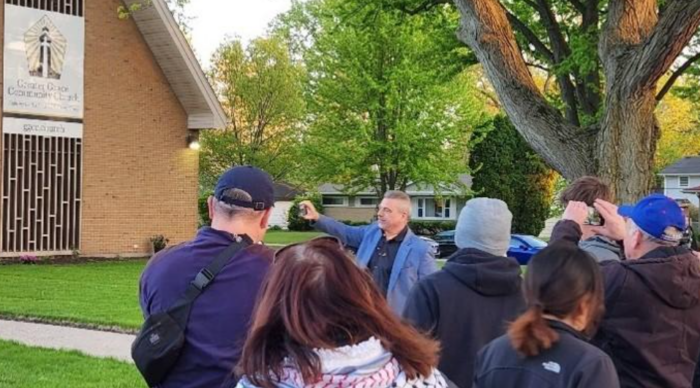
I stand near Thea and Marion and Josh, each wearing a minister’s stole. Jill holds a handwritten sign that reads: “Jesus weeps.” We’re here—rapid responders and faith leaders—to say that the Jesus of the gospels and the Jesus of MAGA are not the same. Not even close.
We’re also here to stand with our at-risk neighbors. The church sits in a low-income Latino area. ICE vehicles dot the parking lot. Off-duty agents defile the sanctuary.
With us are Hispanic teenagers, parents, and grandparents. They carry American flags. And signs, of course. “Keep Immigrants—Deport Racists.” We have bullhorns to taunt guards patrolling the church perimeter: “F**k ICE!” The anger is fiery and thick. “Why are you protecting killers and not us?” someone bellows as local police escort Bergquam away. “Whose side are you on?”
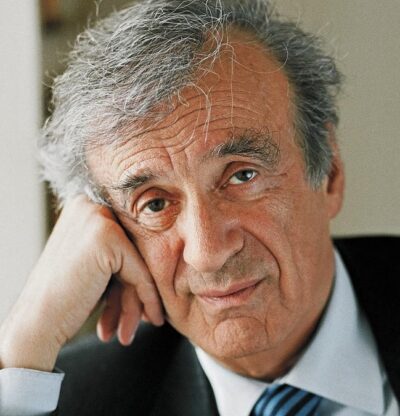
1928-2016
I had to be there. Silence is complicity. Docility is consent.
Elie Wiesel said
the greatest commandment in the Bible is ‘Thou shall not stand idly by.’ When you witness an injustice, don’t stand idly by. When you hear of a person or a group being persecuted, don’t stand idly by. When there is something wrong in the community around you, don’t stand idly by. You must intervene.
Wiesel’s eleventh commandment draws upon Leviticus 19:16: “Don’t just stand by when your neighbor’s life is in danger” and echoes Proverbs 31:8: “Speak up for those who cannot speak for themselves; ensure justice for those being crushed.”
The Bible is full of people who refused to stand idly by. Moses confronted Pharaoh and Samuel rebuked Saul. Nathan called out David’s sin. Daniel and the Hebrew children refused to bow to Nebuchadnezzar. Esther advocated for her people before King Xerxes. John the Baptizer scolded Herod for marrying his brother’s wife. The apostles declared that they would obey God rather than human authorities.
Church history too is full of faithful protesters. Polycarp of Smyrna refused to participate in mandated rites for the Emperor. Joan of Arc defied Church authority, acting on her own visions without Church approval. Bartholome de las Casas defended Indigenous peoples against colonial abuse. Maria Stewart, a Black abolitionist, challenged White slaveowners. Allan Boesak opposed the South African apartheid state. Oscar Romero spoke out against injustice and violence in El Salvador. Indeed, we Protestants got our very name from protesting.
I was protesting outside the church because protest is deep in our Christian bones.
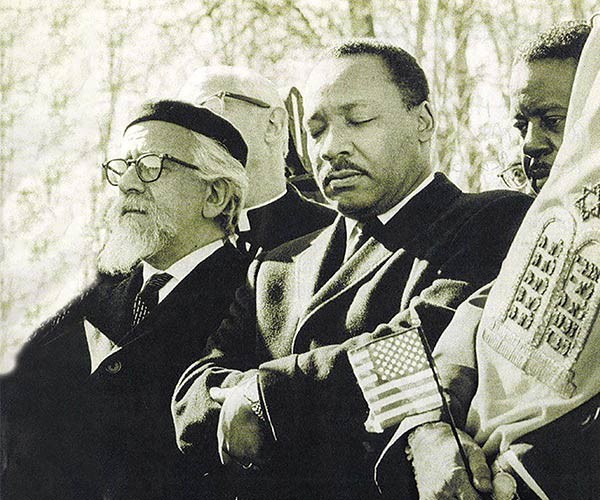
“I felt my legs were praying,” Rabbi Abraham Joshua Heschel remarked after marching with Dr. King at Selma.
I’m no Heschel. Certainly, no King.
But in this age of Trump 2.0, protest has become praying with my legs. Hands Off Medicaid. No Kings. ICE Out Now. I attend them all. I carry signs. Sometimes I speak. Always, I grow.
Richard Mouw calls it “exercises in corrective spirituality” — activities of mind or body, done deliberately and regularly, in order to engrave Christian perspectives and dispositions into our characters. Søren Kierkegaard rejected the idea of being Christian as something we statically settle into. Instead, we’re always in the process of becoming Christian through faithful repetition. Prayer. Fasting. Worship. Sabbath. These practices implant in us a vision of reality and a way of life attuned to God’s Reign.
I would add public protest to the list. Praying with my legs etches the character of Jesus into my own.
I’m an educated, middle class, White man. I have privilege. It insulates me from experiencing firsthand the traumatic stress that my Latino neighbors live with constantly. I know many personally and am active in immigrant protection. Still, their anxiety and alarm can become abstract and remote for me.
Protesting outside a church makes it concrete. Vivid. Near-at-hand
I hear vitriol screamed at elderly women leaving the Bergquam event. Acrimony directed at macho young men posing in red hats. Yet beneath the tip of the hostility iceberg, I saw pain. Fear. Panic.
- A loved one detained.
- A friend deported.
- A coworker in hiding.
- A quinceañera cancelled.
- A landscaping business on the brink.
The rage was only the surface. Underneath it lay grief.
I needed to hear those voices — the vitriol and acrimony. It moves me beyond theoretical ideas about evil. To practical embodiment. Standing shoulder to shoulder. Looking into tear-streaked faces. Listening to nauseating stories. Realizing once again—in my heart, not my head—that “immigration policy” has names and faces. Consuelo and Alejandro. Ximena and Luis. They’re being devastated. Destroyed. Demolished. Devoured.
And I needed to be a voice saying that this cruelty in God’s name betrays the Liberator who sets free the enslaved and protects the stranger; the same One who repudiates dinner guests for taking the seats of honor.
Bonhoeffer described Christian formation as “being drawn into the form of Jesus,” being molded to his way of life. He knew that Jesus’s call upends our allegiance to social and ecclesial realities that contradict the gospel. In his case it was a dictatorship concerned with the purity of the volk and a complicit church that “witnessed the suffering of countless innocent people without raising its voice for the victims or finding ways of rushing to help them.”
In our case it’s a quasi-authoritarian government and churches hijacked by hate that are gleefully disappearing innocent immigrants. Saying “NO!” and participating in public demonstrations of disapproval is a spiritual practice.
Sometimes the most faithful prayer we can offer is refusing to stand idly by, and instead standing beside our vulnerable neighbors.
3 Responses
Hi James: Thanks for your words. I like your rendition of Leviticus 19:16, because it fits what following Jesus is about, but I was wondering what translation you were using. I was unable to find one that matched what you cited. NIV had “Do not do anything that endangers your neighbor’s life.” ESV had “You shall not stand up against the life of your neighbor.” And the NRSV had “You shall not profit by the blood of your neighbor.” The Good Samaritan is a great example of someone not standing idly by. But I suppose there may be good and bad ways to jump into action (as seen in Moses earlier getting involved by killing an Egyptian and later getting involved by obeying God’s command to confront Pharaoh).Thanks for not standing idly by.
Thank you for these good words and for your strong, courageous actions
Jim.. Ad I say and read your writing, I was moved, and wished I had attended that protest at the Evangelical church.. Thank you for bringing so much awareness, to such a disgraceful event, and time in which we are living in.Anything we can do to help, big or small is essential in making a difference. I’m grateful to have you as a friend and a partner, working together to bring about change…Let’s continue to make “good trouble”……