
At age 32, I bought my first house. I had just moved back to my small hometown, and found a charming 800-squarefoot, 1940s-build on a little hill down a quiet street. I felt all the feelings: independence, living completely alone for the first time; gratitude for the first-homeowner’s grant; and fear of this daunting financial responsibility.
Days after closing on my house, I accepted a job on a marketing team, and I would be working remotely from my new home office. After more than 10 years on various marketing teams, I was excited for this new role, albeit wary of future burnout (that had afflicted me in the past) and wondering if my new employers would expect me to squeeze every ounce of production from every moment of my day (as previous employers had expected).
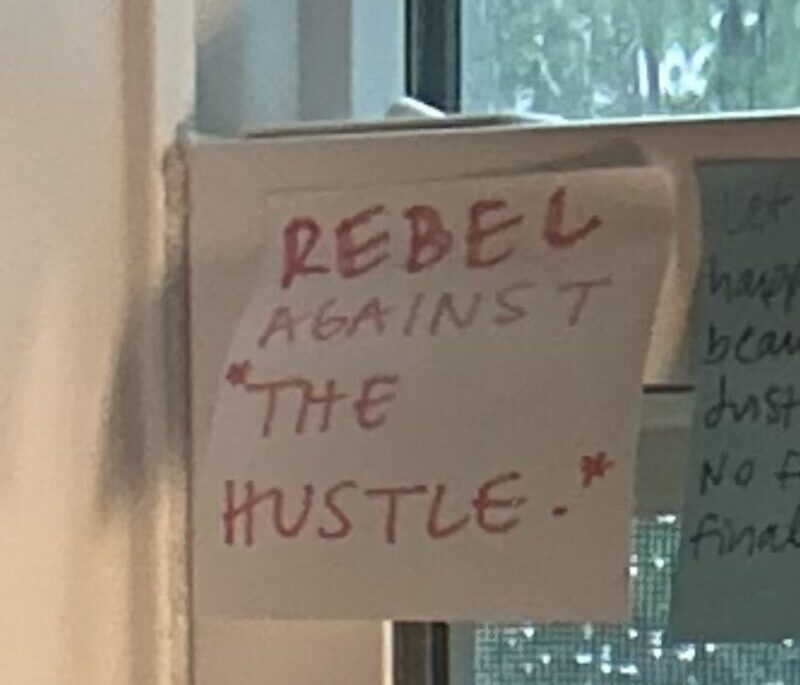
So, in a super-poignant moment of rebellion and protecting my peace, I scribbled out a very important reminder on a post-it note: Rebel against the HUSTLE.
Most of my life, society laid a plan for my life, as a woman residing in this country: go to school, get married, buy a house, bear children. I had accomplished graduating from high school and undergrad, but I had side-stepped the rest of those expectations. Buying a house meant that I had achieved a sort-of fiscal graduation into a level of money and aplomb that our culture told me was because of my hustle.
However, I had become disillusioned with the hustle. A long commute and late nights at my first job meant I was tired every evening and longed for every weekend. Each of my subsequent jobs also met me with long to-do lists, tight deadlines, and zero energy once the sun set. I wondered why I continued on at these jobs and jumped from one to the next, utterly burnt out. Of course I needed a paycheck, but this culture of hustle as a revered personality trait didn’t sit well with me.
The hustle is often an individualistic idea that ignores the community of friends, family, and neighbors who surround us. It’s an idea that production should be the primary means and individual success, the ultimate goal. This results in no rest and no rejuvenation.

Rest as a gateway to better and further production is one of the hustle’s many downfalls. The hustle demands more and snatches rest to gain power and money, instead of the wholesome peace that rest provides.
In All About Love: New Visions, author bell hooks penned, “Americans were asked to sacrifice the love of freedom, love, and justice and put in its place the worship of materialism and money.”
We’ve taken countless hard turns down dark alleys of individualism and power in our country, but are we too far to redeem each other from the hustle?
The Nap Ministry (founded in 2016 by Tricia Hersey) certainly seems to think rebellion and redemption against the hustle is both possible and vital. The organization advocates for the “liberating power of naps” and “rest as resistance” to grind culture, and I couldn’t agree more. When I rolled across their page in early 2020, their mission became my beacon and permission to rest simply for the sake of rest.

Sometimes I forget how much life lives in rest: a nap on your comfiest couch with sunlight streaming in the window, reading your favorite book for the fifth time, walking around your neighborhood with a beloved friend, sitting in your backyard watching fireflies dance in the evening.
When it’s not a task to check off a to-do list, rest allows a full breath. And in that breath lives the moments we actually like to remember; the moments that make us human, connecting us to each other, ourselves, and the earth.
I acknowledge that not everyone has the ability to slow down for much more than a moment, especially if you’re caring for children, living paycheck to paycheck, or a multitude of other reasons. However, I do advocate for curiosity and intention, noticing and observing as a crucial part of the human experience, which can certainly be done in small moments.
Mary Oliver, poet queen of nature and noticing, wrote in her poem, Sometimes, “Instructions for living a life: Pay attention./ Be astonished./ Tell about it.”
And in her poem, Yes! No!, she reflected, “To pay attention, this is our endless and proper work.”
Noticing only happens when we slow down, and finding joy in these small observances explodes for us an entire world of wonder. A curious life, filled with rest and awe, is a precious life lived.
I am still employed at my remote marketing job, and my post-it note reminder remains above my desk. I still make lists and check off tasks, but “rebel against the hustle” infuses each moment of my day. I sip my morning coffee, I walk around my neighborhood, I notice the changing flowers of the season and the birds chirping outside my window. I take my time, slow down when I can, and make room for rest. I practice noticing, and I do believe it has made my life richer and more intentional.
Alongside Mary Oliver, I too have found the work of paying attention and slowing down as good and important work, and the ultimate rebellion against the hustle.
Header photo by Jackman Chiu on Unsplash
Matches photo by Tangerine Newt on Unsplash

5 Responses
Thank you, Aemelia, for reminding us all to slow down, pay attention, and take naps. In my family, when the adults seem a bit tired and the children are zooming around, my mom always asks the grandchildren and now great-grandchildren if they want to play her favorite game: napping!! Someone even bought her the children’s book, “The Napping House.” We all laugh about it, but it sounds like she is on to something. 🙂
Thank you, Amelia! It struck me that these brief lines from Mary Oliver’s poem:
Instructions for living a life:
Pay attention.
Be astonished.
Tell about it.
are also terse instructions for how to live the writing life.
Reading this I was nodding along, saying, yes, I hear you, but also couldn’t shake the awareness that I’ve read or heard some version of these meditations at least a thousand times in the past fifty years. It’s a feature, not a bug, of our society, that the qualities it demands you develop (on pain of not being able to afford what you want and need) also destroy your quality of life, and of those you’re connected to. I’ve always loved how singer James McMurtry put it:
They’re holding all of your phone calls
But it’s no relief
You’re staring out the smoked glass window
At the cars down on the cloverleaf
And a picture of a kid with a ball glove smiling at
The lense
And a woman on a sailboat
And all those years you just had to hope they’d bend
Well you pushed so hard they bent so far
That they won’t either one get straight again
But then I realized we’ve been complaining about the cost of our lives for much longer than fifty years. What was Henry Thoreau’s observation about the mass of men living lives of quiet desperation, or Emerson’s about things being in the saddle and riding mankind referring to, but this.
Will we ever shake this condition, that of the self-loathing bourgeoisie, and the market it creates for life-coaching that teaches you how to accommodate yourself to it all without, of course, rejecting it? (As much as we idolize certain elements in the hunter-gatherer existence, nobody’s actually up for it. The fishing, yes. The dying at 35, no. But don’t worry, the dream factory–that would be Hollywood, btw–will cook up some fantasies you can escape to–of course you’ll need to join the rat race to make the money to afford the streaming fees.)
But really, is this actually anything new under the sun, unique to the post-modern, late-capitalist bourgoisie? Go back and interview some bronze age farmer, and ask him what his to-do list looked like, whether his deadlines were urgent, and how much energy he had once the sun set?
It is, perhaps, a sign that we were meant for something else–a garden perhaps?–that we keep rediscovering that we earn our bread by the sweat of our brows (sweating with exertion or anxiety, take your pick) and being astonished at it, over and over again.
I was going to say, maybe the one new thing under the sun is the market all this chosen dissatisfaction creates for people selling us coping strategies, but what, after all, is Ecclesiastes itself?
Thanks, Aemelia. I’m a fan of what you’re saying. Peace and rest may not be synonyms, but if you swap out peace for rest in a few New Testament verses, the results are enlightening.
Blessed are the rest-makers (Matthew 5:9)
Rest I leave with you, my rest I give to you. I do not give as the world gives. Do not let your hearts be troubled, and do not let them be afraid (John 14:27)
Therefore, since we are justified by faith, we have rest with God through our Lord Jesus Christ (Rom 5:1).
For the kingdom of God is not food and drink but righteousness and rest and joy in the Holy Spirit (Rom 14:17)
For God is a God not of disorder but of rest (1 Cor. 14:33)
The fruit of the Spirit is love, joy, rest, patience, kindness, goodness, faithfulness, gentleness and self-control (Gal. 5:22-23)
For Jesus is our rest (Eph 2:14)
So Jesus came and proclaimed rest to you who were far off and rest to those who were near (Eph 2:17)
Make every effort to maintain the unity of the Spirit in the bond of rest (Eph 4:2)
And the rest of God, which surpasses all understanding, will guard your hears and your minds in Christ Jesus. (Phil 4:7)
Now may the Lord of rest himself give you rest at all times in all ways (2 Thess. 3:16)
Let them turn away from evil and do good; let them seek rest and pursue it (1 Peter 3:11)
Grace, mercy and rest will be with us from God the Father and from Jesus Christ, the Father’s Son in truth and love. (2 John 3)
May mercy, rest and love be yours in abundance (Jude 2).
Rest and contemplation of the moment are invaluable. Years later, I can think back on those quiet moments that left an indelible memory. An hour of just holding and rocking a baby. Minutes of just staring at a photo of travels and pulling the memories from that trip. Re-reading a publication and recognizing the value of the words I wrote on paper and appreciating the work I completed. Sometimes it’s not about “doing” and non-stop activity. It’s valuable to include rest, and, I think, contemplation.