
We continue to look at Jesus’s parables of the kingdom in Matthew 13. This week I’d like to look at the parable of the Weeds in the Wheat (Matthew 13: 24-30), after discussing the Parable of the Sower (Matthew 13: 3-9) last week.
We see again in this second parable of the Kingdom the five themes found by R.F. Capon in the first parable of the Sower:
- Catholicity: Weeds and wheat are found everywhere.
- Mystery: Who are the weeds? Who are the wheat? Initially they both look a lot alike.
- Actuality: Both do grow up.
- Hostility: Where did the weeds come from? Was good seed planted?
- Response: We do NOT pull them up. Instead Jesus says, let both plants grow up. Be patient with evil for now, let God separate good from evil later at the final harvest.
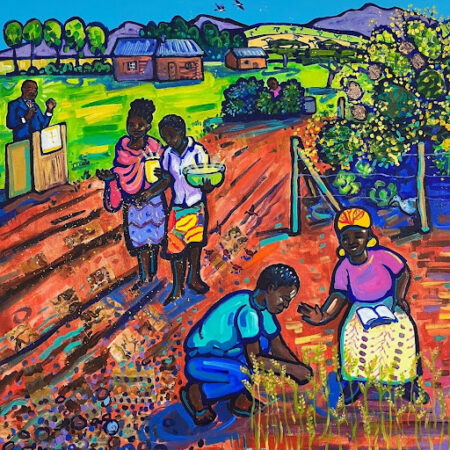
We see a woman on the bottom right of Joel Schoon-Tanis’s painting. She has an open Bible on her lap and is telling the man to wait. “Don’t separate the weeds from the wheat. Don’t uproot the good with the bad.”
In real life, men (and fathers) are often quick to judge, too eager to punish. Women (and mothers) are often more patient, forgiving, willing to give people (especially children) a second chance.
I wonder if more women had been on more consitories and other church leadership roles how church history would have be different.
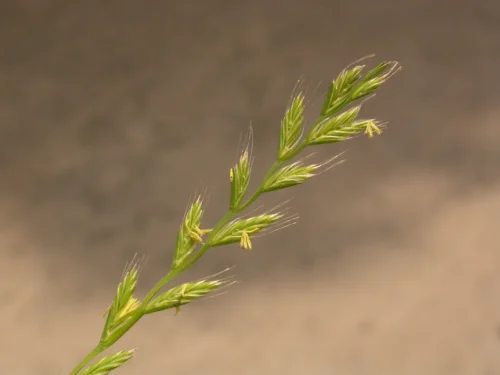
Scholars have noted that the toxic weed, darnel, looks very much like wheat when it first shoots up. Others note that there is evidence in Roman legal history in New Testament times of enemies sowing noxious or poisonous plants in the fields of their rivals. This parable may have been based on actual events between two farmers.
The African Bible, perhaps drawing on Aleksandr Solzhenitsyn’s famous quote, has a great note on this parable:
The line separating good from evil does not pass in the space between the individuals or between groups, or between nations: it passes within the heart of every person. That it why it is not possible to intervene with fire from heaven: everything would then be destroyed, the good as well as the evil.
We all have both good and evil within us.
Because of this truth about human nature, I find comfort in the fact that the final separation is done by God, NOT by us. It is only the Master who will direct the harvesters to separate the weeds from the wheat at the final harvest at the end of the age (the eschaton). Then the Son of Man (Jesus) will send his angels to throw the evildoers outside (see Matthew 13:39-42). It is never our job!
Too often in church history and in churches today we have rushed to premature judgment assuming we know who is clearly evil and who is good. In hindsight, we have all made too many mistakes. It is so tempting to burn with righteous anger, assuming we and our friends are on the Lord’s side and whoever is against us must be on the side of Satan and thrown out of church.
I am not saying there is never a need for church discipline, but I am appealing for more of what Saint Augustine reportedly (and Rupertus Meldenius actually) said, “In essentials unity, in non-essentials liberty, and in all things, charity.”
The question remains of course, how to distinguish among these: What is “essetial” and what is “non-essential” today? It would be nice if we could all agree or at least when in doubt, agree to disagree and live with that tension, leaving all final decisions up to our God.
For the love of God is broader than the measure of our mind.
And the heart of the Eternal is most woderfully kind.
~Frederick W. Faber, 1854, verse 3 of There’s a Wideness in God’s Mercy
10 Responses
How many wars and schisms might have neen averted had someone not insisted on violently pulling out the weeds (or retaliated against someone who did)? Have we not all realized, later in life, there were times we had been weeds when we thought we were wheat?
Thanks, I always remind my students, “when you point a finger at someone else, three are pointing back at you.”
Amen! I just read a Wendell Berry quote:”Are you finished killing everyone who is against peace?”
A timely reminder! Thank you.
In Finally Comes the Poet, Walter Brueggemann warns pastors of the dangers of “suffocating certitude.” WB liked this parable a lot. Thanks for reminding us of Jesus’ subversive critique of not just certitude but presumption.
It is this parable that gave me pause at synod a few years ago when the human sexuality report was being debated. I felt then as now that in our redefining we were forgetting that we were not to be doing the weeding, but to leave it to God. Grace should have been all important. Thanks for the reminder.
In the history of the church, have the weed pullers often – if not always – been the force behind religious persecution, trials (even beheadings), and schisms? Still turning a deaf ear to Jesus?
When I ponder this parable I go back to Genesis, and the tree of the knowledge of good and evil. God said, “Hands off that one.”
It is relatively easy for me to receive (and give) the counsel to be patient with evil, especially when I am only minimally affected by it. But would that counsel have been appropriate for early 19th century abolitionists (and 12-14 previous generations of like-hearted people, seeking the end of chattel slavery)? Do we ever run out of patience and sense “the fierce urgency of now.”
Good observation In situations like that we need the whole counsel of God in the entire canon and we need long deliberations by all God’s people on both sides of the issue. Even then we make our decisions carefully and subject to revision.