
When I was growing up as the daughter of a Christian Reformed minister in the 1980s and 1990s, I moved about every five years. There were aspects of this that were difficult. Saying goodbye to best friends and making new friends was not easy. But moving so often meant that I had regular opportunities to get rid of stuff. And it turns out that getting rid of stuff is really important to me.
My husband and daughters and I have lived in our current home for 13 years. A few months ago, we decided it was either time to move or simply to purge. We opted for the latter. Tim and I both booked a full week off of work. We rented a dumpster and labored daily from dawn until dusk: dumping, donating, recycling, and organizing. After describing the details of what we were doing to a friend, she said, “I don’t think of you guys as hoarders, but… this kind of sounds like you’re hoarders!” Well, if the shoe fits…
We gave away some big things to neighbors by hauling them to the end of our driveway and hanging a “FREE!” sign on them: two dressers, two bicycles, a bed. We donated five vanloads (and counting) to local thrift stores and filled our dumpster to the brim. Knowing that I do not intend to return to parish ministry, I put the majority of my theological library out on tables in a Sunday School classroom in my former church – free for the taking before I donate them to a thrift store.
We laughed a lot while Tim went through the boxes of keepsakes that his parents have been siphoning off from their house to ours in a steady drip for the last 15 years. Our favorite and most random finds were audio recordings from his infancy, a blue thermos and a NASA lunchbox from his elementary school days in Japan, and a hefty shiny plaque he received for playing in the Unity Christian High School pep band for three years. “I never displayed this and I don’t even remember receiving it!” he said.
We groaned when we found the bag full of the international travel items we’d already had but couldn’t find and so re-purchased before going on the Camino in September: money belts, European plug converters, and a luggage scale.
Our decluttering would have taken another full week if the world hadn’t gone digital right when we started having kids. It turns out that the time we now spend emailing, texting, FaceTiming and posting used to be spent writing physical letters and cards. So many letters and cards. And also taking pictures and getting them developed and making sure to get doubles in case there were good ones we wanted to give our friends and then saving them all (including the negatives), even the ones with our fingers in front of the lens. And then putting the best pictures in frames, displaying them for a year or two, putting the frames in boxes and then eventually buying more frames for new pictures because we forgot we already had 50 frames.
I had been looking forward to this week so much that I was surprised by how overwhelmed I felt much of the time (especially when I would open yet another box of my own memorabilia that I’d forgotten I ever had). As Tim said one evening after I’d barely eaten all day and was still going strong at 9pm, trying to conscript a daughter into helping me with “just a little project”: “You’re a little bit a lot right now.”
To help me make decisions about what to keep and what to toss, I asked myself questions like:
- When will I ever look at this again?
- Does this box I’ve gone through contain fabric or paper? If so, DO NOT PUT IT BACK UNDER THE STAIRS, because: mildew.
- Is this something we’d want to save for potential future grandchildren?
To tether my heart and my brain when either of them threatened to spin out of control, I reminded myself of important truths:
- It will get worse before it gets better.
- You need to drink water.
- We’re doing this now so the kids won’t have as much work to do when we die.
- This is less like a makeover and more like a colonoscopy prep for your house.
And most frequently:
- Just because this thing shaped you doesn’t mean you should save it.
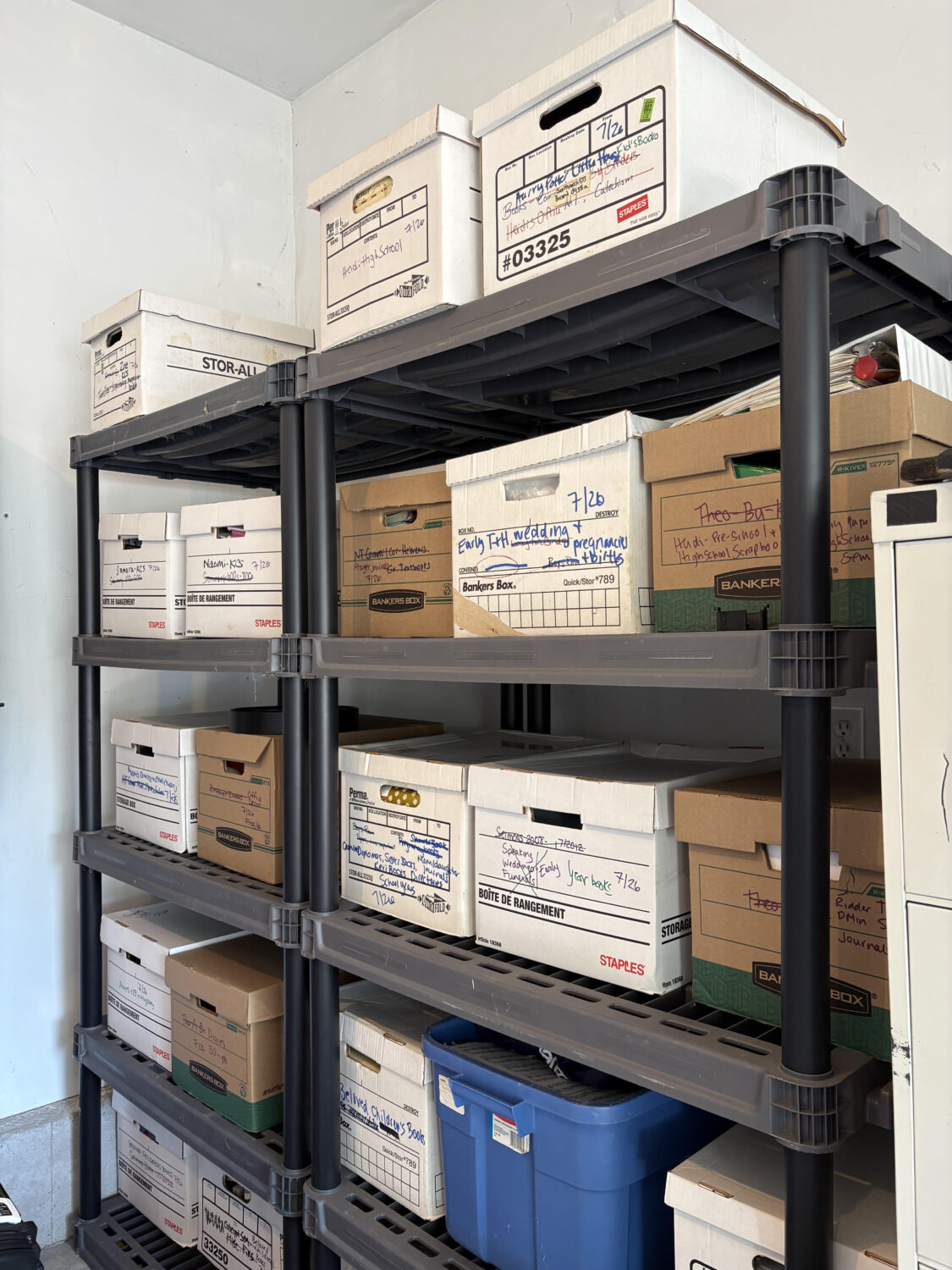
I got rid of many things and I kept many things. I found value in the kept-things, organized now in boxes on shelves in the garage in which we may actually be able to park a vehicle this winter.
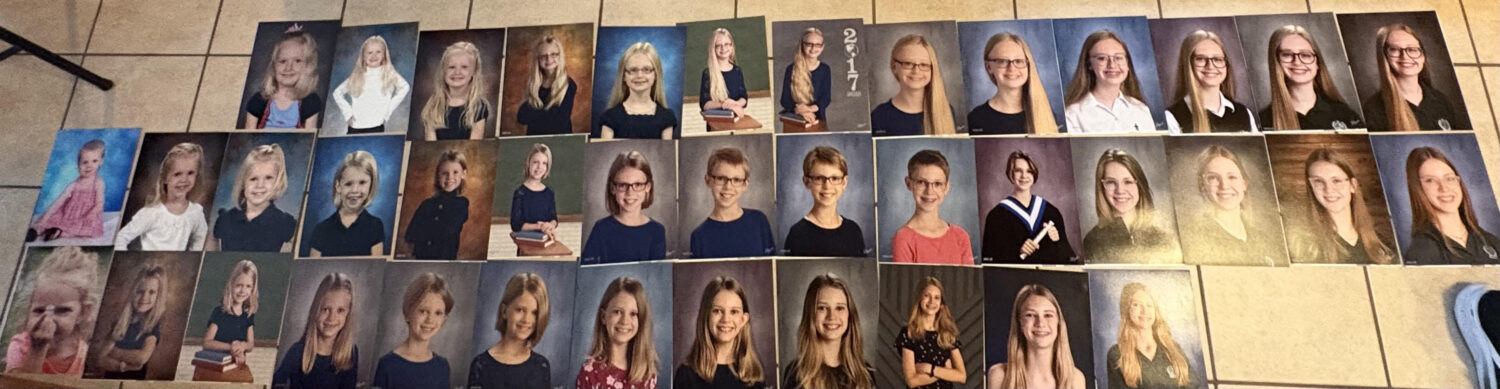
I also found value in the empty space left behind by the things I let go of. But the greatest value – the greatest gift, perhaps – was the time we both spent combing through every square inch of our life. I paged through my boxes of seminary notes and handled each book. I opened every sympathy card I received when my first husband died and wore my mom’s old winter coat one last time. I held the positive test stick of a pregnancy that ended in miscarriage and lined up the 8×10 school photos of my living and thriving daughters.
In the middle of a day in the middle of the week, Tim tossed a card toward me. “I think you’ll enjoy this–especially right now,” he said. It was a card I’d written to him in January of 2001, a couple months after our engagement. “Some day we’ll have a house in which to be,” I wrote. “Rooms to fill with our presence, shelves to fill with our books, drawers with our clothes, tables with our food, bathtubs with our bodies, beds with our love, air with our laughter, cradles with our children, walls with our pictures… warm, cozy nights with our deep rest. Long, busy days with our deep service.”
I gasped and laughed and cried all at the same time. So grateful for the life I’d imagined and the life I’ve been given. I am reminded of Mary Oliver’s closing words to her poem, In Blackwater Woods:
To live in this world
you must be able to do three things:
to love what is mortal;
to hold it
against your bones knowing
your own life depends on it;
and, when the time comes to let it go,
to let it go.

11 Responses
Tolkien makes the point (which elves dont understand) that mortality is a gift of God to human beings.
“This is less like a makeover and more like a colonoscopy prep for your house,” made me laugh out loud. We have been in our house for over 30 years. Not hoarders but . . . And the “Let it go” made me cry. My mom passed away in December–so many photos and afghans!
This is inspiring in more ways than one. Oh, the things I keep…,
Thank you for this thoughtful reflection. My word for the year has been “release.” Little did I know that we would be moving and once again have to declutter. But this time, I was able to release some treasured items that were just gathering dust. Letting go is good for the soul in so many ways – physically, emotionally, and spiritually.
If you haven’t donated your theology books yet, you may want to check in your area for a place that takes books and sends them to seminaries overseas. There is a place here in Grand Rapids, Michigan that does that. That also was hard to do – release so many books, that make us as pastors look well-read and knowledgeable. 🙂
Nancy it is hard to believe we’ve reached that age. I know this article would touch home.
Now in my 90s, I look back on a life of “letting go.” Sometimes the letting go yielded sighs of relief.
More often it stirred deep feelings of sadness and loss.
And the final one is still to come, but closing in.
The Word from above becomes more precious now: “I will never let you go.”
Thank you, Heidi.
Thanks, Heidi. Throwing out is hard. I have found that I frequently “need” something after I pitch it. When I retired, I got rid of my hard copy Reformed Journals and Perspectives periodicals from the 80’s and 90’s, but only after going through each issue and putting good quotes and summaries of articles in a database. But now, while writing a book, I’m finding that I need to get more details and bibliographical info from them than I had recorded. Fortunately, while I was on vacation to NW Iowa, I did find time to track down about 20 issues at Northwestern College (on microfilm!) to get the info I needed. I could view all the old Christianity Today’s on line for a subscription fee, but not RJ or Perspectives. It would be great if someone who had the old issues could scan them, save them as pdfs and turn them over to the Reformed Journal to keep them on line as a resource. Any takers out there?
Thanks for this, Heidi. I feel so seen–except for the part about actually doing the work. I dream of doing it. Maybe someday soon. Going through stuff is a spiritual exercise in letting go: yes.
Thank you, Heidi, for putting into beautiful words the painful process of letting go. We just spent months doing this in preparation for retirement and a move across country. So much letting go at so many different levels.
I still have not opened the box of sympathy cards from when my son died 2.5 years ago, so your comment about one last read of the cards after Layton died also hit home. And recycling all of my seminary notes and handouts, and leaving behind 2/3rds of my theology and pastoral books. Sadness but also relief.
Thank you for sharing your journey so that many of us could relate.
A poem I wrote in May 1970:
DE – BASEMENT
Spring again and time to clean
a winter’s worth of dust and junk
strewn all across the basement floor,
objects to throw out, others merely
to rearrange: dripped cans of paint
now filled with layers of leathery skin;
down from the bedroom wall,
a mangy kangaroo pelt bought at Banff
for thirteen dollars, a bargain then;
seven cases of Molson lager beer,
dust-covered, reminiscent of hot
last summer nights with friends,
accompanying barbecue with crusts
of salmon still glued to the rusty grill;
bald spare tire, broken washing machine,
briefcase, supposedly leather, from
graduate student days, the cardboard bottom
long worn out; moldy baby stroller,
Danish newsstand we bought as newlyweds,
suave, but fragile; with bent rear wheels,
my daughter’s tricycle I backed the car into;
blue spinning rod and reel received
from father-in-law, the black remains
of a golf course dew worm still on the hook.
I sweep the floor and the swirling dust
sends me coughing. I wipe my eyes
and stand among these domestic remnants,
trying hard to decide which memories
to let the garbageman haul away,
and which to keep for another day.
The mindset needed to attend one’s own accumulated stuff can come powerfully when dealing with parents’ estates after they have passed. Quoting my dear spouse Ginny, who dutifully began the process even before her mother passed, and continued after, clearing Denver house and mountain cabin, and assisting years later helping/advising as we did the same for my mother’s possessions: “I’ll not put my daughter through this . . .”
She then brought the mindset home, and it seems we are in a state of continual assessment and release. One of her spiritual gifts, indeed. :}
We also see how paralyzing it can be for others, especially for friends older than we as they downsize to move into retirement living spaces and communities.
Let it go, let it go . . .
Thanks, Prof Baron, for the reminder and witness that God will never let us go!