
Nobody has ever accused me of being pollyannish. In fact, one former colleague once told me “there’s no silver lining you can’t find a cloud around.”
That may mean that in addition to being a faculty member at a Christian university, I’m also perhaps the target audience for a book that the Guardian describes as “sparklingly sardonic and hilariously angry” on the back cover. I read Peter Fleming’s 2021 Dark Academia: How Universities Die while at the lake this summer.
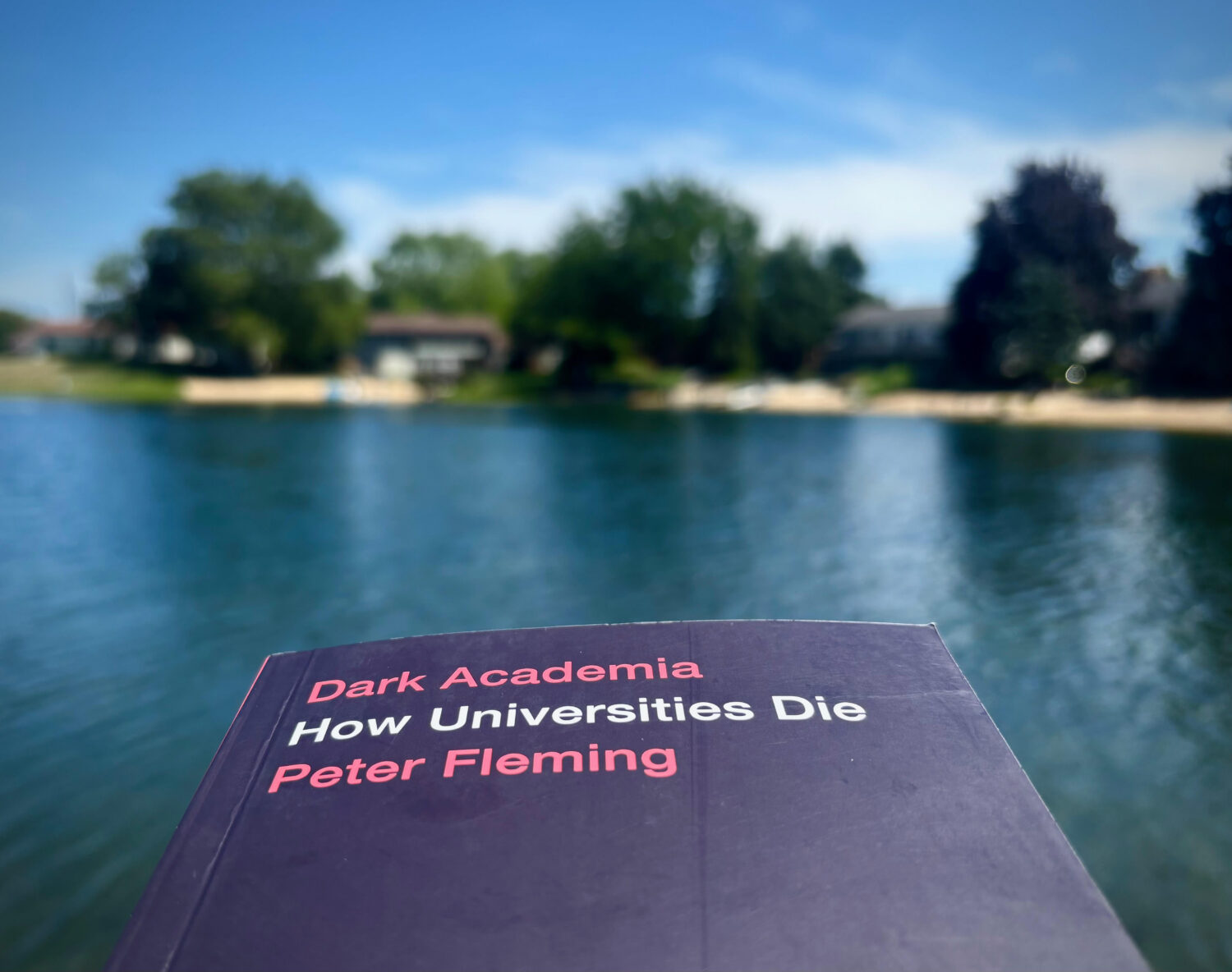
While I don’t think that Fleming’s account is fully accurate, there is much in it that resonates deeply with me after 20 years of teaching at three different universities: top-down hierarchies that can overshadow academic expertise, the conversion of institutions of formation into production-lines, the multiplicative nature of “sludge work,” perverse incentives, and the over-focus on quantitative measures of efficiency.
Fleming rightly asks us to consider “efficiency in what sense?” Answers to this question may reflect a university’s values much better than its mission statement.
If Fleming’s take is even only mostly accurate and this is what contemporary universities are truly like, why have so many of us committed our lives to higher education in such institutions?
There’s no single answer, but for many of us a significant subset of the reasons is related to a deep conviction that the work we do here is meaningful. Many of us experience it as “vocational calling.” And because of this view of our work, we’re tempted to think “we are what we do. We live our careers to the point of exhaustion” (90).
While we’re fortunate to love what we do, such love comes with a risk. Fleming elaborates, “Loving what you do is great but unrequited love is depressing” (19). And Fleming gives evidence that when fiscal realities come into conflict with caring for an institution’s employees, time after time the former easily outweigh the latter. Our love is reciprocated — until budget cuts are needed.
This issue doesn’t only affect faculty. Staff are obviously affected as well. Earlier today I had coffee with a now-former Calvin University staff. One of the reasons they cited for their decision to depart was precisely how the university’s mission is leveraged to extract even more out of employees. They were told that their pay was going to be cut, but that they’d need to do the same work as before—just for less money. They simply were not going to let the university’s mission be used to justify mistreatment as an employee
Staff are committed to the mission of the university and the importance of the work we do here. In many ways, staff are even more vulnerable given that they are at-will employees. They don’t have the protections of tenure, and are already paid comparatively less than faculty, not to mention the university does far less for staff development than it does for faculty.
As problematic as this dynamic is in general, I think it’s worse at Christian universities. By “worse” I mean two things. First, such a dynamic is especially likely to arise at a Christian university. After all, we don’t just love our jobs; many of us also see them as an expression of our Christian commitments.
Are we willing to take on another responsibility beyond what our contract specifies, often for no pay or a small stipend? Yes, much of the time, because we see it as a way of contributing to the good that the university does, as a way of supporting our students. But American Association of University Professors’ data shows that smaller, private university faculty already tend to be paid approximately ten percent less than their colleagues of the same rank at public universities, and often have less benefits. For many of us, the financial hit is something we’re willing to take because of our commitment to the university’s mission.

But, and here is the second sense of “worse,” Christian universities often leverage this commitment when it serves their need. We’re told “we’re all rowing in the same direction” or “the university’s mission is more than just a job; it’s a family.” That is, of course, until there are budgets that need to be balanced. Then suddenly the mission language disappears. The family metaphor evaporates. We’re treated as expendable employees.
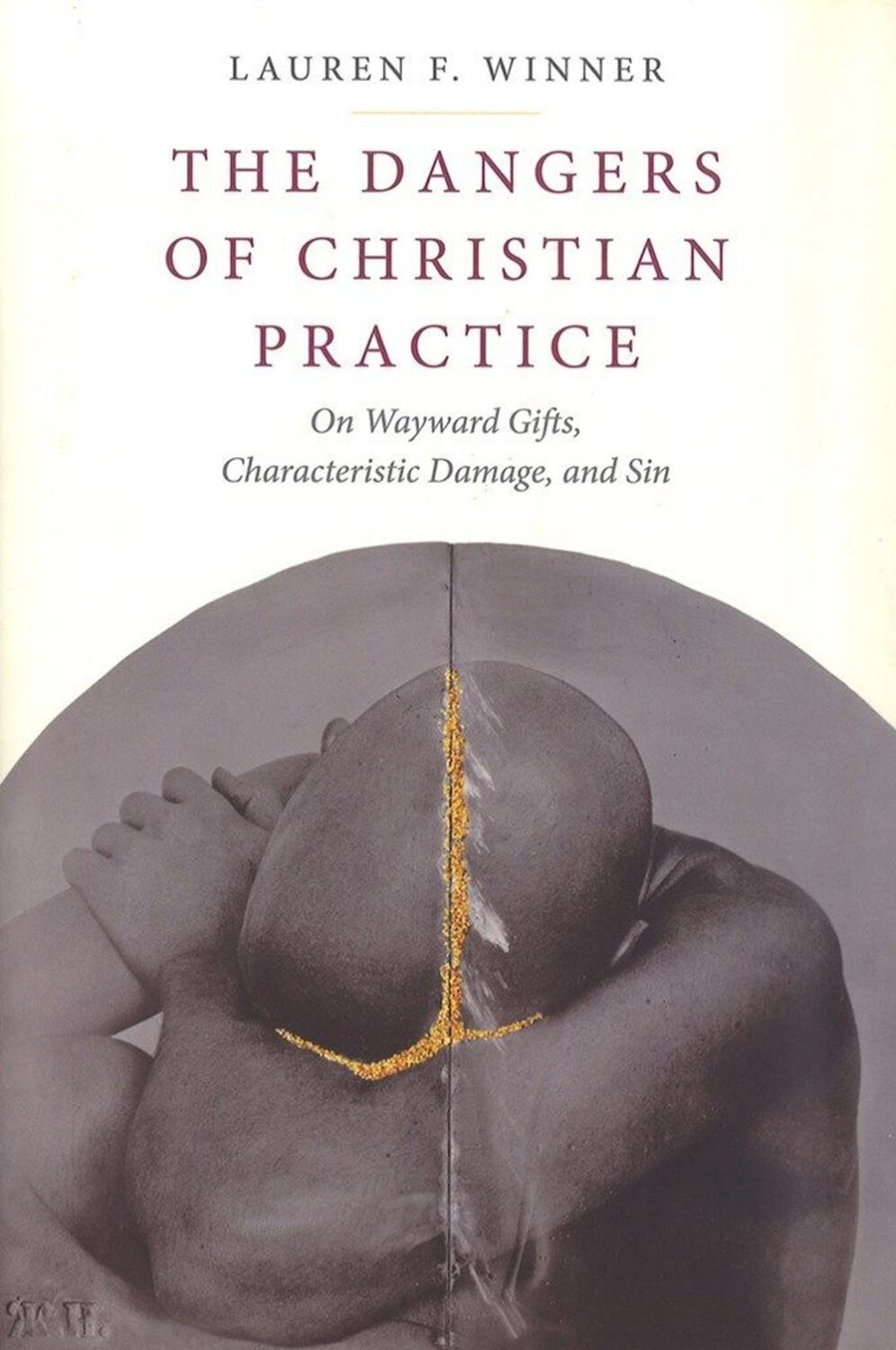
Another book I recently finished, given to me by my colleague Matt Lundberg as part of a de Vries Institute faculty development initiative, is Lauren Winner’s The Dangers of Christian Practice. Winner’s central point is that even our most treasured Christian practices can go wrong when we fail to notice what they encourage. Sometimes practices are deformed in ways that are intrinsic to the practices themselves. Winner focuses on “deformations of Christian practices that are characteristic of the practices themselves; deformations that are somehow about the practices” (14).
I’ve come to wonder if a commitment to a Christian institution’s mission can be deformed in precisely this way when the relationships that the mission encourages are asymmetric and our love and commitment are unrequited.
Often what is best about working at Christian institutions is the very same thing that encourages us to accept such treatment. This is what is especially tragic for the faculty whose positions have been cut and the staff who have left in this past year.
This is in no way unique to my current university. I saw the same thing at my previous institution. It’s present in many institutions that are trying to stay open despite the challenges of the current environment of higher education.
It is, however something that Christian institutions should think more carefully about, because such deformation is antithetical to our calling — even if the calling and mission are what makes the deformation so seductive.
16 Responses
Thanks for these sobering reflections. Like Kevin I served on the faculty of three higher ed institutions — one a fine Lutheran liberal arts college, one a state university, then as Kevin’s colleague at Calvin– but half my working years were in academic administration, half in teaching. It seemed to me from both perspectives that a religious affiliation, even a relatively loose one, made life better for all. EG: stronger sense of common purpose, closer collaboration on teaching and research across disciplines, better alignment between academics and student life. In other ways not so much. EG: openness to everyone (much progress in this but still more work to do), vigilance against abuse of power (state universities have led the way, in policy if not always in practice), and yes, faculty compensation. But I was fortunate to be able to retire while financial issues were a major hindrance but not yet a terminal illness.
There are indeed wonderful things about teaching at religious institutions like Calvin, some of which you name. Overall I think it’s worth the tradeoffs. But I do worry that we sometimes don’t adequately discuss the downsides.
I enjoyed having you as a colleague, David.
I have no expertise in this area, but I have always felt that professors and researchers are among the most unfairly compensated professionals. They also seem to be the most highly suspected and scrutinized professionals, with scientists and philosophers at the top of the list. After all, they are “paid” to question their own and everyone else’s premises. As such, they disrupt our bubble of certainty and orthodoxy. But as long as we are ranking sins, and that is what this is all about, we must challenge the premise that God hates questioning and searching more than affirming something one does not genuinely believe. Such “sins” are sins against the institution, not the creator.
Wheat or weeds? Let them grow, suggests Jesus, because you cannot yet discern the difference.
I agree with you that questioning and searching are essential to both the religious and academic lives. I think certainty ought not be our goal, in part because it is virtually always impossible to achieve. (I’m a fallibilist about almost everything. Descartes was importantly wrong.)
As someone who, like David Hoekema, has been both a faculty member and an administrator, I’ve lived out the tensions that Kevin Tempe wishes would cease. Me too. But in this life we are faced with unpleasant realities. When grappling with hard choices, we should strive for as much integrity as we’re capable of, and confess when we fall short. Here’s what I wrote about this years ago:
“Self-conscious pursuit of knowledge of God and God’s created order and recognition that whatever success they have is a gift from God through Christ are distinctives of Christian academic communities. Yet this gift is always contained in earthen vessels. In this case, the earthen vessel is institutional life, which is an aspect of the Earthly City. Because Christians are at times more focused on temporal rewards than on the love of God, we are as much in need of institutional rewards and sanctions [and balanced budgets] as non-Christians are. We do not yet fully live into our citizenship in either the City of God or an ideal scholarly community.
“An aspect of the vocation of Christian colleges and universities is to learn to live out this dual nature, both as institutions where temporal sanctions [and balanced budgets] help keep good order and as communities that are self-conscious occasions of grace. While aspiring to be guided by the Eternal, we must come to terms with the fact that we do not currently abide in heaven. We can neither lean totally on our Earthy-City-hood nor pretend to abide fully as the City of God. Christian colleges and universities must continually strive to negotiate the tensions of this dual nature in a way that nurtures a thriving Christian teaching and learning community.” — “Can Two Walk Together Unless They Be Agreed” The Cresset, 2018.
As a Professor and head of faculty council at a Jesuit institution I really can appreciate what you wrote. We are struggling with this as a faculty.
Thanks for the comment, Caroline. I agree that we should aim for integrity. But, as I understand it, one of things that integrity requires of institutions is honesty and consistency across the board, including the domains that I mention above in the piece.
As a practitioner in the art of building healthy organizations, it is my experience that a common abuse by Christian organizations is to appeal to one’s dedication to Christian ministry to extract commitments for staff to do more, to work harder, for much less money. As if such requirements serve as evidence of one’s faith commitment. And by implication it is a sin to push back against such requests in interests of justice and maintaining a healthy work environment.
Yes, this is a central point that I was trying to get at. Thanks for the support.
Wow! Thanks for putting words to this, Kevin. As someone who has taught at of both secondary and higher education Christian institutions–and experienced personnel cuts at both–this really resonated. This was especially true of the “family” language that often accompanies “asks” but not pink slips. Your explanation of the corruption of vocation and calling was also revelatory. Thank you.
I’m sorry that this resonates with your experiences, Caleb. I recommend Winner’s book (or at least the first and last chapters of it; some of the others are longer than are needed for the main point, which I think is correct). I think it was well worth the read.
I was talking with a University professor who said it well, “When the university wants something from you they appeal to the mission, when you want something from them they become a business; you may love an institution, but it will never love your back.”
Yep, the institution cannot love you back, even if the people who run it are well meaning. I have learned to value my work in the moment, to value our shared mission deeply, but also understand clearly that I am an employee with all the vulnerabilities thereof. Moreover, in the humanities, more than ever, we have to do what we do and FIGHT to do what we do. We are constantly trying to defend the value of what we do against cultural forces much bigger than we can manage. And as we have seen, tenure is not teflon.
Thank you, Kevin, for these sober and careful reflections.
Amen and amen. May we find the prudence to know how to go forward and courage to do so.
Good you could address this issue of your compensation “while at the lake”
I confess I’m not exactly sure what you’re asking; there’s one way of reading your comment as if I’ve somehow violated my job, but I don’t know you and don’t want to assume it’s intended in that kind of way.
Faculty aren’t paid by the hour. And crucial parts of our jobs are to think and read and write. All of these are things that can be done in a number of locations. I’ve proofread book manuscripts while at the beach, and I’ve written papers while in the parking lot of our kids’ schools waiting for various practices to end. I often do parenting tasks for our kids in the afternoon and then work in the evening. So there’s nothing at all to suggest that I was somehow not earning my compensation while at the lake. Especially since it was a saturday. (But I do think that thinking about these issues and discussing them with colleagues is an important part of my job, as both philosopher and faculty member.)
But if I’m completely missed what you’re trying to get at, let me know and I’ll try again.