
The parables of the mustard seed and the yeast (Matthew 13:31-33) are two of my favorites in the New Testament. Both are short but pack a powerful one-two punch in just a few carefully chosen words. Jesus was a master teacher, but also a subversive one.
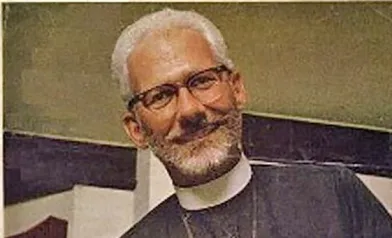
1925-2013
Again, following Robert Farrar Capon we see the five themes or clues to the kingdom parables in both of them.
- Catholicity — the mustard seed eventually takes over the whole garden, and the yeast leavens the entire loaf.
- Mystery — both the mustard seed and the yeast are hidden, secret.
- Actuality –the mustard seed grows into a bush with branches big enough for birds to nest in or rest in its shade. The yeast makes the entire loaf rise — all three measures, about 60 pounds of bread flour.
- Hostility — planting mustard seeds in gardens was forbidden. The “birds of the air” likely imply Gentiles (see Daniel 4:21 & Ezekiel 17:23; 31:6) and leaven was usually an image of corruption for the Jews of that day,
- Response — mustard seeds would have us look for small bushes instead of large cedar trees and look for Gentiles instead of only Jews. Yeast needs the warmth of God’s breath/spirit (ruach) to get started and we need to trust the yeast (and Spirit) in us and in everyone else made in God’s image.
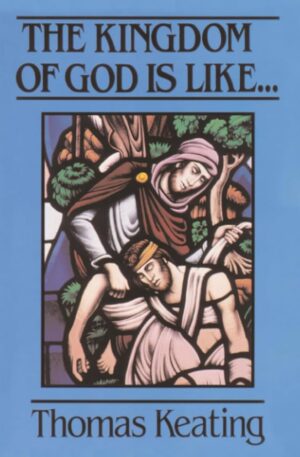
In The Kingdom of God is Like…, Thomas Keating writes, “the purpose of the parables is to subvert the distorted myths in which people live their lives” (1993, 36). In Jesus’s time, the cultural symbol for the mythical vision of Israel as God’s chosen people was the mighty cedars of Lebanon. Using the smallest of all seeds for the Kingdom of God is to subvert their distorted myth of greatness.
The whole mustard seed parable is subversive. Rabbinical law prohibited mixing certain plants in the same garden and mustard was forbidden because it would spread and displace the other vegetables. So the parable begins with an illegal image. Even then, when the mustard seed reaches maturity, it is only a small bush, not a big tree, certainly not a towering cedar. This parable implies we can find God in the ordinary places of everyday life.
We do not have to look or wait for God’s dramatic, apocalyptic intervention. The Kingdom may come in modest results. Instead of building big, cold cathedrals, maybe we should be building small warm shacks for house fellowships. It is okay to remain a modest shrub, especially if we provide room for nests and shade for outsiders. The Kingdom of God is made manifest in modest changes in attitudes or improvements in our behavior.
Keating’s book devotes four chapters to the parable of the yeast, even though it is only one verse long, just 25 words. Here again there is corruption. Leaven was unholy/profane, and women were considered ritually unclean, unreliable witnesses. This parable is challenging us. Can “evil” be good? Can God work in marginal people and with questionable things?
A contemporary version might go like this: The Kingdom of heaven is like a virus that an invasive species brings ashore, so that the whole island is infected. The image is intentionally unsettling because that is exactly how Jesus’s parables work. They challenge our assumptions before they comfort us.
According to these parables, the Kingdom of God is free to appear anywhere, any time and in any form.
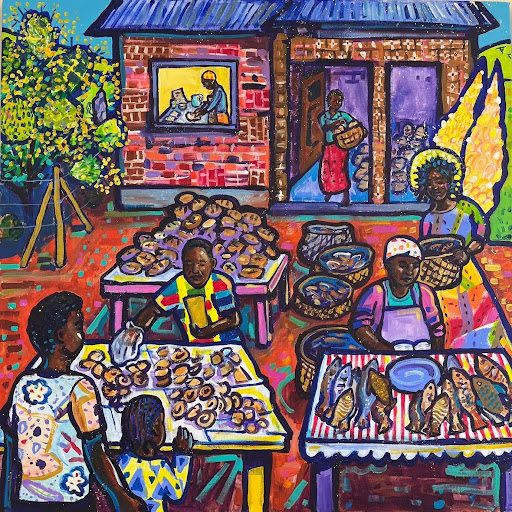
It is no accident that the woman mixes the yeast into three measures of flour, the very same amount Sarah used to feed Abraham’s three visitors at Mamre (Genesis 18). It is enough to make 60 loaves and feed 120 people. In Joel Schoon-Tanis’s painting, it makes many small mandazi (a local donut). The kingdom of God may be present where we only perceive massive corruption, like leaven.
Finally Keating suggests that the Kingdom of God is found in our disappointments, failures, problems, even in our inability to rid ourselves of all our vices. If God is in complete solidarity with the outcasts of society, then why are we so afraid of being one? And why do we hide from outcasts?
These two parables not only show us that our ideas of God’s Kingdom may be incorrect, they may even be the opposite of the Gospel.
6 Responses
Thank you very much for this.
Thanks, Rowland. I really like your contemporary version of the yeast parable: “The Kingdom of heaven is like a virus that an invasive species brings ashore, so that the whole island is infected.” It’s so like Jesus.
Thanks, it came to me in an “aha moment,” after I had written a different version.
I already found a way to include it in a systematic theology book I’m working on, giving you credit, if course.
Thanks so much for this, Roland. Whoa – Jesus using illegal elements like mustard seeds and leaven to depict what the Kingdom of Heaven is like. Challenging (in a good way) to think about those elements and people we consider “illegal” today who could be pointing us to the Kingdom.
Good to hear from you! My original version had manure that an illegal alien spread in a garden. I still remember how excited you were about the compost you had made.