
“Some see things as they are and say why. I dream of things that never were, and say why not.” (George Bernard Shaw, paraphrased)
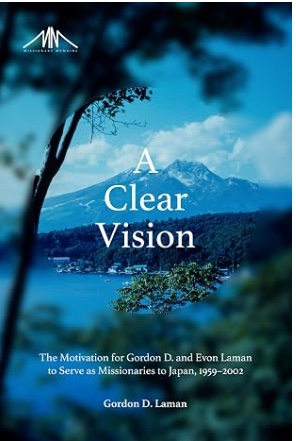
To review a volume written by one’s “uncle” is a daunting prospect–more will be said about this relationship later in this review. That notwithstanding, Gordon D. Laman’s most recent book is a delightful read, chronicling his and “Aunt Evon’s” missionary service in Japan from 1959-2002 and all that prepared them for this calling.
The early chapters focus on Gordon’s family of origin, growing up in Muskegon during the years following the Great Depression and World War II, the beginning of a call to missionary service while a camper at Camp Geneva during the summer of 1947, meeting Evon while he was in high school, and his preparation for ministry while at Hope College and Western Theological Seminary. With transparency, vulnerability, occasional humor, and recalling very painful experiences, Gordon offers the reader insight into all that formed him to serve Christ and the Japanese people for over four decades.
The Lamans first arrived in Japan during the late summer of 1959. Their first year in the country was spent in Tokyo, learning the Japanese language. Gordon was insistent that, if he were to be an effective communicator to and with the Japanese, he needed to be able to preach and teach in the Japanese language. During this first year, Gordon and Evon welcomed their son Timothy, who has a distinguished career as a biologist and photojournalist, occasionally contributing to National Geographic.
In 1960, the Lamans moved to the southern island of Kyushu where they would serve for 20 years. Their ministry began in Saga Prefecture, while living in the city of Saga. Very early in its missionary endeavors in Japan and other countries, the Reformed Church in America decided that missionaries would serve in cooperative relationship with indigenous pastors. Shortly after they arrived in Saga, Gordon met and began to serve with the five pastors of the Japanese church in the Saga District. Realizing that conventional means of proclaiming the Christian message may not have been effective, it was during this season of ministry that Gordon began to use remarkably creative means—music concerts (to this day he has a wonderful voice), Christian movies, and even kamishibai (telling stories with illustrations on posters). Working with the Japanese pastors in evangelistic outreach, he preached in the congregations of Saga Prefecture while also offering Bible studies in Japanese and English (more than a few Japanese youth attended missionary-led English Bible studies to learn the language), and engaged in ethnographic research. He began to use print media as a means to broaden the evangelistic outreach. It was also during these years that seeds of discontent began to develop with one of the Japanese pastors, about which Gordon writes with sincere honesty.
Following the Laman family’s return to Japan in 1970 after their second furlough in the United States, the issues that had confronted Gordon in Saga proved to be unresolvable. Gordon and Evon were invited to move with their family to Sasebo, a port city on the west coast of Kyushu. Here Gordon partnered in ministry with the pastors of the Nagasaki District, where Gordon assumed primary responsibility for the work on Hirado Island. Hirado has a storied Christian history dating back to the arrival of Portuguese missionaries in the mid 1500’s. Beginning with a nucleus of three Christians, Laman planted a church and labored in it until 1977.
In 1981 Gordon was invited to join the faculty of Tokyo Union Theological Seminary (TUTS), where his service continued until his retirement in 2002. Beginning by teaching English so that students would be able to read and use commentaries and theological publications in that language, he later assumed responsibility for the field education of TUTS students, taught courses in communication, and frequently lectured on topics related to theology and pastoral ministry. Gordon concluded his missionary career in 2002 as a very esteemed member of the Tokyo Union Theological Seminary faculty.
Interspersed in Laman’s account of his missionary service are the details of his Doctor of Ministry work at Western Theological Seminary and a plethora of anecdotes about Laman family life in Japan. What I found particularly heartwarming were his mentions of and interactions with other Reformed Church in America missionaries and their children, all with whom I grew up during my years as a missionary kid in Japan. Laman acknowledges that missionaries became “uncles” and “aunts” to all the RCA missionary kids (MKs) and that, to this day, we MKs consider each other our “real cousins.”
A Clear Vision is a testament to Gordon’s remarkable ingenuity and creativity during his and Evon’s years of missionary service. While others saw things in the Japanese church and culture and said “why,” he was willing to dare to dream of things that never were and say “why not.”

2 Responses
What a delight to hear of another book about my extended family; you must be, and are writing about, my 2nd cousins, then? I still have and treasure my father’s kamishibai.
Noruden Sensei, I have to add this to my list.