
What is it about music that has such power to move and connect us?
My sister introduced me to a new musician, Mon Rovîa, in January and I’ve been obsessed ever since. I listen to a lot of music in general, but this artist has managed to be a buoy for me this year. I was also lucky enough to catch him live at a pop-up concert in Cambridge in May. That concert was such a moving experience, which is part of what has got me thinking about the power of music to connect us and create community.
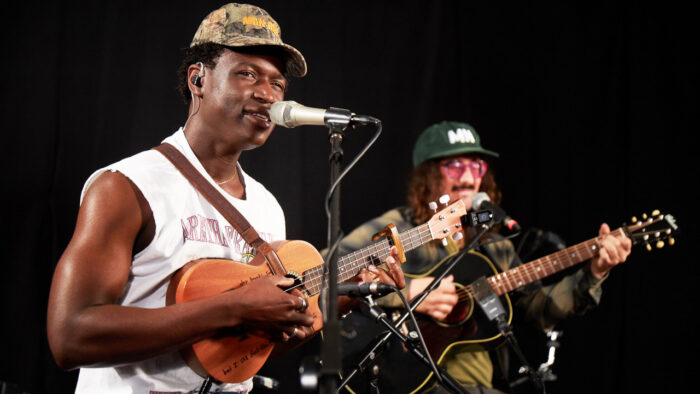
Mon Rovîa has an interesting life story, and consequently, his music is also interesting and thought-provoking. He was born in Monrovia, Liberia (where he gets his stage name from) during their first civil war, but was adopted by an American family as a child. He released his debut full album, Bloodline, earlier this year, and it’s been on repeat for me ever since.
The album is part autobiography, telling the story of his childhood in Liberia and his experience as an adoptee. It also touches on our current political moment; some tracks on the album feel almost like protest songs. The album is cathartic in that way. While it’s not all explicitly about current events, the vibe of the album speaks to what I’m feeling in our present moment and how I’m often struggling to make sense of and find hope in a confusing, sometimes violent world.
Many songs on the album acknowledge and explore the legacy of violence and racism both in Mon Rovîa’s birth country as well as here in the United States. “Somewhere Down in Georgia” describes the specter of racism in the American South, while songs like “Black Cauldron” and “Day at the soccer fields” reflect on Mon Rovîa’s memories of Liberia’s civil war. Other songs speak to how tiring it can be living under the weight of this history and through unprecedented times – like the poignant refrain in the song “Running Boy“: “Oh, where’s the rest for my mind?”
Many of the songs are also about hope, love, and resilience in the face of violence and oppression. “Heavy Foot” is one I’ve seen making rounds on social media. It’s an upbeat and catchy tune. Mon Rovîa sings about the current state of the world, the ways governments and people in power lie to and oppress us, but with an emphasis on the ways solidarity and community can sustain us. The lyrics in “Infinite Pines” also emphasize that hope for the future: “And there’s a change that’s coming, like veins keep running our blood, and though the lights keep fading, there’s a peace that’s waiting for us.”
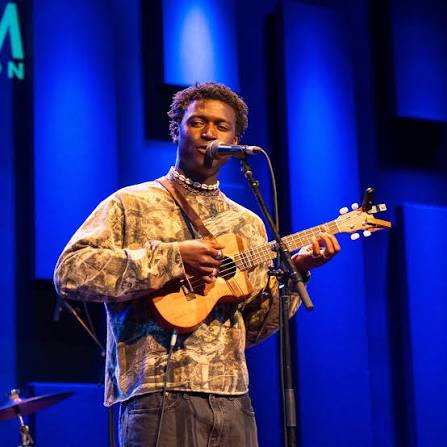
The album has so much depth. In addition to politics and history, Mon Rovîa explores race and identity, childhood and family, mental health, history. He also seems to be asking and answering questions about what it looks like to work toward peace and build solidarity and community.
His music is great to listen to on its own but there was something even more magical and healing about listening to it live with other humans when I saw him in concert in May. His music performed live with his own commentary about the songs, his experience and inspiration, and how his music intersects with current events and performed in a venue filled with like-minded people – it makes you feel not so alone.
I feel like many of us have turned to music for comfort and hope these last few years. And in this album, you get the sense that like the rest of us, Mon Rovîa is struggling to make sense of the world right now and pondering the path forward out of this mess. In a world that feels so violent, dark, and chaotic, Mon Rovîa’s music, and even his social media and stage presence, feels gentle, and that in and of itself, feels radical and refreshing.
To close with a lyric from the last song on the album: “But life is short, made long through love.” Yes, life is complicated and painful at times but there is always hope in art and music and the community and solidarity they can create.

3 Responses
Thank you, I will look into Mon Rovia.
Thanks, Allison for this recommendation. From my cursory listening just now to song snippets on iTunes, the music had a lilting, wistful feel with touches of sadness and hope. The few lyrics I heard gave me the sense of a strong moral and/or spiritual compass. For people of my generation, it made me think of some of the early Simon and Garfunkel songs. Thanks.
Allison, I got my CD and had my first listening and it is good. Thank you for the wonderful recommendation.