
When our daughter Emma was three, a dear woman from our church was babysitting her. When the babysitter pulled a vacuum cleaner out of the closet, Emma gasped, “Can women vacuum?”
Children absorb our assumptions about gender roles remarkably early. Adults, it turns out, do too.
Jeff Munroe, the editor of the Reformed Journal, has dubbed me “the knitting correspondent.” So here is my third, and probably final, installment on knitting, this time focusing on knitting and gender.
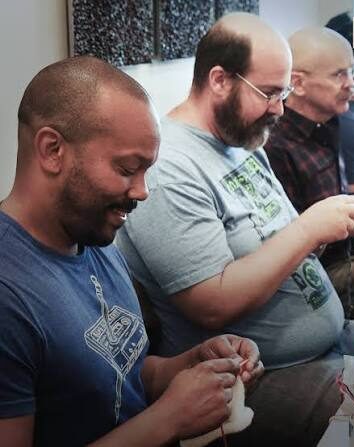
“When and how did you learn to knit?” I asked a male colleague during a recent conversation. He is a respected friend whom I have known for many years. Almost as long as I have known him, I’ve seen him with yarn and needles, knitting.
“It started when I was leading a college age group at church.” he said. “One young woman came regularly, but hardly ever spoke. All she did was look angry and knit furiously! But she kept coming, so the group must have been important to her.
“After several weeks, I asked her if maybe she would like to teach all of us in the group to knit. Suddenly she lit up and became engaged and excited about the prospect of sharing her gift with us. So she taught me and others in the group to knit. And I have kept it up.
“Later, I discovered that her parents were going through a very acrimonious divorce. Knitting was one way for her to expend her anger and nervous energy, even as she tried to stay connected to the group.”
But what my colleague shared next was even more wonderful.
He used to travel quite a bit, speaking at youth conferences and Christian high schools.
“I found knitting was one way to spend my time while I waited for flights or during long bus trips. It was always a conversation starter. People, especially older women, would approach me and ask me about my knitting. The comments I received were almost exclusively positive. People were curious or wanted to tell me about their own knitting projects. Once in a while, I would get a snide remark, mostly from male youth leaders who seemed weirdly threatened by a man involved in fiber arts.
“But it was among the young people that I was speaking with that my knitting seemed to send the most important message. It seemed to convey that I wasn’t another sports celebrity speaker or someone concerned about traditional gender roles. Maybe I seemed less imposing, more approachable?
“I discovered that my knitting was also an entry point for students who were unsure about or questioning their sexual orientation or gender identities — and some, of course, who were very certain, but scared and closeted. Somehow knitting lowered the bar. It made me feel safe to them, and they would come and talk to me.
“In those years I knit hats. They were quick, easy, and made good gifts for students at my speaking engagements. It’s amazing how once or twice a year I will hear from someone who tells me that they’ve pulled out one of my hats and remembered me.”
Can men knit?
Obviously. The answer is an unequivocal yes!
In fact, historically, knitting was almost exclusively an activity pursued by men. The earliest surviving knitted artifacts date to around the eleventh century in Egypt, although historians are uncertain who made them.
By the late middle ages in Europe, professional knitting guilds were exclusively a male domain. A demanding apprenticeship was required to become a “master knitter.” Knitting became a huge commercial enterprise. Shepherds and fishermen in northern Europe also knitted sweaters, caps, and socks for themselves to keep warm in their outdoor labor.
Only with the advent of mechanical knitting frames in the late sixteenth century was hand-knitting no longer profitable and relegated to the realm of domesticity. Women at home became knitters for their families and communities.
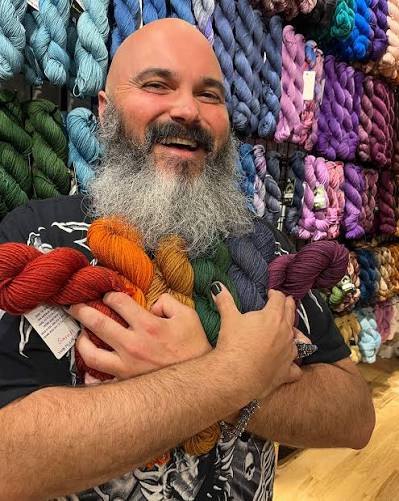
Today, however, there is a revival of knitting among men. Yarn stores run groups reserved exclusively for men to gather, learn, talk and spend time together. One such example is Yarn Dragon, a male-owned fiber shop in Seattle, that regularly hosts men’s knitting circles and retreats.
Can women chop wood and build things? Can men knit or sew?
My colleague’s experience reminds me how easily we are trapped by assumptions about which hobbies, skills, and interests belong to men and women.
Yet when we step beyond these confining expectations, we often discover a new pastime. We also make new and unexpected connections. We create space for conversations that might never have happened otherwise.
Sometimes it only takes a pair of knitting needles for someone on the margins to recognize a safe place—and a friend.
14 Responses
This is great, Sophie. Thank you. As one knitter to another—what would we do without knitting? I read/watched an interesting post/reel in which a doctor of neurology explains why knitting can help ward off dementia, recently.
Loved this, Sophie! Who knows? Maybe “the knitting correspondent” will be struck with another idea for a piece on knitting and life! We can only hope! I really appreciated this one.
Very Good thoughts Sophie. While I have no interest in knitting myself due to arthritis, I am a lover of the final product.
This post reminded me of my late brother, who stitched detailed counted cross-stitch fabric art. He found it very relaxing, especially after a long, contentious consistory meetings. I have kept and framed many of his pieces.
I have a retired teacher friend who taught her 3rd graders to knit. She found that students who needed a timeout could use knitting to relax and then return to classroom activities. I don’t know how many girls and boys kept up the knitting later in life but it was a powerful tool for both genders! I’m with Lori hoping for another post from the “knitting correspondent”!
Thanks for this wise, whimsical essay, Sophie. It’s especially wonderful that your knitting served as an entry point for those questioning their sexual orientation or gender identity. You made them feel safe, and that is a gift.
I am a guy who knits. When I knit in public, in airports, coffee shops, it starts conversations likely because seeing a male knitter is so unusual. My mother first taught me and then my wife (a far more accomplished knitter than I am) encouraged me to pick up needles again, about five years ago.
Knitting has helped me experience to a small extent, the quiet prejudices that women experience every day. When I show up in a yarn shop, particularly if I’m with my wife, I am largely ignored. Shop keepers talk to my wife, even when answering a question I have asked. When they do notice me, explanations come in such simple terms, knittersplained, assuming I know little or nothing. Beyond the wonderful things I have been able to create and the satisfaction that comes from that, I have been able to appreciate the struggles many women face as they move through a male dominated world.
Loved the piece and this comment! It’s so interesting to hear about a man having the experience in yarn shops that I’ve frequently had at the mechanic, the hardware store, whenever someone comes to do work on my house, and so on … not that it’s a good experience, but it’s interesting to learn about a different version of it!
One of my favorite photographs is one I took, well nigh two decades ago, of my nephew, an accomplished knitter, trying to teach his mother, my sister, how to knit. He looks on patiently as she has her face in a determined grimace as she tries to get her fingers to cooperate with his teaching.
In the Netherlands of the 1800s and early 1900s, both boys and girls were holding knitting needles at the age of 3. They were often expected to provide their share of the family’s requirements by the age of 6.
In Pella of the 1840s and ‘50s, men and women knit at every gathering. During the horrible winter of 1848, they ran out of wool and knitted candlewicking into somewhat waterproof coverings that went over mittens.
Knitting required the contribution of everyone; no gender implications involved.
Beautiful Sophie! Keep knitting and writing!
Sophie, thank you for putting a big smile on my face with your article.
My mother, Mary Ellen Lunderberg, was always knitting. She taught my two sisters to knit, but never taught me. My daughter gave me a “retirement” gift: a beginner’s DIY knitting book, needles, and yarn.
This comment to your article is a public commitment to use my daughter’s gift and start learning how to knit. Any advice will be readily and gratefully accepted.
Mary Ellen did teach one of her grandson’s to knit. When he was teaching ESL in India and Japan, he was a hit at the local knitting groups. They all assumed he was lost and then he surprised them when he pulled his needles out of his back pocket and started knitting.
Someday (soon), I hope to follow in my nephew’s footsteps.
Thank you for a wonderful, catalytic, article for a 66 year old man who hopes to be knitting before he turns 67.
I have a 14 years-old grandson that taught himself to knit by watching YouTube tutorials.
My grandfather, born in 1864 to Dutch immigrant parents, was a knitter. I don’t remember ever seeing him knit, but my older cousin remembers fondly the socks he knit for her when she was small.