
When I teach Cell Biology I begin with a question. It’s a question I cannot answer completely myself.
If scientists created an artificial cell made completely from scratch using organic chemicals, would that cell truly be alive, or would it lack some vital force required for that cell to be truly alive?

About half of my students insist that something essential is still missing—that even if every molecule were assembled correctly, a truly living cell would require something more. Only afterward do I tell them that this intuition has a name: vitalism. In my class, this typically leads to a lively discussion about what it means to be alive, the nature of living things, and how we define a cell. The question inevitably moves into a discussion of the origins of the first cell. . . the first life.
Vitalism has been under pressure for years. One major challenge came in 2010 when Craig Venter’s lab reported that they built a synthetic bacterial cell. The cell was self-replicating and its genome included only 473 genes, leading the research group to call it a minimal cell. This synthetic cell was created when scientists synthesized a genome and transplanted it into a recipient cell to create new cells controlled only by the synthetic chromosome. The use of a recipient cell, however, led some to doubt that this cell was truly synthetic. Perhaps some vital force from the recipient cell was still present. For those inclined toward vitalism, there was still room to argue that genuine life had not yet been built from scratch.
This month the challenge became more difficult to ignore when a group of scientists at the University of Minnesota led by Katarzyna Adamala published a preprint reporting on their creation of SpudCell, the first chemically defined synthetic cell.
To make SpudCell, the research group started with synthetic liposomes. Liposomes form because certain molecules naturally arrange themselves into tiny bubbles: one end likes water while the other avoids it. The result is a membrane remarkably like the membranes surrounding living cells. In a simple way you can think about a spherical butter sandwich where the hydrophilic bread can interact with water from both sides and the hydrophobic butter nestles inside.
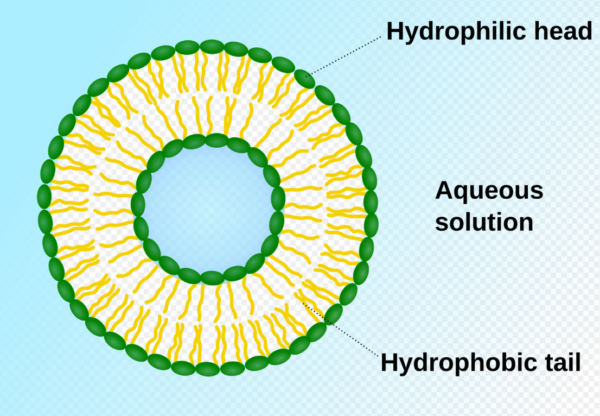
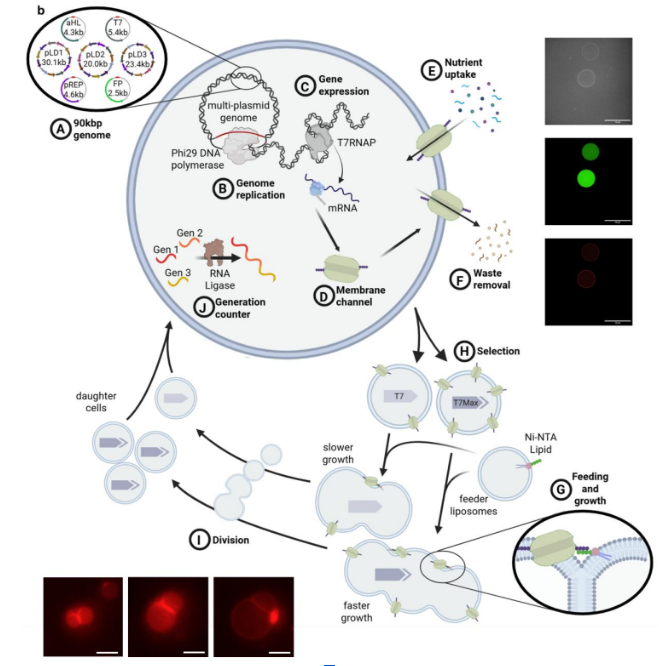
The liposomes served as a compartment in which the scientists housed the chemicals required for SpudCell to complete four life-like processes.
They enclosed a synthetic genome together with the enzymes needed to copy it in liposomes. Once sealed inside the liposome, the DNA successfully replicated—the first of several life-like processes SpudCell could perform.
The second life-like process SpudCell could do was acquiring material and energy essential for the metabolic processes necessary for life. The scientists implemented a “feeding by fusion” mechanism in which they used small “feeder” liposomes which fused in to provide nutrients and the molecules for SpudCell’s membrane to grow.
SpudCell also demonstrated selection. The research group mixed original SpudCells with some that carried a mutation that increased the amount of a protein in the membrane that enhanced the efficiency of fusing with the feeder liposomes. The mutant SpudCells could feed themselves more efficiently. In the mixed population, the mutant SpudCells outcompeted the original ones, similar to the spread of a beneficial mutation through selection that we observe in living cells.
Finally, SpudCell was self-replicating. They demonstrated that SpudCell could undergo at least five generations of self-replication, surprisingly without the cytoskeletal proteins required by living cells.
The scientists reporting this stunning work were careful. They used phrases like “life-like properties” rather than “life.” That said, they have unquestionably “demonstrated key milestones towards construction of synthetic life: a complex cell cycle, including growth and division, and selection, in minimal cells with known identity of all components.”
SpudCell narrows the distance between chemistry and biology. Processes once thought unique to living cells increasingly appear to emerge from carefully arranged molecules. It fills the narrowing gap in the question of how the first cell came to be and makes vitalism a more difficult position to hold.
As a biologist, I don’t see evidence that living cells require an additional vital force beyond their biochemistry. I understand, though, the allure of vitalism for my students and for Christians in general. Vitalism tempts me too. One of the things I love most about science is that every answer produces more questions.
The cell theory states that all living things are made of cells, cells are the smallest unit of life, and all cells come from other cells. This seems to create an inseparable connection between cells and life.

If scientists can create a cell in the laboratory, does that mean that humans can create life? Isn’t the creation of life something we reserve for Creator God? What does it mean to be creators made in the image of a Creator—created co-creators? Does making something diminish God’s role or reveal more of God’s character? Is discovering how life works an act of competition with God or participation in God’s world?
Christians have long recognized that humans create real things—music, gardens, medicines, languages, cathedrals—without rivaling God as Creator. Synthetic cells might belong in that same category, albeit in a much more astonishing way.
Next time I teach Cell Biology I’ll ask my students the same question I always ask. If we build a cell from molecules, is it alive? I suspect the room will divide much as it always has. The science has changed, but the deeper questions remain.
And perhaps that is one of God’s gifts in science: not certainty, but an ever-expanding invitation to wonder what life is, where it comes from, and what it means that we ourselves are creative creatures.

8 Responses
I have no problem with human beings being able to synthesize real life. I see it as sub-creation, but not creation. The amount of very technical intention, methodical intervention, precise provison, and rigid control all exhibit a (collective) mind and will at work. And, to my mind, this has no bearing on demonstrating that such self-selection of molecules for self-replicating RNA might have happened spontaneously in some hypothesized primordial soup. Nor does it disprove, to my mind, that in the observable course of nature, every living thing received its life from a prior living thing. Is that Vitalism? I don’t know. In any case, once again, Sara, you have offered RJ readers another gem. I always delight in your posts.
Re: “this has no bearing on … might have happened in…”?
Dan: Shouldn’t it have at least *some* bearing?
Granted: the hypothesized PSS ({Primordial Spontaneous Soup) doesn’t–as you neatly note–provide the intentional intervening provisioning control that characterized that scientific laboratory.
But for it to happen in PSS, a minimal necessary (though not sufficient) condition is this: the chemical properties of hydrocarbon molecules do, simply when organized in certain peculiar ways, exhibit as emergent properties those key stated distinctives of living cells.
If one is uncertain about whether even this much is true, shouldn’t this (on reflection) contribute at least *something* to one’s overall degree of reasonable uncertainty about whether PSS might be true? But if that’s so, then shouldn’t the elimination of *that* contributor have at least *some* “bearing” on one’s degree of overall uncertainty about whether life *might possibly* arise in PSS? (Some will say so.)
Just asking. How uncertainty works (or should work) on such large-scale questions is very unclear to me.
Steve, thanks for the clarification. Acwelcome improvement.
Sara, thanks for this very informative discussion of the SpudCell and the nature of life. I raised similar questions to my cell biology students, often beginning with a discussion of the phrase “living matter” that many biology textbooks introduce in their introductory chapter.
I argued that “matter” is not alive; living things are alive. Matter is chemical/physical and subject to chemical/physical laws. Living things are subject to biotic laws in addition to chemical/physical laws. “Life” is thus not a thing but a function of living things, a function that is subject to biotic laws, which, I think, is more meaningful than talking about the “vital forces” of vitalism.
So the formation of SpudCells is harnessing biotic laws in their formation. My u understanding of the origin of the first living cells involves God unfolding simple structures subject to the biotic laws of his creation.
Professor Zylstra, I recognize the Modal Scale. I don’t have the scientific chops to judge whether it holds up (in whoever’s version), but even fifty years after learning it from Evan Runner I am still drawn to it, especially its refusal of reductionisms.
I took courses from both Profs. Runner and Zylstra at Calvin. I always struggled to see how the modal aspects made a difference for biology, chemistry and physics, but your comment, Prof Zylstra, was very helpful in resolving what is often presented as either/or. Similar to Diemer’s little book Nature and Miracle you made biology majors struggle with. Thank you!
Sara, Thank you for your (as usual) thoughtful and perceptive thoughts on things biologic. Reading your thoughts and the subsequent posts, I continue to have a difficult time seeing where the line between chemical and biochemical reactions and the subsequent results/products lies. There are simple chemical and complex chemical reactions but one might view those as part of a spectrum. Maybe everything is “life” and the use of terms such as “material” and “life” are simply human constructs that we continue to employ due to cultural momentum. “Vitalism”, in my view, should be placed adjacent to “humors” in the museum of human history.
Thank you, Sara, and post contributors for stimulating my “unscientific” mind to the wonder of it all, expressed so well in your last line: “And perhaps that is one of God’s gifts in science: not certainty, but an ever-expanding invitation to wonder what life is, where it comes from, and what it means that we ourselves are creative creatures.”