
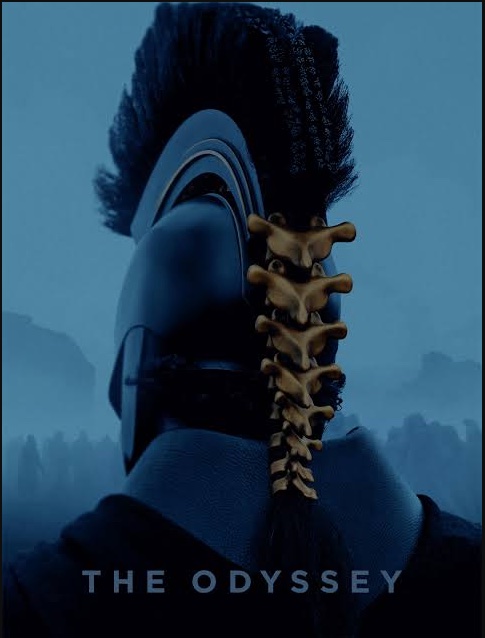
Christopher Nolan’s adaptation of “The Odyssey” is a remarkable achievement, a cinematic tour de force, and a spectacle of such scope and scale as befitting Homer’s 2,800-year-old epic on which it’s based. It has everything you want from a theatrical moviegoing experience: action, explosions, battle sequences, palace intrigue, a fantastical adventure, exquisite landscapes, beautiful humans doing things, and more “how on earth did they do that” moments than you can keep track of. It felt at once ancient and relevant, epic and intimate, personal and political, universal and particular, immersive and propulsive.
If you’re unfamiliar with the storyline, “The Odyssey” tells the tale of the ill-fated and long-delayed return home of Odysseus (played by Matt Damon), the legendary king of Ithaca, hero of the Trojan War, while his wife Penelope (Anne Hathaway) and son Telemachus (Tom Holland) attempt to stave off suitors, led by Antinous (Robert Pattinson), who are taking over the palace and exploiting Penelope’s hospitality in an effort to force her to marry one of them before Telemachus comes of age.
The film is, remarkably, the first attempt to portray the entirety of Homer’s epic on screen–an incredible cinematic gap between written or oral story and film version for a story so fundamental to Western society’s storytelling tradition. And Nolan’s adaptation includes almost all of the iconic characters borne of Homer’s imagination, presented almost entirely in flashbacks Odysseus relays to the nymph Calypso as the memory-dulling power of her lotus flowers wanes after seven long years of delirious captivity.
We cram inside the Trojan horse with Odysseus and his men, enter the cyclops Polyphemus’ cave (though, sadly, aren’t treated to Homer’s delightful wordplay around “Nobody”), look on helplessly as the giant Laestrygonians cut down most of Odysseus’ men, feel immense foreboding as the witch Circe transforms Odysseus’ men into pigs (a truly inspired performance by Samantha Morton, and a grotesquely brilliant bit of filmmaking), and watch in horror as the monster Scylla grabs Odysseus’ men from its home atop the cliffs.
In one of the film’s most inspired and impactful scenes, we watch Odysseus’ spirit broken by the beautiful and devastating song of the sirens. After blocking his shipmates’ ears with wax, Odysseus is lashed to the mast so he would be the only man who heard their song and lived. Nolan opted not to write and record an actual song, which would inevitably fall short of the sirens’ legendary beauty. Instead, he turned the focus on Odysseus and the impact their song had on him. Speaking as Odysseus, Damon’s voiceover, explaining the song to his second-in-command after the fact, describes hearing the sirens’ song as the itch under the skin you can’t reach that becomes unbearable: “It told you what you most want is what you most can’t have and what you most can’t have is what you already had and lost.”
This scene is a distillation of a theme Nolan has explored in so many of his previous films. It is the tension between, on the one hand, the longing for power and significance felt by the “great man burdened with genius” who is a slave to his ambition, and on the other hand, the soul’s ache for home—whether that home exists in memory or reality.
These are heavy—and sometimes heady—themes to engage in a summer blockbuster. But Nolan has developed a reputation for combining thoughtful and complex storytelling with a level of visual flair and thrilling spectacle that takes your breath away even as it prompts you to reflect on something deeper. In this way, his films are Trojan horses of their own.
Which brings us to the central theme of Nolan’s adaptation, which is an innovation on Homer’s original: Odysseus’ grappling with the fallout of his ingenious yet consequential idea of how to finally end the decade-long Trojan War. Using the Trojan horse to infiltrate the walls of Troy and breach them from the inside out, Odysseus enabled the Greek armies under Agamemnon to enter the gates unmolested and sack the city. Nolan’s Odysseus is haunted by the Trojan horse.
The social and cultural context of Nolan’s interpretation of the Trojan horse is “Zeus’ Law,” which in the film is the law of the land. It is a version of the Golden Rule (do unto others as you’d have them do unto you), and it dictates that any stranger who comes to your house must be offered hospitality and kindness, for the stranger may be a god in disguise. It was under the guise of Zeus’ Law that the Greeks “offered” Troy the horse as a “gift”—a peace offering for Athena—which assured that they would bring it into her temple in the heart of the city, beyond its impenetrable gates.
Almost ten years later, Greek society’s commitment to hospitality is waning as rumors spread about the “people of the sea,” a mysterious race of people who defy Zeus’ Law. Every Greek kingdom is feeling pressure to close its gates against these violent foreigners invading their lands, undermining their way of life.
At various points throughout the film, Nolan cuts back to a scene during the sacking of Troy in which Odysseus falls on the steps of Athena’s temple and looks up. But you never see what he’s looking at until the very end of the film. Another recurring glimpse of memory is of a stone statue’s head lying on the ground, seemingly also in Athena’s temple in Troy.
The Trojan horse haunts Odysseus. It made him a war hero, sure. Songs were written and sung about his glory in defeating the Trojans for Agamemnon, yes. But Odysseus sees only regret. In an interview, Matt Damon described “The Odyssey” as a story about PTSD. Eventually, Odysseus comes to realize that his “brilliant” idea set in motion a chain of events that would quicken the collapse of society.
Now, initiating a societal collapse may be more than one man can legitimately claim to have done with his life (talk about hubris!), but clearly the Greeks are the “people from the sea” that everyone—including the Greeks!—are so afraid of. Their refusal to live by their own standards and values, demonstrated by initiating wars to control trade routes and extract resources from foreign soil, created the conditions that now threaten their way of life at home. Not to mention all the lives lost along the way. It is the proverbial chickens coming home to roost.
In Nolan’s capable hands, this ancient story is as relevant as ever. By telling it as he has, Nolan is encouraging us to consider carefully whether the actions of our government, our military, our federal ICE agents, even our own behavior towards each other online, etc., are quickening the collapse of society by undermining the values on which our society is built. It is an important question to consider.
While the movie is clear about Nolan’s answer, it is not devoid of hope. Odysseus is triumphant in his return home, but he does not lord his victory over his people. Instead, he abdicates the throne to his son and departs into the west to honor his men and chase the setting sun with his beloved Penelope. Perhaps Nolan is suggesting that the way forward looks more like loosening our grip on power, acknowledging our mistakes, and seeking to be faithful to who we’re becoming than it does like pursuing significance at all costs, being a slave to our ambition, and creating the conditions that justify violence against our neighbors.

6 Responses
Thank you for this thoughtful analysis. I agree, especially with you take on Nolan’s overriding theme. Sadly, we are the people of the sea.
Thanks, Travis.
Maybe Nolan is suggesting that Odysseus and Penelope heading to the west is today’s equivalent of boomers shuffling off to play pickle ball. Please go away and let some others have a chance!
You said it! LOL
Yes. The scene where Penelope realizes that “we are the people of the sea” was so powerful.
On a personal note, my beloved husband gave up much power, influence, etc. so we could spend the rest of our lives on the same “ship,” headed towards the western sun together. It didn’t make sense to anyone except us and our closest circles, but we are living the most rich and full lives we ever have.
I’m so happy to hear that! All the best to you and your family!
Thanks for this excellent and comprehensive review – it make me more ready and eager to see Odyssey!