
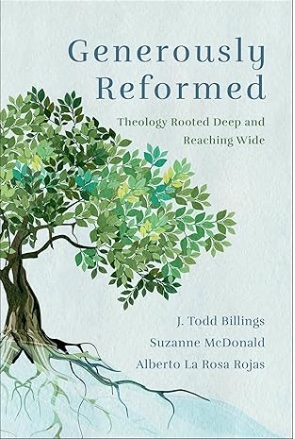
Editor’s Note: In the month of August, our Sunday blogs will be excerpts from Generously Reformed
by J. Todd Billings, Suzanne McDonald, and Alberto La Rosa Rojas.
Why would someone want to inhabit a particular theological tradition like the Reformed tradition? For many, the list of reasons “why not” is likely to be longer than the list of reasons “why.” Distrust of institutions—from the government to church denominational structures—has been increasing in Western contexts. Sadly, all too often this distrust of the institutional church is for good reason: abuse of power, confusion of cultural status with a Christ-following way, wearisome debates that seem to indicate to the world that Christians are ones who bicker together rather than ones who love one another.
This book is not an apology or defense for belonging to a Reformed denomination or network or inhabiting a particular polity. Denominations and structures matter, of course. But for too long they have been confused with something quite distinct: inhabiting a historic theological tradition. It is possible to be part of a Reformed or Lutheran or Methodist or Baptist denomination and to inhabit those traditions in reductionistic ways. In some contexts, theological points can quickly become weapons in warfare, meant to secure the fortress against the onslaught of “the liberals” or “the fundamentalists.” In other contexts, due to exhaustion from years of denominational bitter-ness, a congregation tries to hide their heritage under the rug. As long as it is a fairly homogeneous group, it can seem plausible for a congregation to be “generically Christian.” But when the first controversy related to baptism or church leadership or generational change or accountability emerges, a church split naturally follows.
We understand that while many readers may desire to connect with the Christian faith of the past, the obstacles to committing oneself to a historic Christian tradition are considerable. Is the historic Reformed tradition really worthy of trust? Has it been an ideal church through history? Was it complicit in the horrors of slavery and the history of racism? Did this tradition avoid the cultural Christianity that left behind the Bible when Scripture became unfashionable? Has it resisted the allure of power and chosen the way of the cross?
Let us say this at the outset: The Reformed tradition, as expressed in its confessions, in its theologians, and in the lived reality of history, avoided none of these horrors and errors. It is not an untainted church in its past or its testimony. It has, as we will describe in chapter 2, a “non-innocent history.”
Yet, here is our wager: If we are followers of Jesus, we must decide how we will relate to the larger, historic Christian tradition—with its beauties and profound shortcomings. On the one hand, we can pretend that we belong to a church that is only a few decades old and avoid these larger questions; but that is a decision. That decision assumes a church exists that somehow floats above flesh-and-blood mortals who have followed Jesus for centuries. On the other hand, we can decide to make our home in a much older tradition, whether Reformed or Lutheran or Roman Catholic or Orthodox. There are no perfect options, no innocent possibilities, no churches whose history and life represent unerring purity and faithfulness. Whether we like or dislike church or history, our life decisions display a sense of what it means to belong to the household of God, the church catholic, present through history and in various cultural contexts.
We authors of this book believe that even with its flaws and shortcomings, the Reformed tradition can be a fruitful pathway for growing deeper into maturity in Christ, for hearing from the testimony of the whole counsel of Scripture, and for strengthening our witness—in word and deed—to the good news of Jesus Christ in a hurting and often cynical world. Indeed, the Reformed tradition gives an account of the church as a creature of God’s own Word. The church is fallen and fallible. Yet, through God’s mercy alone, God created a people where there were no people. In union with Christ through the Spirit, we are adopted into God’s household and given new life, an identity to grow into. In this process, we do not need to sugarcoat the church’s sins, yet we also need not despair. God alone is the hope for the church, and his life-giving Word continues to call his household to repentance, growth, and witness.
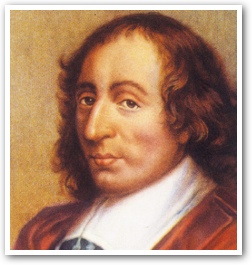
1623-1662
What is at stake in calling this a wager? We use the word to evoke the reflections of the seventeenth-century French mathematician, physicist, and philosopher Blaise Pascal. He offered a careful argument that often shows up in philosophy classes about the existence of God. He does not provide evidence for God’s existence but, rather, gives practical arguments for why it is wise to commit oneself in trust to God, even if plagued with doubts. In essence, his wager is that, given the potential eternal rewards and consequences, it’s wiser to believe in God than not, even without certainty of God’s existence. Uncertainty should not be an obstacle to commitment.
We believe that an adapted version of the wager has implications for Christians considering whether to commit themselves to a particular theological tradition. All traditions are imperfect, and there will always be uncertainties about what such a commitment entails… But if we always stay outside all historic Christian traditions, then the tradition we functionally embrace will put the self, our own preferences, at the center: We decide what to eat at the smorgasbord of Christianity…
We encourage readers to bring their hearts and minds to this book, but we use the concept of a wager to describe the decision of whether and how to inhabit a theological tradition because we know that, on this point, it can be tempting to simply defer—as if we could opt out, stand on the sidelines. If we decide to take a smorgasbord approach, viewing theological traditions as consumers (and ourselves as those who should be in charge), then we should be honest about that decision. But we authors of this book are willing to wager that diving into a particular pathway to inhabit the broad, catholic tradition will be a richer, more fruitful path. And we think that the Reformed tradition, despite all its defects and shortcomings, can provide a deeply biblical, refreshingly God-centered, and profoundly generative pathway into the catholic Christian faith.
Content taken from Generously Reformed by J. Todd Billings, Suzanne McDonald and Alberto La Rosa Rojas, ©2026. Used by permission of Baker Academic, a division of Baker Publishing Group.

2 Responses
Thank you Alberto, Suzanne and J.Todd, this is exceedingly helpful and a critical distinction! My life is infinitely richer because I once walked the same Seminary halls with you. You each help to make WTS a gift to the larger world of Theological Education!
I appreciate the use of the word A when urging readers to “inhabit A theological tradition” and “A biblical pathway,” throughout our history others have chosen THE rather than A, showing a lack of humility or grace.