
(Note: The research for this article was conducted while the author was a visiting scholar at Calvin Theological Seminary.)
What does it mean for the church to meet people where they are? Churches have long wrestled with how to proclaim the gospel while being deeply present in the lives of their communities. How do we bear witness to Christ without retreating from the world’s brokenness? And how do we care for our neighbors without reducing the church to just another social institution? Every generation is confronted by these questions. More than seventy years ago, Eugene Callender embodied one answer in Harlem. His ministry, though often overlooked, offered a distinctly Reformed vision that refused to separate gospel proclamation from faithful presence in the community.
Born in 1926 in Cambridge, Massachusetts to Barbadian immigrant parents who were devoted Pentecostals, Eugene Callender originally planned to become a physician. While a pre-med student at Boston University, a visit to relatives in Harlem in 1944 transformed his sense of calling. Confronted by the poverty, racial injustice, and inadequate housing faced by many African Americans, he concluded that he could better serve his community through ministry rather than medicine. He changed his major to philosophy before pursuing theological training at Westminster Theological Seminary and Union Theological Seminary.[1]
Callender was the first Black student to attend Westminster Theological Seminary and, in 1951, the first African American ordained by the Christian Reformed Church. From the very beginning, his ministry was shaped by a calling to extend the church’s witness among African Americans.[2]Westminster Theological Seminary had longstanding ties to the Christian Reformed Church, whose Home Missions program was actively seeking to establish a Reformed witness in Harlem.In August 1952, after “serious consideration and prayer,” Callender wrote to the CRC’s Home Missions Committee expressing his eagerness to accept the call in Harlem.[3]
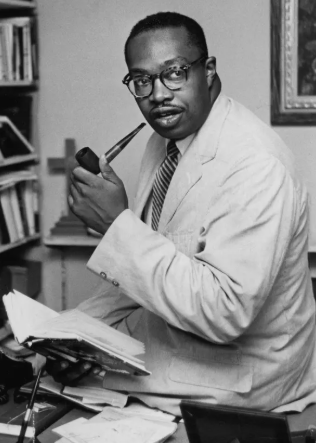
Photo Credit: New York Times
Harlem offered both an opportunity and a challenge. By the mid-twentieth century, the historically Dutch settlement of Nieuw Haarlem had become the cultural and spiritual heart of Black America, shaped by the Great Migration and the Harlem Renaissance. Churches played a central role in community life, even as Harlem continued to contend with overcrowding, racial discrimination, and economic inequality.[4] Yet few Christian Reformed congregations in New York were prepared to welcome Black worshippers into their existing churches, creating an urgent need for a Reformed ministry rooted within the community itself.[5]
Callender believed Harlem needed a gospel that entered suffering with the hope of Christ—a gospel that spoke honestly about poverty and injustice without retreating into escapism.[6] As he wrote, “The Harlemite needs for his living here and now, as well as for his living hereafter, what all other men need: the saving truth of God”.[7]
The beginnings of the Mid-Harlem Community Parish were humble. Callender arrived in Harlem with little more than the church’s blessing and a mailing list of the Back to God Hour radio program audience.[8] He began visiting homes, leading Bible studies, and following up with radio listeners who were searching for a church rooted in biblical preaching and Reformed theology.[9] From the outset, Callender understood that faithful ministry begins by meeting people where they are.
Callender took the pulpit to the streets—literally. Accompanied by a piano and choir, he led public worship in the heart of Harlem, bringing the gospel into the everyday life of the community, rather than waiting for the community to come to the church.[10] His ministry unfolded in living rooms and apartment buildings, where he visited families, offered pastoral care, led Bible studies, and built lasting relationships with people who had little connection to the church.[11]
Under Callender’s leadership, the Mid-Harlem Community Parish organized rent strikes, launched youth initiatives, ministered to those struggling with addiction, and established rehabilitation clinics and support programs for returning citizens, survivors of domestic violence, at-risk children, and all those living on society’s margins.[12] These ministries were not distractions from the gospel. They were expressions of it. For Callender, the gospel spoke to every dimension of human life.
Callender worried that churches had become preoccupied with maintaining institutions rather than cultivating faithful disciples. Paying mortgages, hosting bake sales, and expanding facilities were not wrong, but they were not the measure of faithfulness. He believed the church finds its life in trusting God, proclaiming the forgiveness of sins, worshiping faithfully, teaching the scriptures, and living as a Spirit-filled community marked by love and charity. Without this, even the most outwardly successful congregation could stand before God as a “colossal failure”.[13]
Callender’s understanding of the church also challenged prevailing assumptions about race and belonging. He believed the church could not profess unity in Christ while accommodating the racial divisions of American society. Integration would require more than good intentions; it demanded deliberate action and courageous leadership. Callender insisted that the issue was never whether a congregation was predominantly Black or white.[14]
The real question was whether it would be Christian.[15]
These were not separate commitments but different expressions of the same theological vision. Street preaching and rent strikes. Bible studies and rehabilitation clinics. Each reflected Callender’s conviction that Christ’s kingdom had already broken into the world, but had not yet been fully revealed.[16] For Callender, that meant proclaiming the gospel without compromise, while refusing to withdraw from the brokenness of the world. He rejected both the reduction of Christianity to social action and the escapism of a faith that offered comfort without truth. Harlem, he believed, needed “the whole counsel of God,” a gospel that spoke to life “here and now” as well as life “hereafter”.[17]
Because the church still awaits the fullness of Christ’s kingdom, it cannot be indifferent to injustice, poverty, prejudice, or suffering. Callender wrote, “On the basis of the present Kingship of Christ we must become concerned about the economic and social tyrannies that enslave the Harlem resident. It is because Christ is King that He alone can redeem Harlem’s sinful society for us and through us, by casting out the demons of prejudice.”[18] For Callender, the church bore witness to Christ’s kingdom both by proclaiming the gospel and by embodying its hope in the life of the community.

Callender’s ministry eventually extended well beyond the Mid-Harlem Community Parish. In 1961 he accepted a call to Church of the Master, a prominent Presbyterian congregation in Harlem, where he developed innovative “street academies” for underserved youth and founded the Harlem Preparatory School. Over the following decades he combined pastoral ministry with leadership in civic organizations and public service, while remaining deeply committed to the renewal of Harlem. Although his later ministry took place primarily within Presbyterian rather than Christian Reformed contexts, Callender remained deeply shaped by the Reformed tradition, continuing to unite gospel proclamation with a concern for the social, educational, and spiritual renewal of the community throughout his ministry until his retirement in 2010.[19]
Callender’s ministry belonged to a particular time and place, but the questions it raises remain our own. What does it mean for today’s church to “meet people where they are”?
More than seventy years later, Callender’s work remains remarkably relevant. It reminds us that the church cannot simply wait for its neighbors to come through its doors. Callender certainly welcomed people into worship, but he did not expect worship to be their first encounter with the gospel. Instead, he carried the gospel to Harlem’s street corners and living rooms. As many congregations wrestle with shrinking attendance, Callender invites us to consider a different question.
Rather than asking how to bring people to the church, we might ask: where is Christ already at work in our neighborhoods, and how we are being called to join him there?
The circumstances have changed, but the church’s calling has not. Because Christ reigns now, the church is called to proclaim the gospel while bearing witness to God’s kingdom wherever people experience injustice, loneliness, poverty, violence, or exclusion. These were never competing callings but two expressions of the same gospel. The church is no less called to hold them together today.
Callender also reminds us that churches are not called merely to occupy neighborhoods but to belong to them. He came to know Harlem, to love its people, and to remain present among them. He did not water down the Reformed faith, nor did he expect Harlem to become culturally Dutch Christian Reformed. Instead, he demonstrated that the depth of the Reformed tradition could take faithful shape within the life of a particular community. That remains the church’s calling wherever God has planted it.
Perhaps the best summary of Callender’s ministry comes from Callender himself. Reflecting on his years in Harlem, he said, “Life is broken and makes sense only when we can mend it. The grace of God is glue. It is by the grace of God that my life has been daily mending, molding, shaping to the somebody he created me to be. I, like you, am a testimony that nobody is a nobody.” [20] More than seventy years later, the church is still called to bear witness to that same grace by proclaiming the gospel, embodying Christ’s love within its neighborhoods, and reminding a broken world that, in Christ, nobody is a nobody.
*To learn more about the life and ministry of Eugene Callender, see: Blackmer, Geneva. 2026. “Meeting People Where They Are: Eugene Callender’s CRC Ministry in Harlem and the ‘Already, but Not Yet’ Kingdom of Christ” Religions 17, no. 7: 789. https://doi.org/10.3390/rel17070789.
[1] Evans, Kim Masters. 2015. Callender, Eugene 1926–2013. In Contemporary Black Biography. Edited by Margaret Mazurkiewicz. Farmington Hills: Gale, vol. 119, pp. 27–29.
[2] Evans 2015, pp. 27–29. Callender, Eugene 1926–2013. In Contemporary Black Biography. Edited by Margaret Mazurkiewicz. Farmington Hills: Gale, vol. 119, pp. 27–29; Callender, Eugene S. 2012. Nobody Is a Nobody: The Story of a Harlem Ministry Hard at Work to Change America. Charleston: Reverend Eugene S. Callender; Westminster Theological Seminary. 2013. Staying Informed: First Black Student at Westminster. Archived December 10. Glenside: Westminster Theological Seminary; Christian Reformed Church in North America. 1951–1957a. Home Missions–Mission Fields–Harlem, NY, Manhattan CRC, Correspondence 1951–1957. D.4.8.2, Box 1770, Folder 5. Christian Reformed Church in North America Records, Denominational Offices, Home Missions: Mission Fields. Grand Rapids: Calvin University, Heritage Hall Archives.
[3] Christian Reformed Church in North America 1951–1957a.
[4] Callender 2012, pp. 67–70.
[5] Callender 2012, p. 64.
[6] Callender, Eugene S. 1952b. Sectarianism in Harlem. Reformed Journal 2: 9–11.
[7] Callender 1952b, pp. 9–11.
[8] Christian Reformed Church in North America. 1951. 1951 Agenda and Acts of Synod. Grand Rapids: Christian Reformed Publishing House.; Christian Reformed Church in North America 1951–1957a.
[9] Christian Reformed Church in North America 1951–1957a; Christian Reformed Church in North America. 1951–1957b. Home Missions–Mission Fields–Harlem NY, Manhattan CRC, Missionary Reports 1951–1957. D.4.8.2, Box 1772, Folder 1. Christian Reformed Church in North America Records, Denominational Offices, Home Missions: Mission Fields. Grand Rapids: Calvin University, Heritage Hall Archives; Callender, Eugene S. 1952a. Our Work in Harlem. The Banner 87: 1229.
[10] Callender 2012, pp. 75–76.
[11] Christian Reformed Church in North America 1951–1957a, 1951–1957b.
[12] Callender 2012, pp. 73–76; Evans 2015, pp. 27–29.
[13] Callender, Eugene S. 1957. The True Function of the Local Church. The Banner 92: 6–7.
[14] Callender, Eugene S. 1956. In Christ There Is No East or West. The Banner 91: 550–51.
[15] Callender 1956, 550–51.
[16] Callender 1952b, pp. 10–11.
[17] Callender 1952b, pp. 9–11.
[18] Callender 1952b, p. 10.
[19] Evans 2015, pp. 27–29.
[20] Callender 2012, p. 328.

5 Responses
This is important and valuable, thank you. One question, regarding the sentence: “Yet few Christian Reformed congregations in New York. . . .” What were these?
Thank you for sharing this story of Callender “meeting people where they were at” in his work in Harlem. There is another undercurrent in this story of Callender as he is also meeting his Christian Reformed colleagues where they were at, with their questions of whether or not black church as well as white churches would actually be Christian. I’m sure he had many other conversations like this as well, bending to meet traditional CRC perspectives while he was also meeting his neighbors in Harlem.
Thanks for researching the story on this inspiring, visionary, pioneering leader. I met him at the train station in Bellingham Washington when I was in first or second grade. He may have been the first black person I had ever met. He must have been on a fund-raising trip for the new CRC “Home Missions” board. It must have been a mind-blowing challenge to our farming community in Lynden to hear about a “street ministry” in Harlem. He might as well have been from Mars, but as far as I know he was received well and Lynden churches have promoted “home” missions generously ever since.
Thank you for this piece–it brings back memories. I grew up in Clifton NJ and remember going to Callender’s church as a little girl. I also remember him visiting our house–I think with his wife and daughter. He was a brilliant man.
Thank you all for your wonderful comments! How lovely to hear that so many of you had the opportunity to meet Callender in your youth. 🙂