
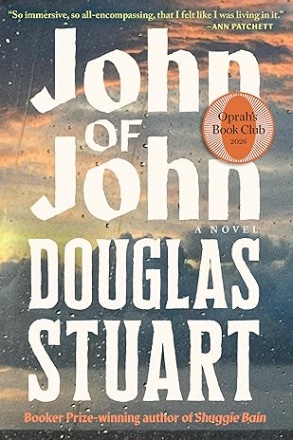
On his way to visit a friend, a man pulls his car into a side street of a small Scottish town, turns off the engine, and leans onto the steering wheel. A devout Christian, he begins to pray, “apologizing to his Maker for how he has been made.”
Sit with that prayer a moment.
It’s a man he’s visiting, one he’s been deeply in love with his whole life. Although John of John includes other compelling themes—among them, a son disappointing a father’s expectations for the kind of man he should be or the profession he should pursue—as a cis straight man, I’ve never read a novel that engaged me so viscerally with the untenable plight many churches impose on gay couples who also love God. Douglas Stuart’s new novel does this with admirable honesty, wisdom, and grace.
Stuart is clearly a gifted writer and master storyteller. This is his third novel, and his debut, Shuggie Bain, was awarded the Booker Prize. So it’s no surprise that Ann Patchett praises John of John, claiming on the jacket that it is “so immersive, so all-encompassing, that I felt like I was living in it.”
John of John is set in the late 1990’s on an island within the Scottish Hebrides, in a fictional village called Falabay, where only 26 residents live, work, and worship. Stuart’s description of the landscape is vivid, as are his portraits of the gritty villagers, most of whom are crofters who, like their ancestors, raise sheep and weave tweed—the famed Harris Tweed, though no one’s getting rich at it, since crofting and weaving are barely a means to subsist on this rugged island they love. The weather is harsh and so wet that the ubiquitous sheep, like the island’s flock of flawed humans, aren’t romanticized: they have to be checked for maggots often. Stuart uses lots of terms of Scottish origin like “fank,” “harled,” and “scunner.” Most characters in the story speak their native Gaelic, which Stuart italicizes in English for the reader’s benefit. The total effect was, as Patchett suggests, like being transported to the Isle of Harris.
The story opens with Cal, son of John Macleod, being summoned home by his father to Falabay because his maternal grandmother, Ella, is seriously ill—or so he’s been told, because this is a story of secrets. Both Ella and his father dearly want him home, so Cal leaves Edinburgh, where, jobless but gifted in textile arts, he had recently graduated from a textile college. When he arrives in Falabay, intoxicated and sporting ripped jeans, a military jacket, and long, flame-colored hair, his father, a precentor in their strict Free Presbyterian Church, exclaims, “You look like a cross-dresser that’s thrown on a coat because he’s run out of milk.”
Cal is gay, a secret he’s kept from his father and the community of Falabay. What he doesn’t know, and what readers will guess early on, is that his saintly father is also a closeted gay man. The tension between the two is significant, and more than once results in Cal being beaten, a fact John’s church seemingly accepts. What’s also clear, however, is the unspoken love they have for each other, since, as Stuart writes, “Their conversation was always censored, missing the things they couldn’t talk about.”
John’s wife, Grace, left the family when Cal was just a boy and moved to the other side of the island. Though his parents are still married, Cal doesn’t yet know the reason for their permanent separation and resents them for it. Grace’s mother, Ella, is earthy and profane and provides Cal and readers some comic relief. Whenever John and Cal speak in the house, they do so in Gaelic, assuming she, from the big city of Galway, doesn’t understand, but Ella understands more than she lets on, chiding John at one point for his disrespect, “If you ever speak to me like that again, I’ll put so much bleach in your bath it’ll melt your face off.”
There are other memorable characters, like the MacInnes brothers up the road—two old bachelors living in one house who haven’t spoken a single word to each other in sixteen years. Whenever guests visit, “they would both sit down to tea, but should you ask one brother a question, you then had to turn and repeat it word to word to the other brother….Any conversation had to be carried on in duplicate or else they felt slighted.”
Eventually, John and Cal begin to work together to care for the croft’s sheep, even managing to weave a single tweed together, alternating daily shifts in a way that requires mirror-like precision from both in order to pass inspection for the high-quality tweed. Later, Cal remarks to his father, “We could be the same man”—an allusion to Stuart’s title, since Cal’s full name is John-Callum Macleod.
Metaphors abound in Stuart’s prose, but the central one that gets at the sexual dilemma is the bellwether, the leader of the flock: typically a calm, castrated ram, with a tinkling bell around its neck that the other sheep follow. Its role, to keep the flock together and safe by showing them where to go, is critical to every crofter. Ella surprises Cal early on by telling him that the flock has a new bellwether, a ewe named Ishbel, which means “God is my oath.”
“Hold the front page,” exclaims Cal, “feminism reaches Falabay.” To which Ella quips, “We can do anything a man can do.”
The idea of a new bellwether figures significantly into the surprising, ironic ending. For John Macleod, another kind of bellwether has always been the strict, graceless church—especially its straight men—where members who commit “unforgivable” sins are “de-membered.” That church is dying, its building about to be sold.
One gay character, whom Cal pronounces the new bellwether, laments to the man he’s loved his whole life about the impossible bind the church has put them in:
I’d like to….go to an art gallery and stand before a painting with you and have you teach me about colours. I’d like to get lost with you….I’d like you to pat me on the arse now and then, gently, like, just to hurry me along. I’d like to sit in a pub as the rain comes down and talk to you without worrying that someone might know us.
He simply wants what we all do: the freedom to be with and to love the person he chooses. And if, Stuart’s wise novel implies, those same loving men also love God, where is the sin in that? They should do so fully, without apology, and without threat of being cast out from the flock.
The selfsame flock they, and the Maker who made them, love dearly.

8 Responses
We’re in an interesting moment in the sexual revolution that began some sixty or so years ago. The demand, of course, to be not just tolerated but celebrated for whatever shape one’s self-expression takes hovers above everything, but there’s still much confusion about what that “self” might be.
That confusion is captured in the language of our moment, echoed in this review, which oscillates between “how I was made” and “choice.” On the one hand–as with modernity in general–the sense that personal fulfilment requires complete freedom and that freedom is only such when it exists entirely unconstrained by any factors beyond the mere act of choice itself is powerful, reflected best, perhaps, in those that claim the”pansexual” or “gender-fluid” identities where one adopts numerous genders from day-to-day or even hour-to-hour, or sometimes no gender at all. On the other side is the more traditional metaphysics that we all have a nature we can’t escape, which is obscured by rather than revealed by our physicality (“biology is not destiny”), and the task of life is to discover that nature and live it. The tension is perhaps best represented by the mutual hostility felt by boomer-era gays such as Andrew Sullivan, and Millennial to Gen-Z adherents of various post-modern gender theories.
It’s an interesting moment for the church. Once the upholder and defender of a robust metaphysics of the body and a system of morals that had developed over millennia that saw the body as well as the whims that spung from mysterious places in the self as threats to be contained, the church has over the past decade or so divided, with some digging in and doubling down on that older system, but others embracing the “you-do-you,” “I just want you to be happy,” “just be kind” versions of the compassion ethic, and insisting that Christianity’s only place in all this is to enable, celebrate, and defend whatever forms human desire may take.
Interesting times, indeed. It certainly keeps Christians busy arguing among themselves whether they should enlist as a platoon in the sexual revolution or militantly oppose the whole thing, and, if enlisting, wondering exactly which side of movement to align with.
Thank you! You draw us into the fabric of their lives, which John would appreciate.
One thing I like about a good woven (or embroidered) fabric is that “mistakes” become new elements that enhance the overall design as they are woven into the whole.
I loved this book and I’m going to put it on my book club’s list for books to read and discuss in the new season. What you highlighted in your review is also what resonated with me: the deep need for love, to be seen, for friendship, for open and honest relationships, especially with family. The novel confirmed for me again that we all need to be more generous about who God made us all to be and celebrate our uniqueness at every level.
Thanks for your review, Mark. This novel is tender and deep and Stuart takes you on a palpable journey observing these unforgettable characters. Highly recommended.
Thanks so much, Mark. As usual you draw us TO the book rather than waste our time applying useless criticism.
I wonder about when sexual love devolves into the love of person.
Mark, I’m even more excited to read this book now. Thank you for being the generous and perceptive kind of reader and human that you are!
Thank you, Mark, for a sensitive and perceptive review. Each of the reviewers has made cogent comments with which I resonated. John Haas spoke to the fact “that we all have a nature we can’t escape” and that “biology is not destiny.” I resonate with both thoughts because of my own cleft palate related speech impediment and what kind was able koto accomplish by God’s Grace. Dana spoke to Mark’s “generous and perceptive” teaching and being the person that Mark is which I have been privileged to experience as a friend of Mark’s.
Thanks, all, for the thoughtful, encouraging comments. I hope a lot of RJ followers will read this fine novel.