
I had no idea how the Roosevelt Park congregation might receive me. The new congregation had inherited the Grandville Avenue building, and the portraits of all the former pastors of the Grandville Avenue church still hung in the council room. They looked stern and boring. Even their clothes were boring—the standard uniform was a black suit, white shirt, and monochromatic tie. Do I need to mention they were all white men?
I wore colorful shirts and ties and was loud and animated. Would I be too much for this crowd? I easily imagined the letters that would start coming in, asking if I could tone everything down. I even sang during sermons sometimes. I couldn’t conceive of any of my predecessors bursting out into song during one of their sermons. I liked to have fun, to let the folks in the congregation know that not only was I alive, Jesus was alive too. Those uncompromising faces lining the wall looked like they would go to great lengths to keep fun out of the church. They hardly looked like there was much life in them at all.
Since we’d moved into that palatial parsonage, I was filled with doubts that this experiment could ever work. My feelings seesawed back and forth. I’d wonder if maybe I was overthinking everything. Maybe I needed to leave all my worst-case scenarios at the door of the church. Although neither Grandville Avenue nor Bethel had ever had a Black pastor, they had called me. They knew who I was. Yet even as I tried to reassure myself, I felt certain they didn’t really know what they were getting into. I felt sure my vibe as an African American pastor would turn them off the first time I opened my mouth. But then I would think that maybe they did know what they were doing. Maybe they were waiting for someone like me to breathe life into this place. More than that, I realized that in all of my anxious fretting I was leaving God out of the equation. God would show up. This was God’s house, after all.
That first Sunday morning,I spent an hour praying and going over my sermon in the church’s second floor pastor’s study. Gospel music pumped from my computer to get me in the mood. With ten minutes to spare, I walked down to the foyer outside the sanctuary. I shook a few hands and greeted some folks and was about to head to my seat in the front pew on the organ side when a member stopped me. He obviously had something to tell me. I gave him my full attention, thinking this must be important. Maybe information about a sick member or an announcement that didn’t make the church bulletin.
“Eenie, meenie, miney, moe,” he said. “Catch a nigger by his toe. If he hollers, let him go. Eenie, meenie, miney, moe.” The man smiled and then asked, “Don’t you think that’s funny?”
I was stunned. Frozen. I had no idea what to say. Was this person serious? Or was this his weird idea of a joke? I said nothing, turned towards my seat, and walked past several pews filled with white people who didn’t know what had just happened. Anger bubbled up inside me. I sat on the long brown wooden pew alone while the organ prelude filled the sanctuary with sacred music—music I could barely hear over the roar inside my head. I had a decision to make. Once the organ music stopped, I was supposed to lead these people into the presence of God. What would I say when I mounted the pulpit? What could I say? With every breath I whispered, “Dear Lord, help me!”
When the organ prelude ended, I slowly approached the front of the church to open the service. My palms were damp and beads of sweat crept down my forehead. That man’s bizarre cruel words kept playing on repeat in my head. I scanned the congregation, feeling sadness and anger. I hadn’t felt this angry since I was a third-grade kid in Chicago.
I was a small kid in third grade. In fact, in every one of my school class pictures from kindergarten to eighth grade, I was the first kid in the front row. They put me there because I had to stand on a platform. My small stature made me a target for bullying. Third grade, especially, was hell, and anger grew unchecked inside of me.
In my mind’s eye, I can still see Mr. Edwin Joyce sitting behind a standard teacher’s desk. He always wore a white short-sleeved shirt with a dark tie. He’d scan the room, taking attendance through his librarian glasses with his piercing blue eyes. His thinning white hair receded halfway across his bald head, making him look like President John Adams’s twin brother. Mr. Joyce was not a happy man, and every word he said to our class came out angrily. I never saw him smile. It was obvious that he wanted to be someplace—anyplace—other than in a classroom filled with active African American kids on Chicago’s West side.
I was usually a quiet kid in the classroom. One day, however, I got into an argument with another student. I don’t remember everything about the argument, but it no doubt happened because I was being bullied again. Mr. Joyce stepped in to adjudicate the dispute. Initially, I felt relief because justice would now be done. I was the innocent party and was sure the other boy would get in trouble. Astonishingly, Mr. Joyce blamed me. He took the other kid’s side, reprimanded me, and sent me to stand in a corner, his typical method of punishment.
As I walked to the corner, I could feel rage over this profound injustice boiling inside me. As Mr. Joyce was making his way back to his desk, I grabbed an empty chair and threw it at the unaware teacher, missing him by inches. Mr. Joyce yelled and quickly sent me to Miss Joanne Bradley, the assistant principal, who called my mother. Miss Bradley was a tall, bowlegged Black woman with big hair, large eyeglasses, and a round face. In my memory, her voice sounds like the “wah wah wah” of the teacher in the Charlie Brown television specials. Miss Bradley spoke to my mother, and I knew that nothing could save me from the whipping Mama was going to give me. I walked home as slowly as possible, but this was largely ineffective since I lived directly across the street from the school.
Mama didn’t put up with disrespectful children. She was a Southern Black woman who firmly believed children never talked back to adults. Throwing something at an adult? Especially a white adult? This was inconceivable. She wasn’t interested in my argument that I was being bullied and Mr. Joyce had taken the wrong side. She whipped me with a green extension cord while my siblings watched. It was important to her that they were there—Mama wanted every one of her seven children to understand that my behavior was unacceptable and that she expected us to show respect towards adults, especially white adults, even if the adult was the one who made a mistake. Needless to say, I never threw another chair again. That green extension cord kept me from getting into worse trouble.
I realize being whipped with an extension cord sounds wrong to modern ears. Sharon and I didn’t discipline our children that way. (If anything, we probably leaned too far in the other direction.) But please realize there was nothing unusual about that sort of punishment in that time and that place. All of my friends could tell similar stories. And also realize this sort of corporal punishment didn’t happen just at home—the following year, when I moved on from Mr. Joyce’s class to the fourth grade, my teacher, Mr. Webb, used a paddle on us he called “bread and butter.”
Mama had expectations. Above all, she wanted us to remain dignified. She especially expected us to be at our most dignified on Sunday mornings. I remember getting ready for church by jumping out of the top bunk and walking to the bedroom closet to put on my Gingiss Brothers tuxedo. I was a junior usher at Unity Fellowship Missionary Baptist Church. I guided people to their pews and prevented people from disturbing the worship service when they were late. Ushers, I was told, had to conduct themselves with dignity because church was one the few places where Black folks treated God and each other with “somebody-ness.” You might be nobody in the neighborhood, but you were somebody at church. Somebody-ness meant dignity. I modeled somebody-ness every time I escorted people to their seats with a smile. I modeled somebody-ness with my full tuxedo and white gloves. God’s people mattered, and so did I. I might have been a little kid other kids picked on in school, but in church in my Gingiss Brothers tuxedo, I was somebody. I mattered. I was trained in a moral space where this community dignified each other by giving our best and being our best.
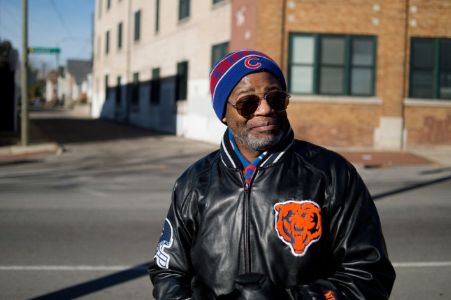
Church is many different things, but at its core deep inside me, it still is a place where people dignify each other by respecting their somebody-ness. I believe that today, and I believed it on my first day at the Roosevelt Park church in 1994. And so there I stood, before my new congregation, trying to remain dignified. I wasn’t wearing a tuxedo. Nor did I look as colorless as the portraits in the council room. I was wearing clothing that met the moment as their pastor: a colorful shirt, nice slacks, matching suspenders, and a nice tie. I was dignified. I was somebody. But those eenie-meenie-miney-moe words struck at my dignity and my somebody-ness. I wanted to scream at the congregation about what had just happened to me.
But here’s the truth: I could not afford to get angry. I could not be an angry Black man. Not if I wanted to be their pastor. Any of those other men whose pictures hung on the wall might have gotten away with getting angry, but the color of my skin made me different. I didn’t even have to consciously think about this. I just knew it. I knew I had to put on the tuxedo of dignity rather than the robe of revenge and resentment. I went on with the service and ignored my feelings. I gave my best, despite the volcanic eruption pushing towards my mouth. My Black church experience had trained me to give dignity even when the act was not returned. And my Mama’s green extension cord had trained me not to show my anger to white people.
I swallowed my anger for the sake of not only the worship service, but for the sake of the congregation and my job as the Black pastor of a predominantly white Christian Reformed Church trying to reach a multiracial neighborhood. I led the service without giving any indication my somebody-ness had taken a direct hit. After the service, I quickly ran upstairs, gathered my computer, and walked to the parsonage. This is the first time I have ever told anyone other than my wife about this incident.
I never corrected the member nor sought the person out for an apology. The stakes were that high. If I was perceived as an angry Black man, I would have no pastoral credibility. Instead of being seen as approachable, I’d be viewed as emotionally unstable. Since some members were related to each other and almost all the members were friends, I knew confronting the offender would spread quickly through the congregation and my leadership currency would drop like the stock market on a bad day.My immediate task was to unite two disparate, mostly white congregations. My long-term task was to open the doors of this new church to their non-white neighborhood. This was tough terrain, and this early encounter signaled that it was going to be even more difficult than I had imagined. Please, Lord, I prayed, could you give me a heads up before the next racial slap?
Was I calm, cool, and collected about all of this? I was not. The doubts that had filled my head before the service were multiplied. What had just happened to me? What had I gotten myself into? Had I made a grave mistake coming back to Grand Rapids? I felt like I had stepped into the ring with a heavyweight fighter and never saw his right hook coming. I walked back to the parsonage, sat in my study, and wanted to cry. Instead, I kept my feelings inside and a piece of me died, the piece that trusted since I was doing God’s work, God—and by extension God’s church—would protect me.
It was unfair. Turn the other cheek unfair. For a Black pastor like me to navigate the white world of the Christian Reformed Church required cross-cultural literacy that white ministers didn’t have to master. I remember speaking about the intense pressure I felt with the denomination’s race relations director when I was a seminary student. If I failed—not just the curriculum as a whole, but any single class—I felt Black students after me would not be treated kindly. Did any other students, besides my one African American classmate, feel the pressure I felt?
Why was the onus to prove you belong by demonstrating calm in the face of outlandish behavior always on the innocent party? It was Mr. Joyce’s classroom all over again.
In Walking with the Wind, John Lewis’s memoir of the Civil Rights movement, he recalled the training he received in non-violent resistance from his mentor, Jim Lawson: “Jim Lawson would be there, hovering over every action, pushing, prodding, teaching, cajoling. It was not enough simply to endure a beating. It was not enough to resist the urge to strike back at the assailant. That urge can’t be there. You have to do more than just not hit back. You have to have no desire to hit back. You have to love that person who’s hitting you. You’re going to love him.”
Could I possess that kind of love? The kind of love required to melt hearts filled with ignorance, hate, and fury? It sure didn’t feel that way. I sat in that big old parsonage wondering whatever had led me to believe I could find the magic solution for this church. I was Alice, who had fallen down a rabbit hole into a crazy place. I didn’t feel safe and knew I had to find a way to survive. I didn’t understand this place as much as I thought I did.
Reggie Smith’s Pastoral Memoir Roosevelt Park Rising, the fifth publication of Reformed Journal Books, will be released Tuesday, August 11. To learn more about Reggie and this book, click here.

22 Responses
I am so deeply sorry this happened to you, and I look forward to reading your book when it arrives tomorrow. We have made many grievous mistakes as white people and as stubborn Dutch people over our lifetimes and I pray we can change and do so much better at recognizing and respecting the somebody-ness of everyone in our midsts.
I am so very proud of you, Reggie.
Only one of so many other accounts in your moving memoir that I received last week and couldn’t put down. Profound thanks, Reggie, for the moving accounts of how much in our churches needs to die before the costly gift of resurrection can be welcomed.
Thanks for sharing these stories, Pastor Reggie. A powerful testimony. I look forward to your book.
You embody dignity, my friend. Always have. Always will. God bless you.
Lots of emails in the in-box on a Monday morning, and I was going to delete the one with this link. Then I saw the by-line: Reginald Smith. I thought, I know that dude. He usually has something worthwhile to say. And you did. Man, this whole piece is worth re-reading and re-reading again. Powerful, personal, instructive. I will be buying and reading your book, no doubt. Kudos, Reggie. Also, I had a chance to go to Wrigley last week. Your Cubs won in 11 innings. 🙂
Thanks for sharing your story, Pastor Reggie. Story sharing helps overcome barriers that divide us. You and Sharon are heroes to me. I look forward to reading your book.
If you could endure THAT…….. Well, I guess we should all be eager to endure so many lesser injustices with dignity and without revenge. Yours is a Philippians 2 attitude and this will be your legacy. Thanks for your leadership!
Reggie, thank you for your vulnerability to share this story and thank you for living out “somebody ness.”
I’m reminded of a message I heard years ago from church educator, Dr. John Westerhoff III, who said that when we see any person walking down the street, we also need to see the angels who are surrounding this person and heralding the news – “Make way, make way for the image of God!”
Absolutely slurped up the book, but this racist “Morher Goose” incident was the worst example of all. You handled it in a Christlike way. I was amazed at your grace and forgiveness throughout the book. Your story is phenomenal.
The book was especially interesting for me; I began my teaching career as a 14 year old vacation Bible school teacher in Lawndale and then as the first kindergarten teacher at the Potters House. I was with you all the way.
Such a powerful, painful and moving piece of writing, Pastor Reggie. I echo what others have already responded, and look forward to reading your book.
I will remember “somebodyness”.
Thank you for your ministry. I am moved – and speechless. I am going to buy your book. Thank you for sharing your story.
One other thought as your stories keep running through my mind today. I cannot imagine what it must have been like for you to face that same thoughtless fellow sitting in a pew Sunday after Sunday… Truly touched by the way you handled that encounter, and feel blessed for hearing you share it.
Thank you for this convicting account. I look forward to reading your book. Sounds like it should be required reading for skeptics and deniers of CRT, especially those who identify with the CRC. Your voice is such an important one! Thank you for a career (and future) of courageously putting yourself out there for the benefit of us all.
Thank you for sharing these personal experiences with us, Pastor Reggie. First, I was appalled by the blatant racism. Next, I was filled with admiration as I read how you handled the situations. Finally, I was inspired as I learned that you stayed at the church and built community, while knowing that with some church members, you would never be good enough. You can walk tall with your head high. Great job, Sir, and kudos to your Mom for raising an outstanding human being.
Thank you for this moving story. I’m curious if your book tells us whether and how your relationship with that fellow developed. I know my own experience was very superficial compared to yours, but I can remember how crushed I felt as a seminarian on an internship. As a Jesus freak finding my place in the RCA, I had a moderately hippie look at the time, and when greeting at the door after church, a parishioner just gruffly said to me, “Get a shave.” I later went back to that church as their pastor and kept on visiting him, and eventually he warmed up to me. But it’s not easy to love those who reject you out of the gate simply because of their stupid prejudices. Thanks for being the kind of “somebody” who loved your enemies — like Jesus.
Deeply touching, convicting, and unforgettable. And inspiring too by the Spirit’s leading you to grace as God’s image bearer.
Reggie, I was in the audience at Dordt U when you were speaking and when an audience member said some really terrible, racist things in response. I did respond to him with a bit of an edge but you responded in love. I sincerely appreciate your efforts at getting to be that way. It has been years and it has been many opportunities for you to develop this Christ like behavior. Thank you. We all need to develop it. Isn’t it sad when this comes from the CRC and CRC supported institutions.
I was so moved by this post. Thank you for showing such cruciform love to your very fallible congregation. Thank you for persevering. I plan to buy your book.
Oh, my brother! Your first Sunday in church and you have to cross an Edmund Pettis Bridge—and all by yourself. God have mercy, and thank you for never turning back. May your witness teach us all.
Thank you for sharing such a personal story. I indeed learned a great deal from it. I ordered your book and can’t wait to read it. No one has beaten me (at least not yet) but then I’m a 78, almost 79 year old, white woman. But I still would like to learn to “love” the way you describe in your story. I tend to get really angry when I read or see injustice. I have learned to say a prayer for those on the receiving end but love the giver of injustice–that’s a tall order. Thanks again.
Reggie. I can believe that man said something so unfeeling and uncaring to you. I am sorry you went through this especially right before the start of worship. I once had a white Dutch man say to me after the service in which I preached in my home church. “You’re not much if you’re not Dutch.” This is another kind of racism which I call Master Racism. Prejudice can still be found everywhere. My ancestors were Irish and when they emigrated to America were greeted with signs on job opportunities which said “Irish Need Not Apply.”