
The first paper I wrote in college was returned to me ungraded by a kindly professor who suggested I try again. This was a shock—it was for an American history class and I had excelled at American history in high school. Turns out I had a lot to learn.
I’ve been thinking about how history is told lately, especially since the Presidential administration has said the Smithsonian National Museum of American History “fails in the basic task of illuminating our heritage,” and also as I’ve worked my way through three magisterial biographies.
My high school history classes were about memorizing names and dates, which I was good at, and understanding the story of the United States as a series of victories in wars. We focused on successful generals like Washington, Grant and Lee, and Eisenhower. The prevailing wisdom about Robert E. Lee was that he was a good man and great general who, out of loyalty to his home state of Virginia, had no choice but to fight for the Confederacy. His genius was such that his army almost won the war. He was aided by other colorful generals, the most notable being Stonewall Jackson, another great American. You might think I went to high school in Mississippi, but this was Flint, Michigan, in the 1970s.
I remember my college history professor saying on one of the first days of class that we weren’t going to study wars or generals. Nor would we be expected to memorize a bunch of names and dates. The emphasis shifted from knowing what happened to understanding why things happened. I was expected to do research (hence that first paper being returned), grasp nuance, and wrestle with contradictions. For example, I was the high school history nerd who got extra credit for knowing Rutherford B. Hayes was elected President in 1876. A question on my college history midterm exam read: “Explain the significance of the 1876 election of Rutherford B. Hayes as President.” The name and date didn’t matter in a question like that. (If you are unaware of the answer to this question, click on the link and learn about it. It really is important.)
In college, I learned that several of the Founding Fathers were slaveholders and that Thomas Jefferson had fathered multiple children with a woman he enslaved. I did not believe this could possibly be true. Alas, there I was, forced (again) to do research. I learned the story of the United States was a two-steps-forward, three steps-back ongoing struggle to live up to the ideals of liberty, justice, and equality expressed in its founding documents. I learned the word “xenophobia,” learned about the death of Elijah Lovejoy and the anti-abolitionist riot in Alton, Illinois (this also is something you should be aware of), and learned about Emmet Till. I learned maybe Robert E. Lee and Stonewall Jackson weren’t such great Americans after all.
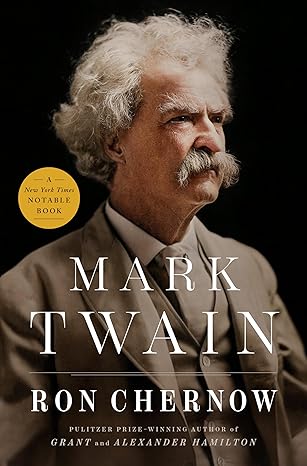
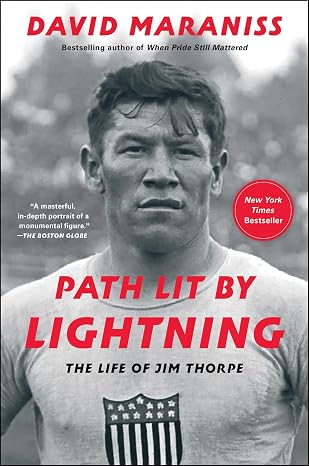
I’m still learning, trying my best to understand the history of my beloved country. This year I’ve undertaken reading three massive biographies which illuminate the American story in fascinating ways. I’ve finished Mark Twain by Ron Chernow and Frederick Douglass: Prophet of Freedom by David Blight. These days I’m well into Path Lit by Lightning: The Life of Jim Thorpe by David Maraniss. As different as their lives were, the same thread runs through all three books.
My interest in Mark Twain goes back decades—he actually ruined me as a reader many years ago. There was a time when I struggled to read other writers because they weren’t as funny or insightful as Twain. As a result, I had a “Twain-phase” and devoured most of his work. Reading Chernow’s biography, I’ve been struck with how Twain’s life mirrors America’s struggles. He was from the South, fought briefly for the Confederacy, and slowly came to realize what “all men are created equal” might possibly mean. (I saw a woman wearing a tee shirt that said “All Men Are Created Equal” the other day and felt that slogan on her meant something far different than what Thomas Jefferson had in mind.) For Twain (and Frederick Douglass), “All men are created equal” meant supporting women’s suffrage.
Twain was full of contradictions, a terrible businessman, and his family was visited frequently by tragedy. Yet Huckleberry Finn opened more eyes than a thousand sermons and essays and is arguably the greatest American novel.
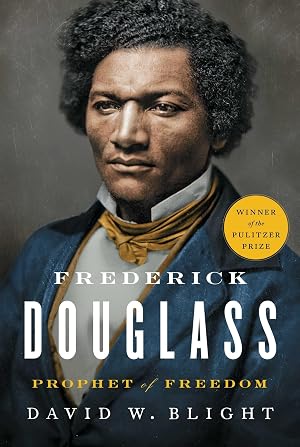
Twain’s contemporary Frederick Douglass was the embodied challenge to white supremacy. A former slave, he became a powerful orator and major political figure. He wrote three landmark autobiographies, and no less a figure than Abraham Lincoln sought Douglass out after delivering his second inaugural address (one of the greatest speeches in American history) asking Douglass what he thought, saying there was no one in the country’s whose opinion he valued more. Like Twain, Douglass endured several family tragedies. Unlike Twain, his early years involved beatings from a sadistic man bent on breaking slaves.
Like Douglass, Jim Thorpe also became the representative figure of his race in the nation’s popular imagination. His story involves the thorny legacy of the Carlisle Indian School (founded on “kill the Indian, save the man”). Thorpe was an amazing athlete who accomplished much despite racist treatment throughout his career. Not long after winning gold medals in the pentathlon and decathlon in the 1912 Olympics in Stockholm, those medals were taken from Thorpe in a hypocritical move by the International Olympic Committee (and restored in 1983, 30 years after Thorpe’s death). Despite playing major league baseball and being the first star (and president) of the National Football League, Thorpe’s later life is sad, marked by alcoholism and poverty.
So much of America’s promise and contradictions are contained in these biographies. Why not read happier stories with uplifting endings? Why dwell in negatives? Don’t I already understand that sin stains everything? These are not just hypothetical questions; they were posed to me this summer.
What can I say other than I just can’t settle? I’m not content with “what,” I want to know “why.” Among the many reasons I am deeply uncomfortable with those who refuse to tell the truth about the past is my belief that they cannot be trusted to tell the truth about the present.
Blame those woke professors I had in college. Blame God, who told Hosea to marry a prostitute (a story I was also introduced to in college). Loving America, like loving ancient Israel (or, for that matter, modern Israel) is complex. Just ask Mark Twain, Frederick Douglass, and Jim Thorpe. Blame Frederick Buechner, my literary and spiritual mentor, who said above all a preacher must tell the truth.
When the culture wars fixate on the Smithsonian, truth may be an endangered species. Read about Twain, Douglass, and Thorpe. Truth is worth striving for.

13 Responses
This sentence is what I needed to remember today: “Among the many reasons I am deeply uncomfortable with those who refuse to tell the truth about the past is my belief that they cannot be trusted to tell the truth about the present.”
Thank you for that. It’s my reminder to always strive for the truth.
Thanks for this insightful blog, Jeff. This history teachers endorses your insistence on truth, nuance, and complexity in history.
Jeff Munroe is one of my best friend’s and one of the best authors I’ve ever read. He is also a great writing coach. In the years we spent together at Western Theological Seminary I never sent out a communication that Jeff hadn’t eyeballed first! Thank you Jeff for this article and so much more!
Being almost through the Frederick Douglass biography, the ‘why’ of history is heartbreakingly told as the escaped slave becomes a man of self-taught eloquence who helps to inspire the massive struggle, only to see the country turn its back on Reconstruction as those in power forget or regret the freedoms given to all men, regardless of color. What is most striking is that we are in the midst of the same kind of attempt to roll back what has been rightfully attained; power held in the hands of the few as history repeats itself. It brings to mind the Peter, Paul and Mary song “Where Have All the Flowers Gone”: “when will they ever learn, oh when will they ever learn?”.
I appreciate the last sentence of the article: “Truth is worth striving for.” In that regard, Frederick Douglas campaigned for the freedom of African Americans, but he did not campaign for freedoms given “to all men.” He specifically refused to campaign for freedom for indigenous Americans (Indians), discounting them as lazy and unworthy of citizenship.
Asking “why”: the first step in developing critical thinking skills. Asking this simple question has got me unfriended by insecure people on Facebook!
Simply beautiful.
On the flip side, I am currently reading “Regime Change.” It, too, tells a sobering story about the American project.
Jeff, Thank you for your insightful thoughts. I increasingly now appreciate the positive effects of studying and acknowledging the negative threads of our national and cultural history.
These are all great books and one might consider listening to the free Yale online course by Professor Blight on the Civil War or his testimony at a recent Congressional hearing on the Smithsonian. History is about truths beyond the facts and is not intended to be propaganda.
As you went through your”Twain phase ” ,I am rediscovering John Steinbeck. I would suggest that your readers consider passing on the lastest best selling/everyone is talking about/soon to be on the clearance table offerings and try re-reading some of the greatest American authors. Reading GRAPES OF WRATH for the second time in 50+ years was a moving experience illustrating once more that the tragedies and sufferings of our national fabric continue in different guises with different players.
Will the Smithsonian soon have a display of how through bombing we won the war in Vietnam like we’re winning the war in Iran.
A very concerned Vietnam Vet
Thank you, Jeff. And thank you for not saying “It’s too long,” when you picked up any of the three.
…” those who refuse to tell the truth about the past cannot be trusted to tell the truth about the present.” !!!! And the mocking, dismissive tone toward the teachings of Christ just feels so disqualifying. Blasphemy disguised as patriotism. We must do the right thing for the right reason. Zero for two.
Even those of us who are not preachers strive to speak truth and your reading list is so appreciated. Thank you Jeff.
The history lessons that you are describing happened 60 years ago. It’s all different now in k-12 schools, almost the complete opposite of emphasis than what you describe. Textbooks and curriculum of today tell about the groups of people who were discriminated against almost to the point that young people are growing up ashamed of the USA and reviling our nation, discounting its outstanding contributions to a beneficial life. Would you be willing to do some research and check out a number of 4-12th grade textbooks and write a follow up article about what you’ve found?