
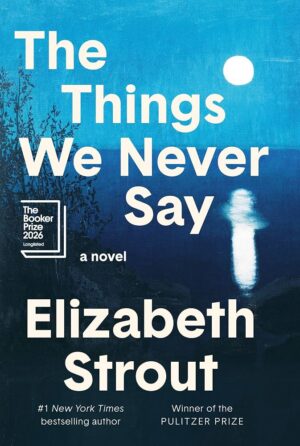
I just finished reading Elizabeth Strout’s The Things We Never Say, and it left me wondering about the things we say and the things we don’t say, and how much damage we do with either one.
How many times have I said something and wished I hadn’t? Too many. Complaints. Retorts. Angry words. Sarcasm. Telling secrets. I can come up with examples of all of these from my life. You probably can as well.
And then there are the times when I should have spoken up. Someone needed encouragement, and I was too self-absorbed to realize it until later. Someone needed an advocate, but I was too threatened to be the one to step up and speak. Comfort. Praise. Wisdom. Advice. Confession. Again, it doesn’t take much to recall moments when I have regretted keeping my mouth shut.
Strout’s book is about a teacher in his mid-fifties who lives a comfortable life. He and his wife have one child, a son, whom they both love deeply, who is struggling with a marriage that seems to be falling apart. For the most part, the main character is satisfied with his life. He loves his wife and he loves his students. But there is a part of him that is inexplicably sad as well, a mystery even to himself.
Then one day he is shaken when he learns a big secret about his own marriage. He debates whether to speak to his wife about it, but keeps hesitating, not wanting to do more harm than good by confronting her. Meanwhile, he discovers that his son’s new girlfriend has stolen a knickknack from their house. Should he tell his son? He catches a student doing something seriously wrong and wonders whether to report him. And finally he discovers that his new best friend, with whom he has never talked politics, is a Trump supporter, much to his dismay. Should he try to talk about it with his friend?
The reader is torn by whether or not to hope for some revelations to come about. I will not spoil the story by telling what is said and unsaid. But it makes one think about choices we make when we speak. In the book, the main character finds himself and his relationships both protected and damaged by some of the things he doesn’t say.
All of this sent me to scripture to glean some wisdom about what we say and don’t say. Here are a few gems:
- James 1:19 admonishes us to be quick to listen and slow to speak.
- Proverbs 10:19 asserts that when words are many, sin is hard to avoid.
- Colossians 4:6 urges us to let our speech be gracious.
- Ephesians 4:29 encourages us to use our speech to build others up.
- And of course, Ecclesiastes 3:7 is the famous “a time to be silent and a time to speak” reminder.
So where does this leave us?
I can remember one time in high school when I spoke up against someone who was about to do something very cruel. I found myself treated with disdain and venom. Still, when I look back on my less-than-stellar high school career, that moment is one of the few times when I felt like congratulating myself.
It seems to come down to what Proverbs preaches so frequently. The wise person thinks before speaking.
When I finished Strout’s lovely book, I was not sure the main character had always made good choices. But I trusted his goodness as he struggled to discern the course his life would take depending on what he said or didn’t say. Perhaps that is the best we can do, too.
Header photo by Kristina Flour on Unsplash

6 Responses
I love Strout’s writing, and I identify with your wrestling here. Thank you for sharing it here.
Thanks so much for this! I just finished The Things We Never Say and loved it. Your focus on the scriptural balance between honest truth telling and grace-filled speech is a powerful way to think through these issues
The difficulty with what you are talking about is we almost never know the answer until we act one way or the other, and then, we still might not know.
Slowing down and thinking/praying/seeking counsel from a trusted mentor feels like the first steps of the scripture texts you reference, but sometimes you just do the best you can with what you believe is right.
Thanks for your writing this morning.
Thank you, Nancy, for introducing us to Strout’s book that makes us rethink the challenge of taming our tongue to speak when we should and to keep silent when it’s wise to do so. The Lord helping us, we pray – in this stressful time of stressful tensions.
There is a cruelty in being kind, a cruelty in failing to lovingly hold another to account for harmful behavior. It is a difficult skill to acquire, but withholding a loving challenge denies one the opportunity to grow and transform. Our culture does not value or encourage this kind of truth telling.
I love all of Strout’s books and especially the Olive Kittridge character.