
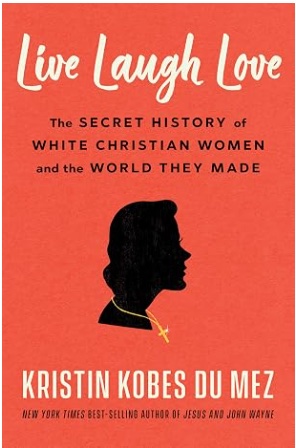
One of my 2026 Summer Beach Reads was an advanced reader copy of Kristin Kobes DuMez’s Live Laugh Love: The Secret History of White Christian Women and the World They Have Made. Live Laugh Love is DuMez’s highly anticipated follow-up book to Jesus and John Wayne (2021). Where Jesus and John Wayne focused on Christian evangelical masculinity and the rise of Christian Nationalism in America, her newest book, releasing on September 15, turns readers’ attention toward the feminine with a historic look at White Christian evangelical women and the world they have curated. The book is not an easy, breezy summer beach read in any way. Still, because of the way the book expanded my understanding of how I have been shaped, formed, and even manipulated at times as a White Christian woman in America, I’m giving this book a “must-read, 5-star rating” in this summer’s book list journal I’ve been keeping.
The book is divided into three eras of history: Part 1 examines the 1800’s-1950’s, Part 2 considers the 1950’s-2000’s, and Part 3 is about the 2000’s up the present. Each of the three parts of this book offers a comprehensive and well-researched perspective on how the lives and faith of Christian women have developed and evolved throughout history. The book introduces the reader to many people, both female and male, who have influenced the culture of White Christian women through their writing, preaching, and discipleship tactics. Familiar names like Dwight Moody, Norman Vincent Peale, Oral Roberts, Elizabeth Elliott, Amy Grant, Doug Wilson, Jen Hatmaker, and Erika Kirk are part of this history. Additionally, people whose names and stories were new to me, such as Hannah Whitall Smith, Henrietta Mears, Helen Andelin, Mary Crowley, Lonnie Frisbee, Paula White, David Green, and Allie Beth Stuckey, were also included because each had a critical place in the story of the Christian culture of White, evangelical women.
Much of this history for White Christian women has roots in Christian perfectionism and holiness theology that can trace its beginnings to a book written in the late 1800’s by Hannah Whitall Smith entitled The Christian’s Secret of a Happy Life. Smith’s own life was challenging due to the loss of several of her children at young ages and because of the difficulties of a challenging marriage yet, heavily influenced by Methodist perfectionism, Quaker inner light, and holiness theology, Smith wrote in her book about how no matter the challenging circumstances that may come in life, the Christian life is one of happiness and success when–specifically for women–it is achieved through “sweetness and subordination” (p. 33). These beginnings of “sweetness and subordination” from Smith’s book are the precursors to the White Christian woman’s world today of Hallmark movies, Hobby Lobby, and HGTV home aspirations. The book covers a vast amount of history that includes the influence of Mormonism in evangelical Christianity, the role of Christian publishing houses over the centuries, direct sales companies like Amway, Tupperware, and MaryKay Cosmetics using the power of positive Christian thought and holiness theology to hook distributors, and the influence of books like the Little House on the Prairie series and Amish Christian fiction to perpetuate women’s traditional roles in the home and family. DuMez’s book takes the reader on a thorough and fascinating exploration of this history, tracing Hannah Whitall Smith’s book and its evolving influence through time even as it showed up at Turning Point USA’s 2025 Women’s Leadership Summit.
On that note, sadly, I am confident there will be several people who will read the first paragraph of the introduction to Live Laugh Love who will not continue reading, as Kristin Kobes Dumez gets right to the heart of the matter with quotes from Erika Kirk’s at her husband’s televised funeral three days after he was killed on September 10, 2025. Some people will close their minds to what this book has to say at the mention of the Kirks by immediately assuming the book’s message without considering how the rest of the book may teach, reveal, or inspire them to live differently as Christians in this world. My encouragement is to approach this book Ted Lasso style, with curiosity instead of judgment. This book is for everyone regardless of gender, political leanings, denominational affiliation, or stage of life; there is something in Live Laugh Love for all of us to learn. We are all part of shaping the future for White women of faith, and if we are willing to take a good, hard look at the past, I am hopeful that the future could be one where more and more women are thriving, safe, and leading with confidence and joy in our churches and communities.
Two things to consider before reading Live Laugh Love. First, it may be helpful to read with a pencil in hand. I found myself taking notes and making connections to previous chapters and to current events we are seeing in our newsfeeds. There are also a lot of names to keep straight, and I made a list inside the book cover as I encountered them, finding it really helpful to have a reference of the names and some dates handy along the way. Secondly, Du Mez does not offer too much of her own commentary and takeaways for us as readers. I think this is intentional on her part as a historian, writing about the stories and names and connections that she has discovered in her research, and then giving us the space to digest and think about our own lives and the women in our faith communities today and how we might take this knowledge into the world in wise and discerning ways to help shift and reshape the world of White Christian women into a healthier and flourishing future for everyone. Live Laugh Love would be a great selection for a book club or a church reading group to work through and discuss together.
I’m off to the beach for my next summer read: a New York Times best-selling fiction book about, ironically enough, a ‘trad-wife.’

4 Responses
This is the best book review I have ever read. Factual, helpful, and making me eager to immediately go grab the new release off the shelf. Thank you for your thoughtfulness and care in writing this, I cannot wait to read DuMez’s important new work.
Thanks for reviewing this important book, Michelle. LLL is excellent and well-written on its own merits, but I agree that it is best read in community so the discussions can go beyond the history.
Michelle, this is a terrific review of an important book, you really hooked me with the Ted Lasso reference: I am fully curious to read this now. Thanks!
I can’t wait to read it. Our church has planned an adult Sunday school class around it and I’ve put it on our book group list for 2027.