
In the meeting room at my office, we have a large framed map of Canada hanging on the wall. The map has no mention of borders, provinces, territories, or even major cities, but even so it is densely packed with place names – the ones given to the landmarks and the waters by the Indigenous peoples whose home this was for thousands of years before European colonists arrived.
Place names are listed in their original language and with an English translation, and an explanatory note in the map’s margin says that the names it contains “are instructive signage along land and water routes. They tell how to walk on the ice there, or which direction is wrong, or where the eggs and berries are. They connect to each other in stories.”
On the west coast of Canada, there’s a Quw’utsun writer and educator named Jared Qwustenuxun Williams who would agree with this idea of place names as markers of learning and stories. I’ve been following Jared on social media for a while, where he posts about the Hul’q’umi’num language of his people, and he shared a video a few months back about naming places.
It’s always kind of interesting to me that during early colonization, there was this idea of the new arrivals to rename places,” he says. “Where I am right now, Vancouver – what do you know about Vancouver from the name? Not much. It was named after some old white guy who was here for a couple weeks, maybe a couple years, and then left… A lot of colonial names are the names of individuals, but you don’t learn nothing… There’s this space off of Salt Spring Island named Long Harbor, and Hul’q’umi’num name is Stsa’tx, or Halibut. Wonder what we were doing there? Our names help us learn to live on the land. Western names just help you learn who was here first. Or at least, first in their mind, anyway.
Changing the name of a place is a rupture in the story. My own city is Kingston, literally “King’s Town”, so named by British Loyalists in the 1780s in a rush of patriotic sentiment towards King George III, who notably never set foot in Canada at all, let alone Kingston. Up until then, the area had been known as Ka’taroh:kwi, a Haudenosaunee name meaning “place where clay gets taken out of the water”.
As I have looked at the hints of all the stories told (and ruptured) across that map on our office wall, I’ve wondered what must it have felt like to the Indigenous people to have someone from outside, with no connection to local place or story, just say something like, “Actually no, from now on this place isn’t called that, it’s called This. Look, we changed the writing on this map, so it’s true.”
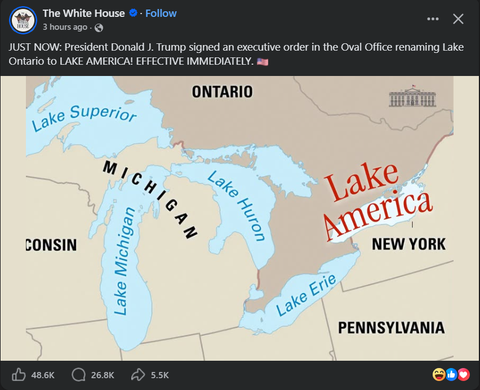
And then, this week, someone tried to do just that, and I have been able to experience the shock and disgust of being on the receiving end. Less than half a kilometre south of where I’m writing right now is a body of water that Donald Trump has now proclaimed is no longer called Lake Ontario, but Lake America.
But why?
President Trump was asked about his message to Canada as he signed the Executive Order to change the name. “No message,” he said, but then added a message. “Canada has been ripping us off for a long time in trade, very sadly… We can’t let the whole Canadian thing, it’s been going on for decades, and it has to come to a stop… If you think about it, we have a gulf, and we have a lake, and now all we need is an ocean. So maybe we’ll have to change the name of the Atlantic and/or the Pacific. Maybe we’ll need to change them both.”
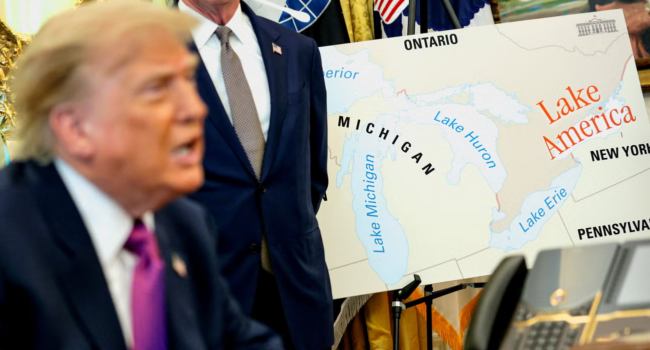
There are some who downplay this. “Oh, that’s all talk, it doesn’t mean anything.” (Or more annoyingly, “It’s just a joke.”) But in truth, the act of dictating that rupture is, in and of itself, a strong colonizing act. It’s not as tangible of an act as forcible relocation or physical occupation, but it’s absolutely a power move to tell someone, “No, this isn’t where you are; this isn’t the name of your place. It’s called what I say it’s called.”
Afterward, the response becomes a barometer of submission. Those who acquiesce are acknowledging a level of power that the colonizer has to rename our home and redefine our story of place. And we look around to see who among us will bow their head and agree. Google Maps didn’t take long to bow. To the dictator of the name change, evidence of who in the room obeys is just as important as the symbolic act of renaming.
The connection between power dynamics, place-names, and language is far from trivial. The rupture of a colonizing act changes a place’s story from a description of life on the land to a story of survival against opposition, and I’m sure that while a White woman like me might be feeling shocked by the current news cycle, this story is the “same-old same-old” for Indigenous language preservers like Jared Qwustenuxun Williams.
Not all Indigenous names disappeared from our everyday maps; many did survive colonizer language purges. Ontario is one of them. Oniatarí:io is a Wendat word (from the same linguistic family as the Mohawk language of the Haudenosaunee) meaning something like “beautiful, sparkling lake.” As someone who lives on the shores of this lake, I can confirm that this description is true.
There’s pushback to the Trumpian audacity, of course. Prime Minister Carney stated, “We know that America is changing. Their trading relationships, their foreign policies, their national monuments, their hydronyms. Canadians also know that naming reality means calling it Lake Ontario — then, now and always.”
I appreciated that in his not-bowing to the power move, he acknowledged that this was an attempt to shift reality, and that he isn’t having any of it.
And amidst the talk and the power moves and names and the stories, Jared’s advice in that video resonates. ‘When you’re in a place and you can learn the Indigenous names of the land, learn them. You’ll learn where you are.” And when we know where we are, we have a deeper connection to who we are, and the stories that connect us.
In a few minutes, I’ll drive along the edge of the lake and take a moment to appreciate the view. Beautiful and sparkling. Oniatarí:io.
10 Responses
Most excellent. Wonderful perspective on the whole thing.
Thank you for pointing out the importance of name. As a proud Michigander, I live in Ottawa County, named after the Indians who inhabited this region, just south of Muskegon, mashkigong, which means “marshy river”, and at the mouth of the Grand River, again an Ottawa name, owashtenong, which means “far-flowing water”. What our emporer with no clothes can’t grasp is that the name doesn’t belong to him and that monuments were almost never built by those who bear their names; they were built much later in honor of the memory of a good person. Hopefully in the future all of these names will go back to their rightful owners, the self-built monuments will be erased, and the shame on our nation will fade.
What an excellent explanation of the moral bankruptcy of recent…architectural redesigns. “[These] monuments were almost never built by those who bear their names; they were built much later in honor of the memory of a good person.” Excellent point that bears repeating–and I shall.
Kathryn,
Thank you for bringing thoughtfulness to such a thoughtless notion and act. I can’t help but wonder how the Wendat would translate “little man who thinks he’s king.”
Thank you Kathryn. So sad, so embarrassing!
Thank you, Kathryn. It is so helpful to hear from a Canadian point of view. I have deleted Google Maps from my devices. 😊 It’s just a small act of protest, but important, I think. We live in Iowa, named after the Ioway tribe. I appreciate the way Canadians refer to their indigenous peoples as First Nation groups. Please remind your/our Canadian friends that not all Americans are like our petulant, petty, narcissistic, excuse for a leader.
This is great. It did get me thinking about seeing this happen in the Bible. Abraham and Jacob and even Hagar named some places, which may have been different from the names given by natives, in order to remember what God had done, and sometimes to stake a claim on something. The Canaanites were likely unimpressed. I also thought of how so many places and people had a multitude of names in Tolkien’s The Lord of the Rings, depending on if it was a name from an elvish, dwarfish or human language. There can be room for more than one name. But I agree concerning Trump’s renaming efforts. it’s like him trying to rewrite history all the time too.
Thank you, Kathryn! I share your indignation and resistanc.
Thank you for this. I have been appreciative of more places being given their original indigenous name or bridges being named using indigenous names. I also just noticed that when you are in Canada, Google and Apple Maps both show only Lake Ontario. Yesterday it had Lake America in parentheses. The US can call it whatever they want though I believe New York has said it will continue to use Lake Ontario as the name.
Thank you ! ….for your instinctive resistance to wrongdoing AND for your diligent research in response.