

Every Reformed Church in America (RCA) minister knows the annoying occurrence of a blue squiggly line that appears every time we type the word “classis.” Word, Google Docs, Pages—no matter the software—all of them cannot fathom a word like “classis,” even after you “add it to the dictionary.”
The classis is an assembly and judicatory consisting of all the enrolled ministers of that body, commissioned pastors serving under a commission approved by the classis, and the elder delegates who represent all the local and organizing churches within its bounds. The classis is a permanent, continuing body which functions between stated sessions through committees. – RCA Book of Church Order (BCO), Chapter 1, Part II, Article 1, (2025 edition, p.27.)
Oddly, this annoyance may become a kind of nostalgia in the years to come as many will miss the classis and what it has meant ecclesiologically, collegially, and personally. I suspect there’s also a sense that the word “classis” just feels more church-like than what it’s being replaced with: the “middle assembly.” (For an interesting read and some insight into the restructuring of the RCA, check out this recent article from the Regional Synod executives: “What You Should Know About the Restructuring Process”)
I, for one, find the term “middle assembly” austerely sufficient. It’s an accurate term for what this body will be within the government of the RCA, as the consistory and general synod sit on either side of it. However, what I’ll miss most about the word classis is that it carries a metaphor within it:
Common parlance derives the word “classis” from the same Latin word that means “fleet” (or, if you will “army”) and goes on to describe the classis as a fleet of ships. Allan J. Janssen, Constitutional Theology: Notes on the Book of Church Order of the Reformed Church in America, 2nd ed. (Historical Series of the Reformed Church in America, 2019), 104.
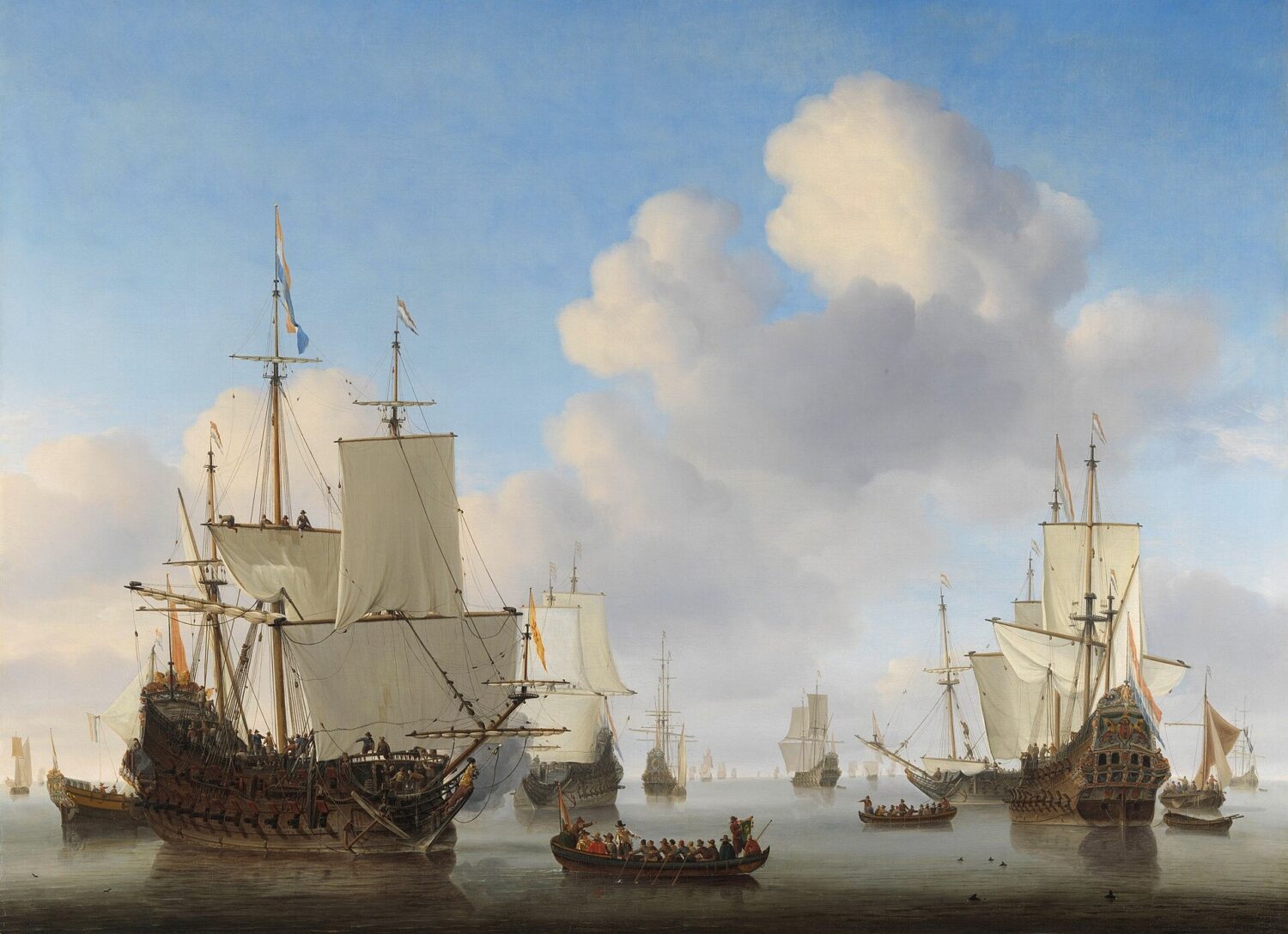
Although the metaphor does not map onto the classis completely accurately, nor do I care for the colonial and militaristic overtones, there’s something powerful in essentially saying, “Whatever this classis-thing is, we’re like a ‘fleet of ships’ sailing together.”
I chuckle at the thought of how many classis presidents’ reports have probably waxed eloquent about this “fleet of ships” metaphor while connecting it to biblical maritime imagery. But then again, who can blame them? It’s a dang good metaphor! It’s good because it generates an imagination of a shared identity and common purpose: In ministry, we’re sailing together.
And that’s why I’ll miss it, but it’s also why I want to suggest a new metaphor for middle assembly, which seems to be lacking a generative metaphor. That metaphor is Swiss cantons. In effect, I’m suggesting that, “whatever this middle-assembly-thing is, we’re like ‘Swiss cantons’ unified and living together.”
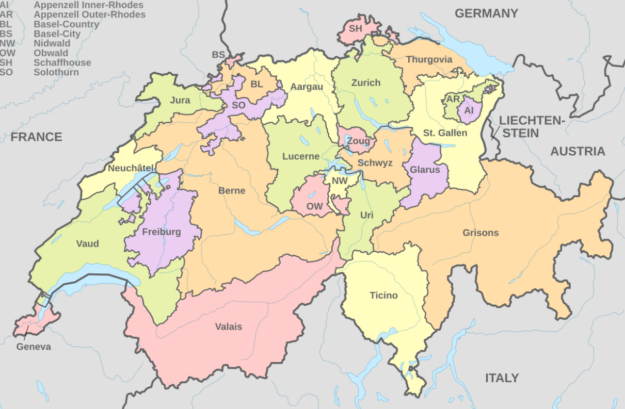
So, what is this canton thing? Switzerland is largely organized in three groupings: 2,110 communes, 26 cantons, and federal confederation. Communes are the most particular grouping and the federal system is the broadest, but cantons draw together communes into a shared identity and purpose. Cantons inhabit the middle between these other two groupings.
Here are two major reasons why I think Swiss cantons offer such a fitting and generative metaphor for understanding the middle assembly:
- Cantons are distinct in geography and identity – The 26 Swiss cantons each have a unique geography that is also linked to a historical and cultural shared identity. Besides being geographically different, cantons speak different languages from one another, have different economies, and even organize differently from one another. Some cantons are not even internally contiguous but have geographical “enclaves” and “exclaves” in different parts of the country. Additionally, even though they can be geographically large, how cantons “live together” is all done on a much smaller, more intimate scale than a US state or Canadian province. Some cantons still vote by raising your hand!
This maps well onto how the 24–25 middle assemblies seem to be emerging in the RCA. Each has its own distinct geography, theological emphases, and organizational practices. Some are not even internally contiguous, and others will intentionally cross linguistic and organize around cultural, ethnic, and racial identities.
I also think the metaphor of cantons can help settle, or at least nuance, a debate that’s been happening for a number of years in the RCA. It is the debate over whether middle assemblies should be organized by geography or identity. Cantons show that it can be both geography and identity, and maybe it should be both. - Cantons are the main seat of political power while also being catalysts for regional life – In the Swiss federal system, cantons are responsible for the lion’s share of political governance: education, healthcare, law enforcement, social welfare, even much or most of infrastructure. Because of this and that they are intimately organized around geography and identity, cantons cultivate a shared life within their bounds, forming identities that are deeply woven into the wider Swiss identity.
This, too, seems to map well onto middle assemblies and the deep, underlying ecclesiological assumptions of the RCA, namely that power—and the responsibilities that come with it—is more localized. In the RCA, the Constitution assumes and spells out that the majority of discretion and responsibility should mostly reside in the middle assembly, and because of this, middle assemblies can cultivate a shared life within their bounds, forming distinct identities that are still part of the larger identity of the RCA, much like how cantons operate in their wider Swiss federal system.
Besides mapping onto middle assemblies well, I also think that working with this metaphor of cantons can also generate different, helpful conversations. For instance:
- How could the General Synod Council be organized, could it be like the Swiss Federal Council? What implications would such a reorganization have for the role of a General Secretary?
- How could middle assemblies relate and collaborate with one another or even other denominational bodies? Could “horizontal federalism” be a concept we embrace and champion?
Perhaps, then, if the metaphor of classis as a fleet of ships sailing together helped us imagine our life together, then the metaphor of the canton might help us imagine our new life together: one organized around both geography and identity, living out the RCA’s distinctive commitment to local discretion, all while remaining connected to the wider whole.
As this is a suggestion, I would encourage you to share your thoughts!
Also, if you have a better generative metaphor, please do share!

7 Responses
This is thoughtful and very interesting, Trey. I really enjoyed reading it.
You are on to something. You ask about what it means for the General Secretary? Indeed. Can anyone name the Prime Minister of Switzerland? I doubt it. I don’t know if there even is one. It was only in the last four decades that Ed Mulder’s ideal of the General Secretary as the “visionary leader” of the denomination was introduced, precisely because he wanted to correct the variety of visions and diversity of loyalties. But the RCA had long been speaking, a la Switzerland, in at least two languages: the Eastern language of inclusion and the Midwestern language of purity. RCA leaders had be bilingual, so to speak.
As always Daniel, you accurately name the tendencies within the RCA.
Interesting name idea. The biggest challenge for the western part of the RCA is that middle assemblies are so geographically large that we can be days’ journeys from each other, which means that the lion’s share of togetherness will happen via Zoom. Something human gets lost. Switzerland is minuscule compared to our middle assembly, which I believe will run from Washington state to Minnesota to Texas. By the way, I did chuckle about the picture of Dutch ships accompanying this article because they did not look at all like they were sailing together at all, but sitting still all pointing in a different direction.
With all due respect to Al Janssen (at least he hedges it) and Howard Hageman and many others, the word “classis” means a fleet of ships no more or less than it means a group of churches. The Latin word simply means an identifiable group, like a class of students, a class of birds, a class of soldiers, a class of ships, a class of churches.
I should perhaps think this through more carefully but it seems to me that Mert De Velder and Arie Brouwer exercised a great deal of visionary leadership without actually having that in their job description. Much more than the last two GS. Or perhaps I don’t agree with the direction of their vision …
Yes, they did, Lynn, i think you’re right, despite it not being the heart of their job description, as Ed Mulder determined it should be.