
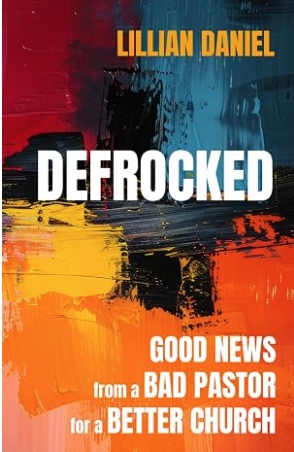
Lillian Daniel is an author many of you likely know—and, given her writing style, perhaps have an opinion about both her content and her delivery. It seems like a lot of people do.
That might be because of her first big seller, This Odd and Wondrous Calling, the intimate, insightful description of ministry and the church written with—or perhaps, more accurately, alongside—Martin B. Copenhaver. It became a kind of textbook both for aspiring clergy and for those already in service who were in search of renewal.
Or perhaps you’re more familiar with her apologetic for the church, When Spiritual but Not Religious Is Not Enough, and its follow-up, Tired of Apologizing for a Church I Don’t Belong To. Her writing style is captured by an early question: “Now, can I vent for a minute?” From there, the venting continues for most of two full books. Daniel’s writing has been described variously as a bit caustic, a lot funny, ribald, wise, biting, hilarious, tiptoeing to the edge of sarcasm, cynical, and full of love and unflinching hope. Say what you want about Lillian Daniel’s writing style and content—and many have said much, including those who count her as a true rock star of the progressive church and others who see her as condescending and patronizing—you’re rarely unclear about what she really thinks.
Enter Defrocked: Good News from a Bad Pastor for a Better Church, her first book in nearly a decade, a memoir of sorts framed by a marketing blurb straight out of a James Patterson thriller: “Pastor Lillian Daniel crossed a line that threatened to cost her everything.” Spoiler: she lived to write about it.
Getting from “harrowing ecclesiastical exile to eventual restoration” invites us into a most familiar setting for Daniel: the church, in all its sacredness and mortality. She continues here her deep love for the church and her forthright assessment of its failures: “the worst and the best of us,” she writes, whose reality truly is treasure in earthen vessels.
At its core, Defrocked is an honest portrayal of the struggle, emotion, anger, insight, betrayal, disappointment and renewal encased in a nearly year-long denominational disciplinary and suspension procedure—or, as she puts it, having fallen “into the ditch,” like the man left and ignored on the side of the road in the parable of the Good Samaritan. (You can buy the book if you need to know the specific nature of her transgression, one which she admits from the beginning.) Daniel’s theological appeal to repentance, renewal, and grace is heartfelt and authentic. You might call it a sympathetic journey, despite its reason for existence.
Less sympathetic is how she describes the experience of being investigated by the church—how, she argues from her place and perspective in the process, the processes and restrictions put in place to protect victims often punish everyone in the system, leaving broken people and murky outcomes in their wake. Like the memoir portions of the book, this part of the narrative—and, to be clear, it’s all interwoven into a single cloth—uses the same single perspective: her own. The result? A description of a process and those who led it that she said was written “as generally and as charitably as possible,” while at the same time being liberally infused with an unsparing assessment of the mistakes and injustices she perceived were done to her by these intentionally unnamed bureaucrats and volunteers.
Did her denomination carry out the process well? Should one-size-fits-all isolation apply to both the secret predator and the self-repentant misstepper alike? Have we designed these processes for restoration, not just isolation and punishment? Those are good questions. They are not ones this book can answer, if only because just one side gets to weigh in. Having been on the other side, charged by my denomination to carry out its rules to the best of my ability, I don’t find her critique quite so straightforward.
Perhaps that’s my own defensiveness to deal with. For in emphasizing compassion, repentance, and the spiritual work it takes to relate to those who stumble, Daniel paints a compelling image: that the ditch is the place to which the gospel can speak deeply, where the God we have always been dependent on comes to find us. And it’s in that ditch, and in the coming out from the ditch, where she imagines the building of a better church–and, perhaps ironically, now as a conference minister in the United Church of Christ.
The challenge, of course, is that this space between promise and practice—I guess the ditch is as good an image as any—will always be a human space, fraught, fractured, and imperfect. Our call and challenge seem not to sanctify what is, nor abandon it for what isn’t, but to continue to work for what it has always been meant to become. It’s work that belongs to people willing to love their church fiercely enough to cherish it, honestly enough to tell it the truth, and without ever asking it to be what only God can be.

One Response
My first thought is that the review is better than the book! My second thought as well. Not that I’ve read the book, and remembering how it all went down, and how disgusted I was by these rock stars behaving badly, I’m not thinking I want to (why not just watch TV), but I am smitten by this powerful review.