
The writer Annie Dillard died earlier this week at 81. To mark her passing, we dip today into the RJ past to offer a slightly edited version of a Journal “As We See It” that took early notice of this stunning new talent who became an inspiration to a generation of readers and writers interested in spirituality, nature, and the art of writing itself.The editorial appeared originally in the issue for May/June, 1974.* Pilgrim at Tinker Creek won the Pulitzer for General Fiction in 1975. Annie Dillard was 28.
The other evening, as I drove in silence alone on the expressway just outside the city where I live, I saw something I’ve wanted to see for about as long as I can remember. In the dusk over the road ahead a large hawk suddenly crossed into full view in the middle of one of those awesome, gyroscopically controlled dives that usually mean quick death for some small animal below. I hadn’t seen the hawk coming, and I don’t know whether it got what it was after as it dropped into the field on my right. Expressways don’t allow you to stop for things like that. But there for a few seconds I had my picture—a routine event in the perpetual balancing of nature and yet a moment of breathtaking power and beauty.

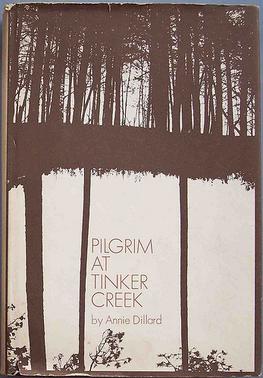
Small events like this are treated with seriousness and sensitivity in a new book I’ve been reading entitled Pilgrim at Tinker Creek. The author is Annie Dillard, a young woman educated in both literature and theology, who has written down one year’s observation of nature around her home beside Tinker Creek in the Blue Ridge Mountains of Virginia.
The tenacity with which she pursues her observation is astonishing—whether she is after the elusive “green ray” to be seen on rare occasions rising “from the sun like a spurting fountain at the moment of sunset,” or quietly and persistently stalking muskrats. The pursuit yields staggering detail and unforgettable pictures—some of them full of microcosmic horror. Ms. Dillard is no sentimentalist. We are shown a certain kind of giant water bug that can fasten itself under water to the underside of a frog, quickly inject it with a poison so corrosive that it dissolves the insides into a liquid, and then suck the frog down to a shrunken bag.
Ms. Dillard is less a naturalist than a visionary. What glows and blazes throughout her book is her wonder at the intricacies and extravagances of nature. “That there are so many details seems to be the most important and visible fact about the universe.” Ultimately her vision becomes religious and points to mystery and yet to meaning and purpose within and beyond the facts. Nature is more than “random combinations of matter,” and in its glorious fecundity “there seems to be such a thing as beauty’s grace wholly gratuitous.” The universe was made in “solemn incomprehensible earnest. By a power secret, and holy, and fleet.”
Moreover, creation is an ongoing event. “After the one extravagant gesture of creation in the first place, the universe has continued to deal exclusively in extravagances, flinging intricacies and colossi down aeons of emptiness, heaping profusions on profligacies with ever-fresh vigor.”
What we’ve got to do is keep our eyes and ears open. “Beauty and grace are performed whether or not we will or sense them. The least we can do is try to be there.”
Pilgrim at Tinker Creek says nothing about our lives as political and social beings. It happened that I saw my hawk immediately after I had attended a conference on Christianity and politics. Scarcely anyone, I am sure, left that conference without being challenged to engage our clamoring and noisy social and political responsibilities. That “no man is an island” is at the center of the Christian message. Yet, I am impressed that the same Thomas Merton who wrote a book under this title also devoted the final section of that book to reflections on silence.
“A man who loves God necessarily loves silence also,” says Merton,”because he fears to lose his sense of discernment. He fears the noise that takes the sharp edge off every experience of reality.” Silence is our defense against muzak and the jaded senses of the complacent life. Silence is also our stay against cant, against the oversimplifications of the shrill pamphlet, the catch phrase, the slogan, and the bumpersticker. It helps to keep our thinking and our language vital. It helps us to see our place in God’s universe. It measures our causes against those ultimate concerns that ought to determine them. And… it can expose us to those sudden and unexpected thrusts of beauty, and power, and grace.
Summertime and approaching vacation seems an appropriate time to be reminded of those moments of “grace wholly gratuitous” that are available to anyone willing to pursue the silences of nature—to “go up into the gaps,” as Ms. Dillard says, echoing the prophet Ezekiel—or even to someone driving with his eyes open and his radio off in the relative quiet of the countryside just beyond the city limits.
*Copyright 1974, William B. Eerdmans Publishing Company
