
In my last post, I suggested a new metaphor for imagining the Reformed Church in America’s emerging middle assemblies: Swiss cantons. In this post, I’ll suggest an analogy for the church’s current state and future work.
The first time I drove through the City of Highland Park, Michigan, a city entirely surrounded by the City of Detroit. I was stunned by the fact that the roads didn’t have any painted lines. There wasn’t road construction in the area, nor were they resurfacing the road. No: The city simply didn’t have the money to paint the roads.
On other visits, my now-husband, Cameron, who grew up in a suburb of Detroit, drove me through other parts of Detroit proper. I got to see old, dilapidated automobile factories and schools that stood mostly boarded up. But what stays with me most is turning down streets lined with dozens and dozens of genuinely beautiful homes, but only a handful were still inhabited.
I couldn’t help but feel a heavy weight of sadness in my chest. All those houses had once been homes, and now most of them sat empty, slowly falling apart—deteriorating monuments to what used to be: a world that is no longer a reality.
To be honest, as a kid who grew up in Hawai‘i and was living in West Michigan, these outings to Southeast Michigan seemed to only confirm what I had already heard in the media and around life’s “water coolers”: Detroit is nothing but ruin and danger—nothing but blight.
Of course, what wasn’t said, but was unmistakably embedded in those narratives, was a judgment about the people of Detroit. Talk of “blight” was not only shorthand for abandoned buildings and empty streets; it also assigned a simple story of shame, failure, and deficiency to the people who lived among this “blight.” It’s right to note that those who live in Detroit are mostly Black, Muslim, or poor immigrants—easy targets for White folks to turn our noses up at.
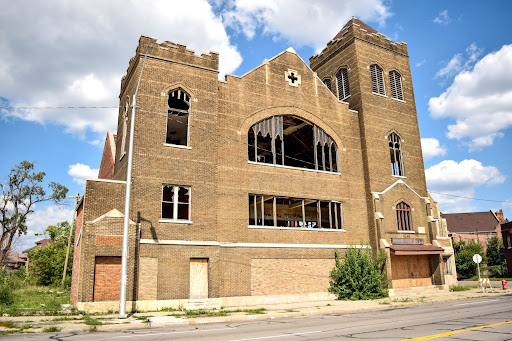
In many ways, I think this is how Christian leaders can experience church properties and the internal workings of congregations. So often we walk through buildings that are falling apart, encounter programs that have lost their vitality, and inherit ministries that have become little more than sentimental monuments to what used to be: a world that is no longer a reality. It can become easy to look at these things and simply imagine churches as places of “nothing but blight.”
We, of course, call this “church blight” by other names: stagnation, decline, dying. But, like the blight-talk of Detroit, we church leaders can also inadvertently assign a simple story of shame, failure, and deficiency to the people who inhabit these churches. We can carelessly question congregants’ ability to imagine and implement change. We might even question their faithfulness. And lamentably, some congregants believe this simple, shameful story, too.
Unfortunately, that simple story of shame, failure, and deficiency—whether about Detroit or the church—is not only incomplete, it’s simply just wrong, and almost always unhelpful. How do I know? Because I had a good, local “pastor” to show me otherwise: Cameron.

You see, Cameron wasn’t just taking me around Detroit for weird, bleak sightseeing adventures. He was showing me places and neighborhoods he had come to know and love while working at a local Detroit nonprofit and the Michigan Department of Transportation. Like a good pastor, Cameron—whether he knew it or not—was challenging my simple, shameful story about Detroit and its residents.
What I didn’t know was that blight—or maybe a better term, systemic vacancy—had taken hold mostly due to realities outside of the control of the city’s inhabitants: the unfettered capitalistic pursuit of profit over people and place (deindustrialization), white flight, historical discriminatory housing policies, and decades of disinvestment in a place and its good governance.
Detroit is, in many ways, a living testament of the Republican and Democratic economic policy consensus of the 1980’s, 90’s, and 2000’s. This might be why MAGA and leftists of Southeast Michigan agree on more than you might expect. You simply can’t ignore the reality that people in cities like Detroit were screwed by this economic policy consensus, and “more of the same” from either party seems like insanity to Detroiters. Politics that ignores this does the same thing that “blight-talk” was doing.
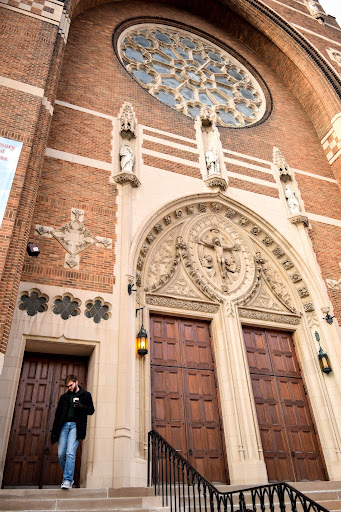
This idea of “realities outside of their control” is almost pound-for-pound the argument Notre Dame sociologist Christian Smith makes about American religion and its “decline.” Smith argues in his book, Why Religion Went Obsolete: The Demise of Traditional Faith in America, that, through a confluence of social factors, traditional religion in America has become “obsolete,” which, I would argue, is what we are seeing when we encounter “church blight.” Smith says:
Traditional American religion has become obsolete among younger generations and, increasingly, older ones. Something becomes obsolete when most people feel it is no longer useful or needed because something else has superseded it in function, efficiency, value, or interest.
Smith is careful to clarify what he means by “obsolete.” Through his sociological data and analysis, he doesn’t argue that traditional religion is hated, nor that most people find it inherently off-putting. In fact, many people may still find aspects of it interesting, meaningful, and even beautiful. He argues that obsolescence can happen simply by circumstance.
To illustrate this, Smith uses the typewriter. There was a time when the typewriter was standard equipment, found everywhere and used by nearly everyone. Today, it has largely become obsolete. But that does not mean the typewriter failed, that it is useless, or that no one uses one anymore. People still do. It simply means that something else has largely superseded it.
Like Cameron who gave me a different way to perceive blight, Smith’s argument can give Christian leaders a different way of understanding the causes of “church blight.” The current reality of the church is not primarily a shameful simple story of failure and deficiency. It’s a story of “realities outside of our control.” Now, could we have done things better? One hundred percent! But our errors and wrongs do not account for the entire reality we find ourselves in—not even close.
Now, of course, the question for both Detroit and the church is the same: “What do we do now?” Here, again, “pastor” Cameron helped me see a different way forward.
In our outings, Cameron didn’t simply show me how to perceive “blight” better. He also bore witness to the people living in Detroit—to their resilience, stubborn hope, and creativity in resurrecting a new reality out of their current one. It’s a witness that has totally transformed my understanding of Detroit and its inhabitants. In fact, it truly inspires me.
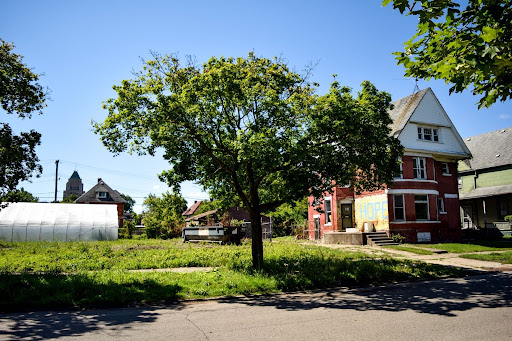
While working at Central Detroit Christian Community Development Corporation, much of Cameron’s work was helping neighbors cultivate gardens in the vacant lots scattered throughout their neighborhood. You see, in the absence of government and institutions—no one was coming to their rescue—neighbors banded together and made something out of what they had. Being in food deserts, they transformed their blight, the vacant lots, into gardens of fresh produce for the neighborhood that also provided employment.
How did these lots with beautiful yet abandoned homes become open, vacant lots of land? Well, largely through fires. Rumor has it that, in the absence of government and for local safety and the betterment of the neighborhood, many of these fires may have been controlled burns conducted by neighbors. After these fires—controlled or not—neighbors sometimes planted gardens and urban farms. In doing so, they cleared away the deteriorating monuments of a world that was no longer a reality, and began the work of renewal within the reality they had inherited.

Something like this is the church’s work, too. We must not only perceive “church blight” through a factual and pastoral lens rather than a simple, shameful story. We also need to discern where controlled burns might be necessary.
As drastic as it sounds, the analogy of controlled burns—or a refiner’s fire might be the biblical metaphor—are what the American church needs right now. Like Detroiters, there is no cavalry on the way to save us. There is no denominational program or church growth model that will magically fix things. We have God, each other, and the reality we have inherited.
So, let’s seriously think about it: What practices, programs, structures, and assumptions have outlived their worlds and need burning? Not because they were always wrong, but because they no longer serve the church’s calling in the reality we have inherited. What might need to become the soil for new gardens of hope?
And for these controlled burns to happen well, we will need to work through the grief—grief usually accompanied by unhelpful sentimentality—about a world that is no longer a reality. But I believe, a faithful “clearing away” of what is no longer useful in order to make way to plant “gardens” in our current systemic vacancies—make way for resurrection—could feel like a joyously stubborn act of hope. So, let’s be inspired by and learn from the residents of Detroit and find some resurrection among our church blight.
May the Spirit give us faith-filled vision so we might better perceive our current reality of “church blight,” courage to make the tough but good judgments about what needs to be burned, and the strength to cultivate the “gardens” of resurrection that God is calling us to grow in our midst.
Answer this question in the comments: What “church-blight” do you think might need to be burned?
All photos by Cameron Carley

7 Responses
Excellent article, and points out the fact that the church must always be renewing and reforming. It even goes back to the time of Jesus. In the sermon on the mount six times he says you have heard it said and then repeats an Old Testament law or Custom and then he goes on to say “but I say unto you“ and proceeds to give a new expanded vision for an Old Testament Custom or law.
Thought provoking. Thank you. To answer your question: I’m wondering about denominations and being certain about what is “right” becoming church blight. The book, “The Sin of Certainty: Why God Desires Our Trust More Than Our “Correct Beliefs” by Peter Enns published 1989 was suggested to me recently—so I’m reading it. I have only wonderings so far but I like the premise of God desiring our trust over the certainty the “right” denomination might give. Not “certain” what that would look like. But I trust He is honoring my searching.
This is GREAT, Trey! Eloquent and convincing.
The three previous responses described your article & thoughts as ” Excellent article” “Thought Provoking” and “Great” I concur Good reading and observations. ThankYou
I like absolutely everything about this except the burning metaphor. Without wanting to sound too pious, it seems to me that burning is up to God (1 Corinthians, I think chapter 3), and God does it. So perhaps some other metaphor for purging and deconstruction.
Interesting. I agree with Joyce’s proposal that certainty and right-ousness deserve consideration for “controlled burns”. I would love to hear more ideas from church leaders. How would it look if relevance, courage, care, and concern were restored to maximum capacity for all of us? If added to pastors with eloquence and charisma, could we end church and urban blight?
Bravo! Excellent article.