
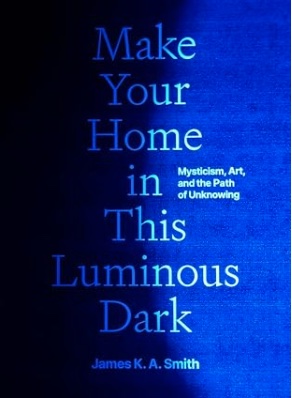
Twenty five years or so ago, GPS devices became common tools for driving. Back then, if your route deviated from the one identified by the GPS, a computer-generated voice would inform you that it was “recalculating”. I believe the more typical message now is “rerouting”. Either term apt describes what James K.A. Smith, known to his friends, colleagues, and readers as Jamie, is attempting in this book.
Jamie is a philosopher and an impressively good one at that. His list of books includes carefully reasoned expositions of postmodernism, narrative ethics, and Christian formation. Some of his books are regular texts in college and seminary courses. He is known for lucid, clear writing; even an author as difficult as Charles Taylor is made comprehensible by Jamie in his important 2007 book, How (Not) to Be Secular: Reading Charles Taylor.
And so, after a few decades of publishing well-received academic works in contemporary philosophy, it was notable when the tone and subject matter of his writing shifted. Jamie is quite transparent about one factor in that shift, both in this book, Make Your Home in This Luminous Dark: Mysticism, Art, and the Path of Unknowing, and in his previous book, On the Road with Saint Augustine: A Real-World Spirituality for Restless Hearts. He suffered a debilitating season of depression that radically called into question all the underpinnings of his scholarly work. He describes this as “profound, ineradicable uncertainty” (p. xi), surely a shock for a professional philosopher. This book is a sustained effort to make sense of an alternate route to understanding self and God, to learn “how to be when you don’t know,” as he puts it in the first sentence of the preface. The pivot for Smith from an accomplished analytical philosopher to a questioning pilgrim that this book narrates is dramatic and unsettling. But he handles this departure with honesty and courage. He says at one point in the book, “Confusion no longer scares me” (p. 27).
The journey that Jamie undertakes is a journey toward mysticism, an important “minority report” in the long and diverse Christian tradition. For him, mysticism has the potential to provide a new way of thinking, being, and doing. This new way bypasses some of the hubris and limitations of discursive and analytical thinking and opens up new possibilities of awareness. In seeking the wisdom of the mystical tradition, he discovers a pilgrimage, not a destination. Words such as inscrutability, uncertainty, and silence characterize mysticism, in place of such words as proof, logic, and argument that characterize scholarly discourse.
Mysticism is painful and solitary, but it has the possibility of wonder and gift and connection with God. Most of us would rather avoid personal, spiritual, and even philosophical crises. Upending structures that have long supported or at least guided us is painful. But Jamie recommends it, difficult as it is. He says, “. . . we can all cultivate ways of life where generative disruptions are more possible” (p. 54).
Mysticism employs a theology that is thoroughly aware of the inadequacy, even the failure, of concepts and language with respect to God. Augustine’s famous insight – that if we think we have comprehended God, then what we have comprehended is not God – is its key insight. Jamie Smith’s encounter with mysticism confronted him with the limitations of his analytical philosophical work. Instead of seeking to secure valid conclusions – the gold standard in philosophy – he opened himself up to wonder. He said, “I was surprised to find solace not in conclusions but in a kind of vulnerable but dogged availability to mystery” (p. 34). And so, his approach to philosophy changed. Smith explains that the “mystical redemption of philosophy” – this is his phrase – invites us to be astonished and then to “think from astonishment” (p. 201).
In this demanding journey, Jamie is aided by profound encounters with art, music, poetry, and film. This is a unique and surprising aspect of the book. Not only does he explore, in humility and openness, a new mystical pathway for philosophy, Jamie is also repeatedly gobsmacked by art. He says, “In many ways, art has been an occasion for me to practice friendship with epistemic failure. Artworks have helped me learn how to feel at home in the dark” (p. 142). Pause for a moment at the phrase “friendship with epistemic failure.” One can hardly imagine a more counter-intuitive posture for a philosopher! Yet, Jamie not only tolerates this posture, but he also commends it.
Jamie’s dramatic encounters with obscure – to me, at least – modern art are deeply moving. He tells a story about his discovery of an enormous painting in the Musée d’Art Moderne in Paris. It overwhelms his senses with a feeling of love and wonder. He remembers, as he stood transfixed in front of the painting, that “gold begins to shimmer through the dark” (p. 56). I looked up the painting on the internet – El Omrane by Swiss painter Helmut Federle – and I saw that shimmer of gold pulsing from the hues of acrylic color in this expansive abstract painting. Smith reflects on this unexpected epiphany and recognizes that his own encounter with mysticism “began in the quiet of a cinema, in the bright hush of a gallery, in absorbed solitude with poetry or a novel” (p. 35). And so he advises the reader to engage with contemporary art in all its “difficult beauty” (p. 50).
One of the compelling things about the book is that Jamie Smith gives frequent concrete examples of how his binary certainty, so carefully honed in a life of scholarly identity, came apart. He is strikingly transparent and vulnerable in his narration of some of these breakdowns and breakthroughs. He admits that the academic mindset is often fearful and defensive. An antidote to that is to cultivate receptivity, even passivity. He acknowledges that we bristle at this and resist it by retreating to old certainties and forms of thinking. But Jamie invites us to consider the gift of not knowing, the gift of receiving, the gift of being beloved by God.
The journey toward mysticism that Jamie Smith narrates in this book is accompanied by many conversation partners in addition to contemporary artists. He is deeply familiar with Meister Eckhart, Julian of Norwich, Augustine of Hippo, John Cage, Paul Schrader, Jean-Luc Marion, Pierre Hadot, Hegel, Heidegger, Husserl, Derrida, Descartes, Thomas Merton, St. John of the Cross, Henri Nouwen, Teresa of Avila, Howard Thurman, David Foster Wallace, and many others! The sheer breadth and depth of Jamie’s scholarly knowledge – and then the sheer honesty and transparency of his narrative – make this an important book from a brave and humble traveler.

8 Responses
Wonderful review. Thank you!
Loved this, Leanne!
This is SO POWERFUL, Leane!
James K. Smith. Kudos to YOU for your journey into and through the darkness of our days.
“O love, that will not let me go, I rest my weary soul in thee; and lay in dust life’s glories . . . .”
You have written this with such heart and clarity. What you have expressed means a lot to me.
Thank you so much
Thank you, Leanne, for this comprehensive and insightful review of Jamie’s book. The journey he traveled from certainty to mysticism and wonder resonates deeply in many ways to my own, and I suspect to many fellow readers.
Leanne,
Thank you.
Steve
Leanne, thank you for your insights into Jamie‘s journey from certainty to mysticism. I have long been drawn to the beauty of Young Children And Worship which centers each Bible story in wonder. Wonder shimmers through the words changing me like the gold in Helmut Federle’s painting.
Wow, Leanne, what an insightful, revealing review of what sounds like an amazing book. Thank you!