

1837-1920
Another Kuyper-related post today. Sorry if these are not your cup of tea; I’ll try to limit myself to two-a-year going forward. But a theme related to Kuyper’s program keeps coming up in social media and private conversations, and we need to try to sort it out here.
Kuyperian?
The theme is “transformationalism:” the idea that Christians are called to engage all areas of life (not just the “religious” stuff) toward the goal of bringing culture and society closer to the kingdom of God. The idea has been lauded by a good number of enthusiasts who have found in it a channel for their idealistic energies. Likewise, it has been ridiculed by an array of opponents—left, right, and center—as either unattainable, unbiblical, or proof positive of “Kuyperian triumphalism,” a particularly sharp stake in the tool shed of Calvinist arrogance.
Where the transformationalist model came from is a good question to which we’ll return in a minute. One thing for sure—Abraham Kuyper did not espouse it. I certainly have not read everything the man wrote, but I’ve read a lot of it and I recall coming across this concept, in the word “metamorphosis,” only a couple times, buried in his three-volume Encyclopedia of Sacred Theology. He proclaims other trademark concepts plenty of times—common grace, principle, antithesis (better, perhaps, “opposition”: tegenstelling)—but not “transformation.”
Critical Cultural Engagement
What Kuyper did advocate, in excelsis, can be better labeled critical Christian activism or cultural engagement. Christians, he said, were to work “in every domain of life” to mount a witness for the faith (“defend the honor of God”), at least to stave off deterioration and at best to seed improvements in the common good according to the best insights of the faith. His tone here was emphatic, trying to rouse the faithful from their pious slumbers. It could also be combative, for he saw contentions everywhere between Calvinists and other (or non-) believers and was trying to lead his followers in tightly organized ranks. As I’ve said before, Kuyper was always on campaign.
But he did not mean to seize or take over culture. His people were to maintain a faithful witness in a long, long struggle—winning some, losing some, but carrying on nonetheless. (The P in TULIP, after all, stands for perseverance.) But what was all this activity for?
At a crucial passage in Common Grace, he cited three of Jesus’ metaphors from Matthew. The faithful were to be salt to prevent spoilage (5:13); they were to be a city on a hill, shining light into the darkness (5:14-16); and they were to be yeast that leavens the whole loaf (13:33). The latter was Kuyper’s favorite and perhaps spells a sort of transformation, but one much quieter and less heroic than what is usually associated with the term. In any case, for Kuyper the measure was faithfulness, not success, and the final outcome belonged to God who keeps a different calendar than ours.
Where Did “Transformationalism” Come From?
Yet it is standard practice to name transformationalism as one of the three “minds” or parties long active in the Christian Reformed Church, and to attribute that mind to Kuyper. A recent example comes from another in a long string of excellent posts by former CRC minister Clayton Libolt. Clay remembers the inspiring education he received at Calvin College in the 1960s as stemming from this corner and wonders, aptly, how it will fare under the rising hegemony of its longtime rivals, the “doctrinalists” and the “pietists.”
These three labels have an unambiguous source, a landmark essay published in the Reformed Journal in 1974 by Nicholas Wolterstorff. There are few if any voices to whom I owe more, and with more gratitude, than Nick Wolterstorff. But the extent to which he attributes the transformational mindset to Kuyper—and that’s debatable—is not quite right.
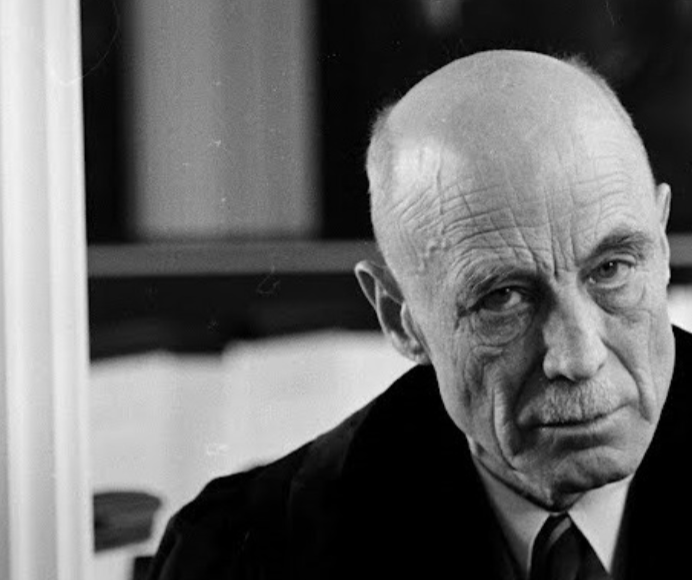
1894-1962
The transformationalist ideal was definitely in circulation around Calvin in the 1960s—I started there ’67—but it came from another source than Kuyper, in fact from a book I read my first year there: Christ and Culture, by H. Richard Niebuhr. We all read it, I think, as an assigned text in CPOL, Christian Perspectives on Learning, required of all Calvin first-years.
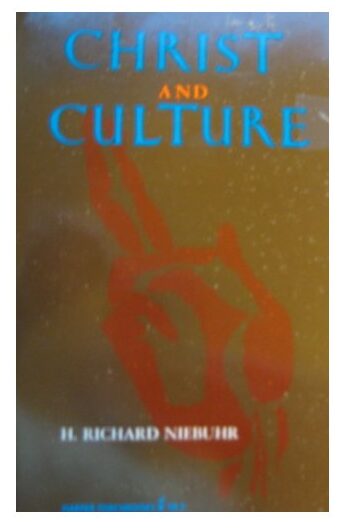
Again, I do mean the praise I give this source before questioning it, for Niebuhr’s is one of the half-dozen most formative books I’ve ever read. Its categories, theses, and conclusions have been critiqued, but Niebuhr asked the essential question and mounted an answer in a memorable typology, and I’m a sucker for typologies.

475 Riverside Drive
Commanding the Heights
Where was Niebuhr lodged in the 1950s, when Christ and Culture came out? Atop Divinity Hill in New Haven, Connecticut, looking out one way over the city and another over Yale University. He could ring up his brother Reinhold at Union Theological Seminary on Morningside Heights (N.B.!) in Manhattan, across the street from Yale’s Ivy rival, Columbia University. Together the brothers could put in a conference call to Secretary of State John Foster Dulles in Washington D.C., link up to John’s brother Allen as director of the CIA and then also to Henry Luce, head of the nation’s preeminent media conglomerate—all without leaving a tight Presbyterian-Congregationalist circle.
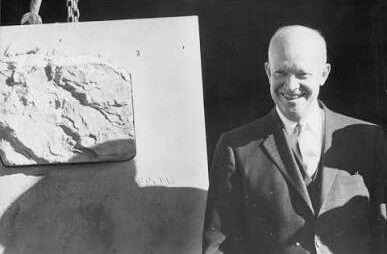
In short, the Niebuhr of Christ and Culture dwelt at the apex of the American establishment. Nothing better symbolized that status than the erection of the Interchurch Center, the “God Box,” as a home for a half dozen mainline Protestant denominations (including the Reformed Church in America) in 1958. John D. Rockefeller, Jr., was lead donor and stipulated that the building’s exterior mirror that of Riverside Church, his personal parish and the mainline’s national cathedral, right across the street. Union and Columbia were but a block away. None less than President Dwight D. Eisenhower laid the cornerstone on Columbus Day that year before some 30,000 witnesses.
A Bit of Paradox, Please!
Of the five types of church-world relationships he laid out, Niebuhr clearly preferred #5, “Christ Transforming Culture.” Cautiously, though; he was measured in his praise and critique of each model. Yet given the power the Protestant establishment appeared to hold in his day, the transformational dream would not seem to have been out of the question. It soon would be. By the end of the 1960s, establishments of every sort were under fierce assault, and the long decline of mainline denominations had begun.
Such power and aspirations were nowhere in Kuyper’s playbook. His political party did have a role in most Dutch Cabinets from 1920 through the ‘90s but they were coalition partners, not sole actors, pushing their agenda but playing fair and hardly pretending to command the whole country.
When I returned to Calvin to teach, some colleagues and I talked about forming a club to promote Niebuhr’s Type 4: Christ and Culture in Paradox. The problem with Type 5, we observed, was not just its triumphalism but its open arms to cultural conformity—Christ transformed by culture. In late 20th century America the syndrome was too plain, and the pressing need was to restore some sense of tension between the two. If Luther was Niebuhr’s representative of this type, we joked, then let’s be Calvinists for Luther.
An Aeolian Harp
We could also have attended to the surprising, and charming, image with which Kuyper concluded his famous Stone Lectures at Princeton. Charming in its modesty, surprising in its quiet, almost passive intimations. Kuyper invoked the favorite Romantic trope of the Aeolian harp which, placed in a window, would produce ethereal harmonies as the breeze passed over its strings. “Let Calvinism be nothing but such an Aeolian Harp,” read Kuyper’s closing words. We needn’t pretend to compose the music or project it all over the neighborhood. All we need, and can, do is to keep the harp “tuned aright, ready in the window of God’s Holy Zion, awaiting the breath of the Spirit.” [199]
The wind blows where it pleases, says the gospel of John. Tune in and follow its lead.
Header photo by Raimond Klavins on Unsplash

17 Responses
Very, very helpful. Thank you once again.
Thank you. I would love to hear you expand on the Niebuhr Type 4 notion. My sense over here in the cornfields of Iowa is that transformational meant the modest salt and leaven and that paradox leads to a “two kingdoms” dualism.
Interesting! I’ve never associated the paradox model w/ 2 kingdoms proposals but can see where that can occur. I guess back in the day we were operating w/in a functional transformationalism and wanted to introduce a bit of tension between the two terms and sobriety about possible outcomes.
His tone here was emphatic, trying to rouse the faithful from their pious slumbers.
I took CPOL a year later than you did, and your blog brought back memories. The experience did rouse me from a kind of slumber. My RCA upbringing had nurtured a “Jesus in my heart” kind of pietism. I saw Kuyper as offering me a way to live out the affirmation in the Lord’s Prayer: Thy kingdom come, thy will be done, on earth as it is in heaven. I did not have the categories at the time, but I saw Kuyper calling for faithful perserverance rather than transformation, as you have described it.
The transformational spirit lives on at Calvin in our current mission to equip students to be “agents of renewal.” A softened version of transforming, but Niebuhr is still in there somewhere. I agree with your caution about cultural conformity; on the other hand, in some ways Calvin is expressing a resurgence of “Christ against culture” thinking. I suppose where to conform, transform, and resist is always the question, as it what you are counting as “culture.” In any case, I think a little more paradox would be helpful in this moment, too.
“What you are counting as ‘culture’.” This is indeed the question. In Niebuhr’s 1950s, the air of consensus was so thick in the American air that the answer seemed self-evident. Polar opposite of our times….
Thank you for this thoughtful, reorienting piece. You didn’t name it explicitly, but I will: The corrective you’re offering here is especially timely in these United States right now, as various ascendant “Christian” nationalist culture warriors have co-opted some of the language (but not the heart) of neoCalvinism.
Thanks for this. I really enjoyed reading about some of the cultural background of Niebuhr’s book. I also found Niebuhr’s book very helpful. His typology is certainly memorable (although it took me a bit to remember #3, and I’m not absolutely sure I got it). But memorable can lead to simplifyingly misleading. It seems to me that rather than settling on one paradigm, it’s better to be “multilingual” with the various paradigms. If ours is a “multi-cultural” culture, then we should have wisdom to discern which paradigm fits which issue or event, and perhaps more than one applies. I think I’m echoing what Debra Rienstra is saying in her reply.
Of Niebuhr’s five types, “Christ the Transformer of Culture” is the most elusive and fragile. Across nearly two thousand years of Christian history, in his view, John Calvin, Augustine of Hippo, and even the Gospel according to John (!) failed to nail it. Only the obscure 19th century British theologian F. D. Maurice managed to ring the bell. This suggests to me that most if not all of the claimants to “transformationallism” (including our revered CPOL instructors at Calvin College) were fooling themselves, and us.
Or trying to trigger energies in a hopeful time? The CRC was emerging from a long hibernation w/in a thick-walled fortress, so maybe their search for new ground was understandable.
Thought provoking article. Thank you and please do not apologize for another article on Abraham Kuyper. His mind probed deep enough to be thought provoking for years to come. There is plenty of relevance for us contemporary Christians.
The last I checked, salt has at least four characteristics. One is to be a purifying agent. Another is to be to enhance flavor in our food. Still another is to act as an antiseptical agent. And finally, it can be an effective preservative. All of these functions Jesus, no doubt, had in mind for his followers. All of which, it seems to me, fall somewhat short transformational, or at most, a weaker form of the word.
I have finished an article by Henry Stob on the “antithesis” between the kingdom of darkness and the kingdom of light. He starts out at the world and life view level of things as a strong proponent of the concept but he weakens the idea of it as it approaches the world of facts and propositional logic. At this level it looks more like common grace.
Seems like we need constant conversation on this dimension of our Christian faith as we follow Christ into culture and your contribution is most helpful.
There is a fifth characteristic of the word “salt” of the Greek Gospels: salt as fertilizer. This is especially intriguing because it is the “earth”, that is the “dirt”, and not the cosmos that is affected by Christian salt.
Thank you, also for the clarification of salt’s functions. I’ve only thought of the preservative one in connection w/ Jesus’ words here.
Please don’t limit yourself in writing about this historical background. It is so important in this time of competing visions of the place of Christian faith in politics. I love the Aeolian harp image.
Nicely done.
As usual for you, Jim, an adroit and revealing piece. I appreciate the caution about attributing an aggressive or, surely, triumphalist doctrine of cultural transformation to Kuyper, but am also impressed by the power of Christ’s image of leavening the whole loaf–the image you say Kuyper does endorse. Someone (could it have been Jaroslav Pelikan?) once suggested a thought experiment: suppose you had a super magnet that you could pass over Western Civilization and pull up from it everything good that Christians have sponsored over the last two millennia. You would pull up K-12 schools, universities, soup kitchens, orphanages, adoption agencies, abolition movements, civil rights movements and institutions, women’s suffrage movements and institutions, inner-city housing movements, anti-war movements, hospitals, political parties, clothing banks, food pantries, and much more. Concede what you need to about the obstacles to and overconfidence of Christian attempts to leaven culture’s loaf. Still, in our thought experiment, you’d need quite a magnet to pull everything up and you’d leave quite a hole in civilization. No doubt good to be shy about the rallying cry for cultural transformation; but, good also to notice that magnet and that hole.
Yup! Balance is the thing.