
There are lots of reasons to read books, and one of my favorites is the way a good one reflects light back into my own life. Whatever it is that delights, inspires, or mystifies in the text, in my experience, is often speaking to some longing that I haven’t fully identified.
That’s recently been the case for The Running Ground: A Father, a Son, and the Simplest of Sports, a slim, strange memoir by Nicholas Thompson that’s been running loops in my head for the past few months. The book tracks Thompson’s athletic and professional careers as well as his relationship with his exceedingly complicated father. Also, unusual for a memoir, it weaves in five short profiles of other distance runners.
For much of his life, Thompson was an above-average but unremarkable athlete, falling off his track team at Stanford due to injuries, stalling out in his race times. At age 30, he was diagnosed with a treatable but jarring form of thyroid cancer. Recovery shook something loose in him, leading to a period of what he calls “post-traumatic growth.” Shortly thereafter, he was contacted by Nike about an experimental program that paired “average” runners with elite coaches to maximize their growth. He signed on for a detailed training plan and saw his performance improve dramatically. He ran sub-2:30 marathons and, at one point, held the world record in his age group for the 50K. This all happened in his late 30s and 40s, long after the age at which most athletes have begun their decline.
At its core, the book is about facing difficulty with discipline and focus. Training, says Thompson, is essentially a cycle of stressing the body and letting it recover, gradually increasing the stress and reducing the recovery time. He has learned that “pain has physical causes but that it’s mostly a mental process: we slow in races less because we reach our physical limits than because our minds get scared.”
Later he extends that to performing a complicated job (he is CEO of The Atlantic): “Our minds create limits for us when we’re afraid of failure, not because it’s actually time to slow or stop.”
That sounds an awful lot like dad advice, or boss advice. But it might also be true.
Thompson is not advising anyone to ignore the body’s pain signals. Healthful training requires more attention to the body, he says, to distinguish between acceptable pain and pain that requires rest or medical help. One of his rules of thumb: Muscles that hurt equally on both sides of the body are fine; it’s asymmetrical pain that may be signaling an injury.
Those five profiles of other runners also explore the nature of limits. Bobbi Gibb, deciding no one would stop her, became the first woman to compete in the Boston Marathon. Tony Ruiz, who grew up in New York housing projects, kicked a crack addiction to become a prominent track coach. Suprabha Beckjord, an unassuming woman from Maine, became perhaps the world’s greatest ultramarathoner by following the Indian guru Sri Chinmoy. Among other feats, she won a 3,100-mile race around a single city block in Queens, a communal endeavor designed by Chinmoy help his students understand “the complex intersection of discipline, surrender, and devotion.”
Thompson traveled from his home in Brooklyn to watch and occasionally accompany her. He quotes another runner, the Kenyan Olympian Eliud Kipchoge: “Only the disciplined ones in life are free. If you are undisciplined, you are a slave to your moods and your passions.”
I’m a casual runner. I have no desire to change that. But something in the book strikes a chord for me. I think it speaks to a desire for a deeper immersion in something, for strenuous effort in a single focused direction, for a sense of momentum in career, or artistic practice, or life. Maybe it’s obvious why Thompson’s story appeals to me, as a 40-something dad with a desk job. But I’m going to examine it for a moment, because it gets at something important.
Unlike swimmers and cyclists, who can effectively train all day, runners meet diminishing returns after two hours or so of daily training; anything longer is likely to lead to injury. The quantity of Thompson’s training was fine, he learned from his Nike coaches. What he needed to increase was time spent running fast.
It’s a matter of focus. Thompson describes his habits of mind while racing: No daydreaming. No high fives with strangers. No unnecessary footfalls—he calculates each turn carefully and runs in the center of the street, where it’s flattest. And, whether training or racing, no music. “Running is a process of learning about your body and developing habits deep inside it,” he says. “Music can confuse the signals … I don’t want a bassline, or the adrenaline that can flow with it, to get in the way.”
I can’t help but compare this to how I run: without any particular goal other than burning off anxiety and letting my mind decompress. I stop to investigate birds in the brush, or to a record a voice note for an essay. It’s the same with other hobbies: I dabble, mostly content to be a generalist. And I worry that I’m missing out on something.
I won’t air out all my questions (a book project? a career move?), but I think the dilemma is common for working parents with dependents. Life seems to ask for stability and patience: Stay in the job with benefits, keep the hobbies modest and compatible with the family calendar. But there’s a desire for something intense, focused, irrational.
Thompson finds ways to fit an impressive training schedule into his daily life. He commutes from his home to his office in Manhattan via 4-mile runs, keeping suits in the office. He takes long runs on weekend, or sometimes at 11 p.m. after a family dinner. When his three kids were young, he found that hallway soccer and goofy wrestling provided ideal cross-training: Bending, twisting, lifting, laughing, varieties of moment to prevent injury.
By his accounting, he’s fully involved in the life of his family, although he’s the narrator, so we have to take his word for it. His wife, like most every spouse of a distance athlete, expresses mixed feelings about his hobby. I’d like to know more about unspoken class advantages (household help, professional assistants), but these go unexplored.
There’s another big theme to the book: Nick’s relationship with his late father, W. Scott Thompson, who was a Rhodes Scholar and White House fellow who rose in the Reagan Administration before coming out as gay and walking out on his family, including a 7-year-old Nick. A self-described sex addict, Scott followed a path of alcoholism, financial mistakes, and short-lived relationships to the Philippines. For years, Nick tried to support his father from a distance while setting boundaries around his own family.
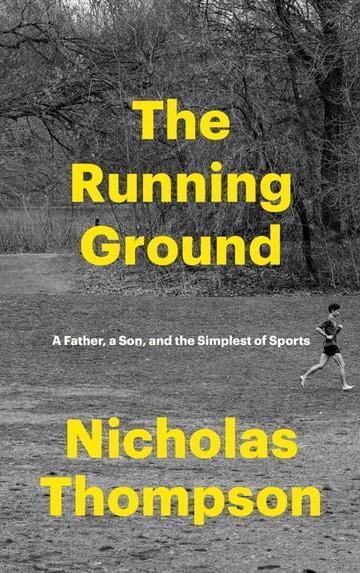
Scott was also a successful runner, one of the few healthy habits he maintained as his addictions spiraled. The junior Thompson acknowledges early on that he runs “because I came to believe it would both bring me closer to my father and help me avoid becoming him.”
This relationship forms the book’s emotional core. Nick’s father warned him (in a public Facebook post, no less), that his life would unravel around age 40. Instead, that’s when Nick found a new gear. As he watched his father oscillate between drinking and running, he reflected on the nature of momentum. It’s one of the most remarkable passages in the book:
My father often talked about momentum in life. Sometimes you have it; each success makes the next success a little easier and a little more likely. Sometimes you don’t, and your losses compound. When you have it, he would tell me, use keep it and use it. Focus. Get more done. Take the confidence that this success gives you and use it. When you don’t have it, he’d say, well, try to get it back. This isn’t bad advice, because every time we do something we create grooves in our minds that make it easier to do the same thing again. It’s how we learn to press our fingers to make a G chord on the guitar, how we learn to sit up straight at the dinner table, and how we learn to quit drinking—or how we get in the habit of drinking to deal with stress. When we have momentum, our habits seem to continually push us in the right direction. When we don’t, it’s often because our habits are pushing us the other way. It’s a depressing thought because it means that each thing that goes wrong makes everything else, forever into the future, more likely to go wrong. Until we realize that the opposite is also true. Each time we do something right, we create a tiny imperceptible tailwind for the future.
There’s something here that rankles, especially that glib “get more done,” as if productivity itself is a path to meaning. If Nick had stopped there, this would be a much thinner book, one more CEO’s ode to meritocratic achievement.
Yet as Thompson wrestles with his father’s advice, he gets at something important about the nature of momentum. He doesn’t use the phrase, but I’ve heard other endurance athletes talk about “base miles” — the ordinary humdrum training sessions that build a foundation for peak performance later on. They aren’t the days for setting personal records, but they make the breakthroughs possible.
I wonder if that metaphor works for the rhythms of family life. Family dinners (even rushed ones), rides to practice, nightly homework checks: Can these build a foundation for something bigger, even if they feel small in the moment? The same with writing sessions when the work feels uninspired. I’m trying to trust in that “tiny imperceptible tailwind” that Thompson describes, in the steady compound interest that accrues with diligent daily work.
I don’t know what to do with my desire for something more. I don’t know whether it’s a fickle, fleeting bout of self-improvement energy, or something more substantial.
For a while now, The Running Ground has got me looking at those questions with fresh eyes. Even if they manifest mostly as longing, I’m grateful for that.
7 Responses
Thank you for an honest breath of angst that can occur in a life where introspection is practiced. Your desire for “something more” may be the answer to your question of “can these build a foundation for something bigger, even if they feel small in the moment?” Those small moments cascade into a torrent of moments that make a life well-lived or at least a life where we have done our best to thrive and help those around us to thrive. You’re also spot-on as to one of the reasons we read books: they do reflect light back into our own lives, to delight, inspire, or mystify us. Perfect Monday morning read.
Thanks, Jan! “An honest breath of angst” is a great little phrase. I’ll hold on to that.
Thanks, Jonathan. I was most struck by your discussion of momentum. It made me recall an interesting conversation I had with the late Dr. Jim Brownson about the role of momentum in churches. Is that a movement of the Spirit? a mere psychological boost? How is God working when momentum is not there? I’m not sure how to answer those questions, but momentum is a part of the reality of every church.
I appreciate that, David. What I like about Thompson’s excerpt above is the neutral “sometimes you have momentum in life, sometimes you don’t.” Sometimes we’ve earned it, but more often there’s an external factor at work. The same is true for churches. Maybe that can give us humility and patience, whether the wind is at our back or not.
I always appreciate your articles in the search for more meaning while keeping a firm reformed foundation faith. I went back and read your piece on author Peter DeVries. We might well be 2nd cousins since my maternal grandmother was a Hiskes from the Chicago south side. My dad’s boyhood friend was Peter DeVries from the old Groeninger Hook neighborhood on 14th & Ashland.
Thanks for the kind words, Bar. Peter De Vries was formative for me in that “search for more meaning” that’s invariably shaped by childhood faith.
Yes, I’m reading one of these now: “Refugia Faith”, by Debra Rienstra. I’m thankful for all the wonderful connections the Reformed Journal has forged in my life.