
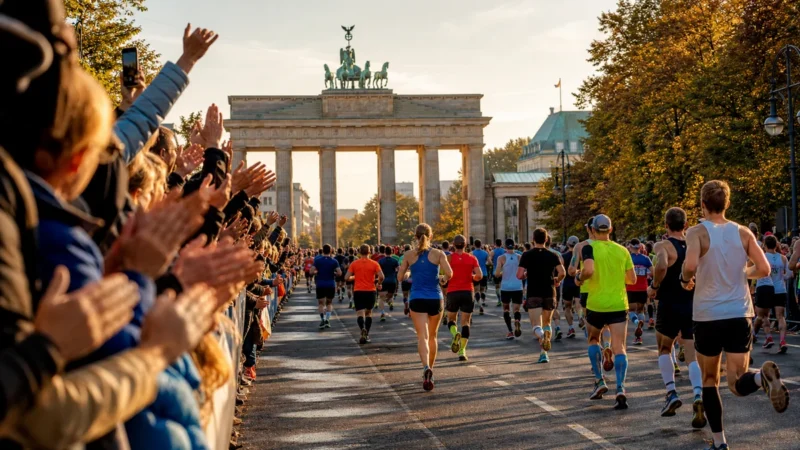
I passed through the Brandenburg gate and eyed the finish line. It was only 400 yards away and yet it seemed like miles. I trudged along with salt-stained shorts, a sore leg, and a stomach pained from dry-heaving. The tears that ran down my cheeks were a mixture of pain and joy. I was finishing the Berlin Marathon. It was by far my slowest, and yet I’ve never worked so hard.
If you follow my posts you might remember that I suffered a traumatic knee injury in February. Running through the woods, I slipped on some ice and tore my quadriceps tendon. After surgery, I spent months on my couch unable to bend my leg.
Slowly, and I mean slowly, I have begun walking. Hours of weight lifting and physical therapy have gotten me to a point that I can walk with little pain. Steps are still hard and running seems quite a ways off. And yet there I was lined up with my wife and daughter at a major marathon.
In the Gospel of Mark, Jesus tries to heal a man who was blind. At first glance, it didn’t go quite as planned. The man could see, but people looked like trees. After a second attempt, the man could see.
Mark’s use of this awkward story is purposeful. The miracle occurs while Jesus is heading to Jerusalem to die. On the journey, Jesus’ disciples begin to catch glimpses of who Jesus is. And yet, they do not fully comprehend him. In other words, they see Jesus, but he looks like a tree. Only later, as their relationship grows and Jesus dies and is raised, do they more fully see who Jesus really was and is.
I love this story. But it has taken on new meaning for me this year. Whether you have wanted to join or not, I’ve taken you on my journey. From leaving a job that I loved and suffering an injury to loss in my family and other bumps in the road, 2026 has been dark with glimpses of resurrection along the way. While I have been able to see resurrection, life, and light, they’ve looked like trees.

Through much of my life I have viewed resurrection as a one or maybe two time event. There’s the resurrection at the second coming of Christ. In this case, there would be some major event that draws forth bodies from the ground. But the first resurrection, the one mentioned in Ephesians, in which a person goes from death to life in this world at their “conversion”, also seemed like a pretty radical event. A person would move from sinner to saved, from out to in, from death to life. But I wonder if this is really the case?
In reformed tradition, we often talk of justification and sanctification. I think we often assume that justification is a one time event, and that sanctification plays out over time. But with a caveat here as a biblical scholar more than a theologian, it might help us to remember that salvation itself, or the “this worldly” resurrection is an event, but it is also a pilgrimage.
This makes sense to me theologically, but it also holds grammatically. The Greek word for justification in the New Testament often occurs in the imperfect tense. This tense means that the verb has an ongoing aspect. In this case then, justification is an ongoing process. Our salvation is a pilgrimage. It’s a journey moving toward a goal. It begins with an event, and it journeys from there.
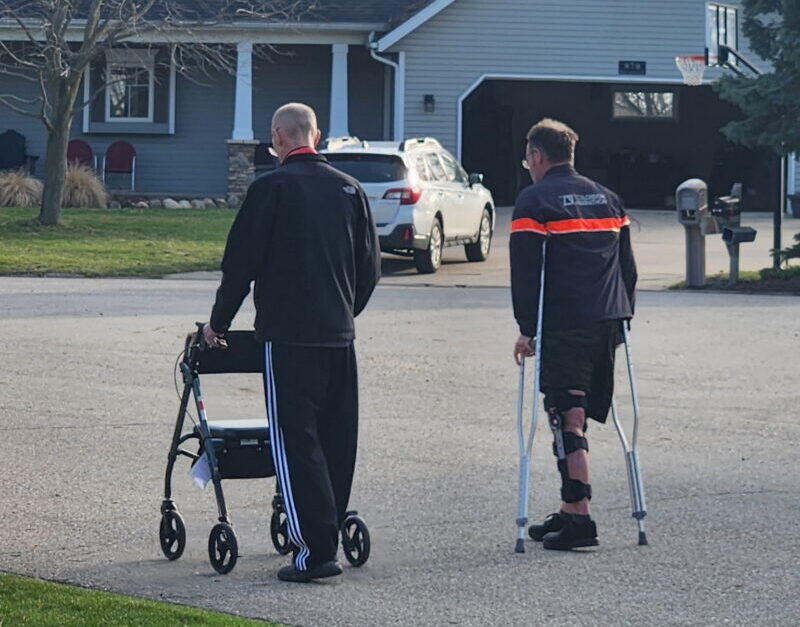
As I continue to process this year, I have thought about resurrection as a pilgrimage. In a world that was pretty dark, looking back I noticed glimmers of light and life. After surgery, I experienced life on a sunny February day with a cup of coffee from a friend. I was given a glimpse of life from my wife who had to live into the “for worse” part of our vows but did so with grace and a smile. I experienced life while walking my culdesac on crutches with my neighbor. I felt new life the first time I could bend my knee. I experienced it when a friend was willing to drive me to Grand Rapids once a week so I could still teach.
And on that Sunday morning in Berlin, as I stumbled across the finish line with a terrible time, I experienced resurrection once again. What has been dead is slowly, and I mean slowly, coming back to life. On this pilgrimage of faith, one that is providing me with more questions than answers, my salvation, my resurrection continues its meandering journey towards God, even if now it just looks like trees.
Unfocused tree photo by Natalie Kinnear on Unsplash

4 Responses
Your painfull story of injury and rehab has given us the gift of a positive story of a rebirth of sorts, just short of miraculous. Your analogy fits perfectly with our journey toward justification; your last sentence encapsulates and gives rise to the hope for the resurrection that so many of us journey with. Thank you for admitting it meanders, with more questions than answers, and is always a work in progress.
Thanks, Chad, for this post. I have been following your journey from injury to rehabilitation. And now this! What a spectacular accomplishment. And, I appreciate the theological discoveries that you have shared with us.
Thanks, Chad. I agree with you that we have defined justification and sanctification too neatly. They’re actually in different metaphorical worlds but united by having the same Agent at work in them both.
I appreciate you honestly sharing your journey with us as I appreciate you. Thank you, Chad. And well done in Berlin!