
Today is Thanksgiving Day in Canada. In the U.S., it is Indigenous People’s Day. Dual citizenship makes the day doubly conflicted for me. So does my backstory.

The sun is setting. Fireflies zip around. I’m on the deck, chilled Yuengling in hand, reading Thomas King’s The Inconvenient Indian. It’s a history of Indigenous rights and treaties in North America. I reach page 91 and stop cold. In 1836—at the same time Georgia was evicting the Cherokee—Ontario relocated the Chippewa (Ojibwe) from the Georgian Bay region north of Toronto. I sit in stunned silence. Knowing my family history intersects directly with forced removal.
The Chippewa lived in the Blue Mountain area on the shores of Lake Huron from time beyond measure. Beginning in the late 18th century, they were displaced from ancestral lands through treaties, war, and land cession agreements. European “settlers” arrived in the early to mid-19th century. Jesse Gould—my great-great grandfather—was one.
Shortly after 1845, Jesse and his family moved to a 50-acre property near Ravenna. Collingwood Township was in its infancy. Jesse cleared the forest, built a small home, and established a farm. Near the meandering Beaver River. On the rolling western slopes of the Blue Mountain.
His descendants—my forebearers, uncles and cousins—became prominent in the local community. I once visited Jesse’s gravesite in the corner of Lot 14, Concession 9, with my dad. There’s so much I wish I could ask him. About what he knew. Or didn’t want to know. And I wonder why I didn’t connect the dots sooner.
Thanksgiving, Maggie Helwig writes, “is a complicated observance. Because those of us who are settler people are presuming to thank God for the harvest from land we straight-up stole from its Indigenous inhabitants, so yay us.” Hard words.
“From Tierra del Fuego to Ungava Bay, the history of betrayal continues to today,” Bruce Cockburn sings. “It’s a stolen land—but it’s all we’ve got. It’s a stolen land—and there’s no going back. It’s a stolen land—and we’ll never forget. It’s a stolen land—and we’re not through yet.”
What do I do with this? Our history? My history? Guilt isn’t the right response. I didn’t do anything wrong—nor did my dad. Maybe not even Jesse. Land was offered by the government—he needed to survive and build a life. Repentance isn’t right either. I can’t apologize for something I didn’t do. I can’t confess other people’s sins.
What I can do is lament.
Lament is a response to suffering and irretrievable loss. It’s “the anguished cry of sorrow, grief, and anger,” Doug Groothius says. “It cries out for healing and resolution.” We lament because we’re what Jerry Walls calls “aching visionaries”—people who know the profound difference between the state of our present world and the coming Kingdom when God’s will is perfectly achieved. Cockburn’s Stolen Land is lament.
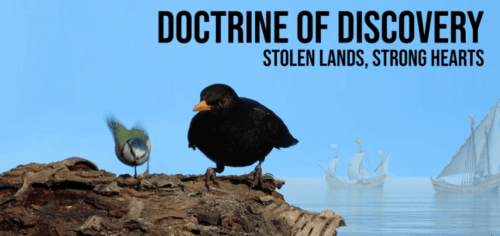
I lament through learning and understanding. By watching the Anglican Church of Canada documentary Doctrine of Discovery: Stolen Lands, Strong Hearts. It explores the papal decrees allowing Portugal and Spain the right to conquer, kill, and convert peoples of the Americas. In the name of Christianity—and a colonial search for gold. That doctrine, from then until now, has dehumanized and displaced Turtle Islanders.
I lament through land acknowledgement. The home in which I write is located within the tribal lands of the Indigenous peoples of the Fox River Valley. The Potawatomi, Ojibwe, and Odawa nations of the Three Fires Confederacy. The Miami, Sauk, Meskwaki and Kickapoo nations. While I’m not responsible for their displacement, I do benefit from it.
I lament through the name I give today. Indigenous Peoples Day. Calling it Columbus Day honors the Italian explorer. Glorifies the Doctrine of Discovery. Whitewashes European colonization. Ignores the genocide of First Nations. Forgets the lasting harm they still suffer. Indigenous Peoples Day is a counter-remembrance—a rebuke—to Columbus Day.
And we must lament collectively. In public liturgy. The Calvin Institute of Christian Worship has materials. So does the Presbyterian Church (U.S.A.), source of these liturgies and prayers.
Through Calls to Worship: We gather on land that was never ours, land stewarded by Indigenous peoples long before churches were planted here. From the prairies and coastlines to islands across the seas, this ground is sacred to those who came before us.
Through Prayers of Confession: We acknowledge with sorrow that Christianity, entangled with empire, arrived not just with Good News, but with forced conversions, cultural erasure, theologies of dominance.
Through commitment to healing: We are here not to erase, but to honor. Not to lead, but to walk beside and learn. Jesus Christ, Reconciler of all things, calls us to build a future where the dignity of all peoples is upheld, and the Church becomes a place of repair.
I can’t return the ancestral lands where Jesse “settled.” But I can sign up for information bulletins and action alerts on policy issues from the Assembly of First Nations or the National Congress of American Indians. I can work for justice in my spheres of influence. Even if my causes have nothing to do with colonial wrongs. Because injustice anywhere is connected to injustice everywhere.
The church and its agencies can’t turn back the clock. But we can repent and make amends. Rehoboth Christian School—where my wife Jenna taught for ten years—was founded by the Christian Reformed Church in 1903 as a boarding school for Navajo children. Speaking the language was prohibited. Cultural practices were suppressed. Harm and trauma resulted. In 2003, Rehoboth acknowledged past mistakes, asked forgiveness and committed to a process of healing. Its efforts toward reconciliation have evolved from formal confession to inclusion of Navajo heritage. That’s restorative justice.
Our nations can’t undo the brutal histories they engineered. Canada, more than the US, makes the right noises. But there’s a stark gap between rhetoric and reality. Both countries need to repair the ongoing damage of forced displacement and coercive assimilation. By robustly funding healthcare, social services, educational opportunities, anti-poverty programs. By recognizing Indigenous sovereignty, honoring historical treaties, returning tribal lands. By moving beyond what Selena Zhao calls “the progressive façade” of reparation.
Cockburn’s song ends in a haunting question.
So now we’ve all discovered
the world wasn’t only made for whites
what step are you gonna take
to try and set things right?
What’s my answer? Your answer? Our answer?
5 Responses
Excellent words. Hard truths, as you said. Thank you.
Not guilt, not repentance, but lament. Only lament unleashes a power that can change a heart of stone to a heart of flesh.
“Injustice anywhere is connected to injustice everywhere.”
Interesting article and true as my family swept through the East Coast to the West to New Mexico . My mother in her latter years finally realized the reality of the loss of land our ancestors took as their right to property over the Indians. She changed her opinions about those actions – our ancestors both killed and were killed by the Comanches in Texas. The toll of the changes that land loss and destruction of language , customs and culture is finally being acknowledged and I pray that there will be healing and peace forthcoming .
Thanks for this thoughtful piece. Lament is a thoughtful response to these travesties. Some groups are also exploring some possible reparations as another response.