
I was the kid who asked her parents to leave the hall light on under the guise of fear of the dark. What I really wanted was the sliver of light that fell on my bed so I could angle my book just right and read long past bedtime.
I still read a lot. Right now, I have an audiobook going for when I work out, drive, or garden, one book for the book group I’ve been a part of for 30 years, one book about biology, one book for pure fun, and one book to stretch/examine my faith. That’s typical for me. I don’t go anywhere without at least one book in my bag.
A recent review of research by scientists at the University of Cambridge found that reading for pleasure throughout life is associated with a remarkable range of benefits, from cognitive performance and mental well-being to reduced loneliness and stress. Some studies also suggest that readers may develop greater empathy. This was fantastic news for a bibliophile like me!
In childhood and adolescence, reading for pleasure is linked to better attention, memory, executive function, academic achievement, cognitive function, and fewer mental health problems. These outcomes may be a result of structural differences in brain regions that support executive control, regulation of emotions and social cognition as seen in studies using neuroimaging of the brain. The benefits of reading seem independent of socioeconomic background, sex, BMI, age, race/ethnicity, or family structures.
Reading may even support mathematical development. Reading and mathematics draw on some overlapping cognitive processes, although the relationship between the two deserves further study.
Reading also benefits adults. Studies suggest that reading for pleasure contributes to well-being and helps to reduce feelings of loneliness. It appears to foster empathy and relieve stress. Reading also improves social connection, a benefit amplified when reading is done in community as a book group.
Reading fiction may be particularly beneficial. It seems that fiction engages brain networks involved in social cognition, helping the reader understand how another person might think or behave. In one study of young adults, participants read literary passages while undergoing fMRI scanning. Scientists observed that specific subnetworks of the default mode network (DMN) responded to different aspects of the texts. Scientists concluded that reading fiction exercises the DMN and leads to its more robust activity, important since the DMN has been linked to positive social behavior, mood regulation, motivational processes, and creative thinking.
Despite all the evidence of reading’s benefits, our society is reading less. Getting my students to read, even a simple, non-textbook is difficult. I hear them say “I’m not a reader” or “I’m a slow/bad reader” or “I don’t like to read” over and over. Generative AI has made the problem more complicated. Students can ask ChatGPT to summarize a book, write a book review, or answer reflection questions. The results can be convincing enough to make it difficult to know whether a student has actually read the book. But the deeper question is what students miss when they substitute a summary for the experience of reading.
Reading in children is also declining. The National Literacy Trust’s data indicate that young people’s reading for pleasure hit a 20-year low in 2025. I am grateful for people like Dolly Parton whose Imagination Library program sends books to registered children once a month, including my grandson. Perhaps programs like these can help reverse this trend.
Scientists are not the only ones who see the benefits of reading. Mary Beard, the classicist, says she “cannot bear the phrase ‘I really love reading.’” She goes on to explain that to say that we love reading undermines and underrates reading. She says reading is more than wellbeing. She argues that reading is essential for humanity because reading helps form us and how we think about the world. Good books don’t benefit us because they make us feel better. They benefit us because they make us see the world, ourselves, and each other differently.
I think she is right and her wisdom aligns with the data coming out of studies like the Cambridge study that examine what reading does to our brains…the neuroscience of reading.
Science can help us understand what reading does for us. Theology invites us to ask what reading is for.
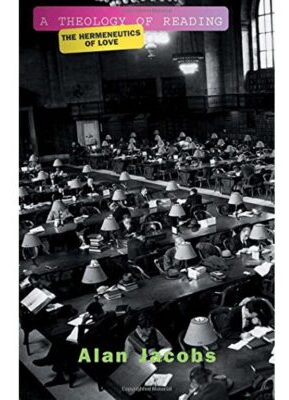
Stories are gifts. They require us to practice humility and curiosity, to pay attention, and to listen to other voices. In A Theology of Reading: The Hermeneutics of Love, Alan Jacobs argues that when we open a book, we must grant the author and their created world the status of a neighbor. We treat them with hospitality. We listen. We care. We love. We practice Jesus’ command to love our neighbors.
I’ve had the privilege of being part of a book group since 1996. That’s 30 years of reading together — 330 books. One per month (in December we bring something to read aloud rather than read a book together). Those 330 books have shaped me, as have the people with whom I’ve read them—figuratively and physiologically. The stories we’ve shared have changed how I think, what I notice, and how I understand the world. If the neuroscience is right, they may even have changed my brain.
The child who read long past bedtime has become an adult who has spent 30 years reading—often with friends. What began as a private pleasure has become a shared practice that has shaped my mind, relationships, and faith.
Curious what we’ve been reading? Here’s our 2026 list:
- The Son by Philipp Meyer
- Silence: A Novel by Shusaku Endo
- Imminent: Inside the Pentagon’s Hunt for UFOs by Luis Elizondo
- The Lost Bookshop by Evie Woods
- Trust: A Novel by Hernan Diaz
- Everything is Tuberculosis: The History and Persistence of our Deadliest Infection by John Green
- The Story of a New Name by Elena Ferrante (Book 2 of the Neapolitan Novels)
- Remarkably Bright Creatures: A Novel by Shelby Van Pelt
- Fierce Desires: A New History of Sex and Sexuality in America by Rebecca Davis
- The Book of Longings: A Novel by Sue Monk Kidd
- The Correspondent: A Novel by Virginia Evans
4 Responses
Yes to all of this – learning to love my neighbor and learning about the world. But I’m also going to just plain say, I love to read! It started with a bi-weekly trip to the library with an aunt and coming home with an arm load of new treasures to gobble up before going back to get more. The world has changed so much since I was 8 years old. We don’t need to make trips to the library to get our books now. And reading takes time. Have other things (social media, sports) squeezed out that time for our kids? I hope we can keep the spark alive in the generations to come after us. It may look (and sound) different than when I grew up, but it is something we can strive for.
You are so right about reading. I would add that, being terrible in school at grammar, my voracious reading has taught me more about writing than many of those grammar rules, although a good editor helps sometimes. Our Reformed book club started in 1978, reading 10 books each year. Through our reading our eyes have been opened to dystopian futures, world-wide histories, biographies of the great and notorious, and so many cultures, with their subtle differences and influences. Reading has expanded my horizons, influenced my beliefs, and, most importantly, has expanded my heart for others. Thank you.
Thanks for sharing your book list!
I will share your essay with my 96-year-old neighbor who reads novels every night!
I do not understand how saying I love reading undermines and underrates reading. The fact that it is important and beneficial doesn’t mean I can’t also love it. Though I don’t usually think of it in those terms – it’s just something I do. I average at least a dozen books a month, a mix of fiction and non-fiction, and I can’t imagine not wanting to read every day. I learn, I enjoy it, I gain a better understanding of other people and about life. And these days I am more likely than I used to be to talk about reading, hoping that someone else may be motivated to read a bit more.