With apologies to Abraham Kuyper for adapting the title of his American travelogue, here are some outtakes from the Hungarian part of a trip my wife and I led through the Black Forest and down the Danube.
- The locals will tell you, with spirit, that Hungary’s history can read like an unending string of invasions and subjugations: by the Mongols, Ottomans, and Habsburgs; then, after a brief hiatus of independence, by Nazi Germany and the USSR. All this in contrast to the noble beginnings spelled by the seven doughty horsemen from the Urals who led their people to the Carpathian plain in 896 and routed assorted Germans to defend their claim.
- Step 2 was converting to Christianity under Saint Stephen, declared the first king of Hungary on Christmas Day 1000 (or New Year’s Day 1001), his crown kindly donated by Pope Sylvester II. Stephen and his successors vigorously promoted the faith, making Hungary a key ally of Rome in eastern Europe. A later pope declared it to be “the shield of Christendom” against all false faiths, like Islam and Orthodoxy. Calvinism too.
- Why did Calvinism thrive in Hungary when it disappeared after promising beginnings in Poland and Austria? Because of the eternal law of politics: the enemy of my enemy is my friend. That is, the triumph of the Ottomans at the battle of Mohács in 1526 spelled disaster for the kingdom of Hungary but an opportunity for the Reformed. The Habsburg regime opposed them, the Ottomans opposed the Habsburgs, ergo the Ottomans tolerated Calvinists. The Hungarian nobility, too, liked Calvinism’s warrant for resistance to Habsburg absolutism. For his part, Martin Luther sometimes had good things to say about the Muslim Turks; other times the opposite. Politics makes for strange bedfellows; add religion to the mix and things can get kinky.
- But that Ottoman invasion, together with a century and a half of Habsburg counterattacks, did spell disaster for the Hungarian domain and the ordinary people who lived there. The various waves of attack and counterattack triggered massive dislocations—be they ethnic cleansing or religious flight—that left deep, bitter memories. They also so desolated the countryside that, by some accounts, it has never fully recovered.
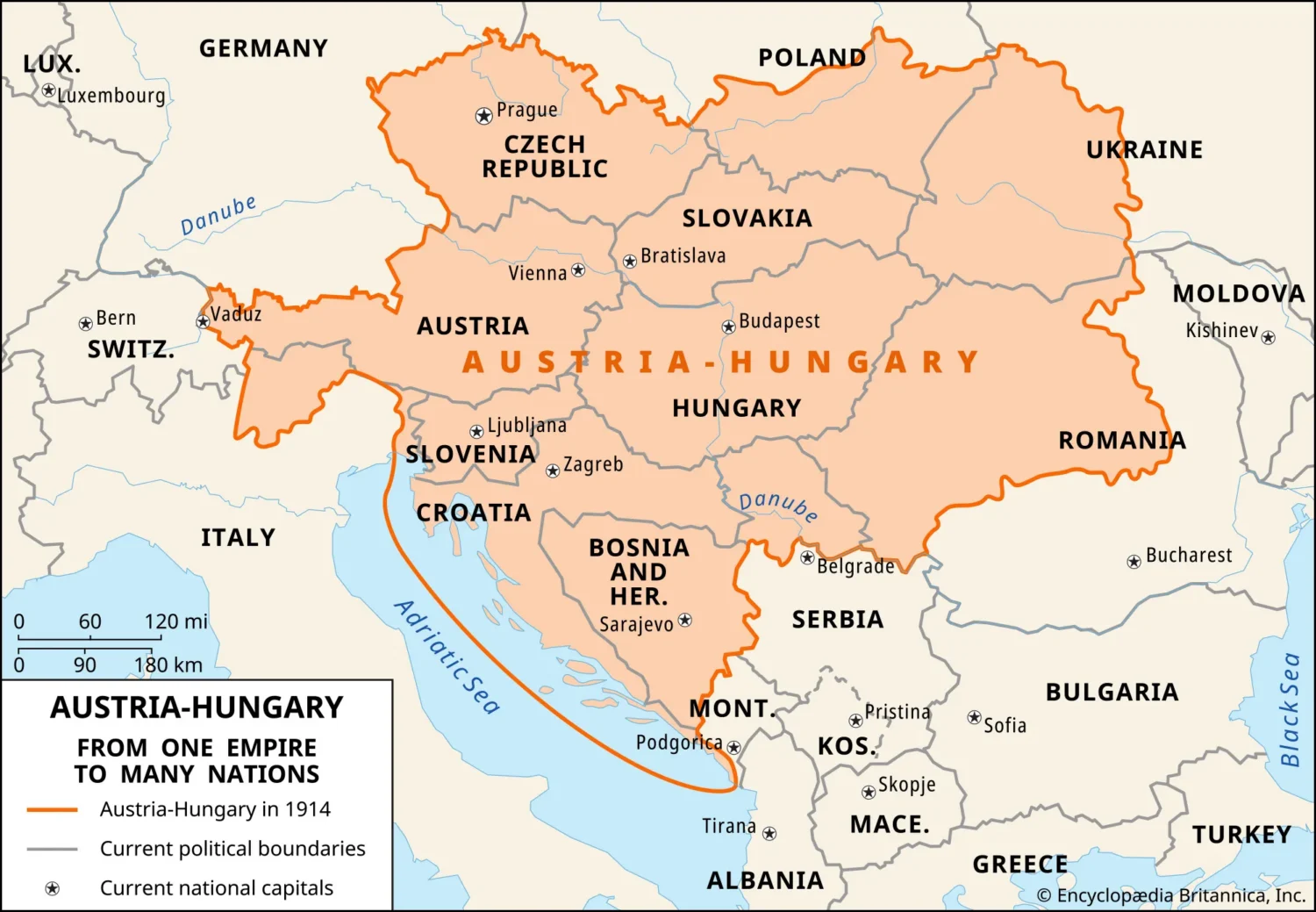
- Some examples of the ebb and flow. In its Ottoman heyday Buda was a predominantly Bosnian city of Muslim religion and Serbian language under Turkish administration. The capital of what was left of the old kingdom of Hungary was Bratislava, today the capital of Slovakia but long known by its German name of “Pressburg,” and for good reason. On the eve of World War I the city’s population was 42% German, 41% Hungarian, and only 15% Slovakian. Total war set new purges in motion: first Hungarians and Jews after World War I, then Germans and Czechs after World War II, so that Bratislava is 90% Slovakian today.
- Ethnic mixtures continue to hover uneasily over the current political scene. Vienna’s population, like Stuttgart’s, is half foreign-born. Austria as a whole is 72% native, 28% immigrant. The USA tilted to Trump when the latter figure was only half that. No wonder Victor Orbán was a hero to Christian nationalists here and there: Hungary is 98% Hungarian.
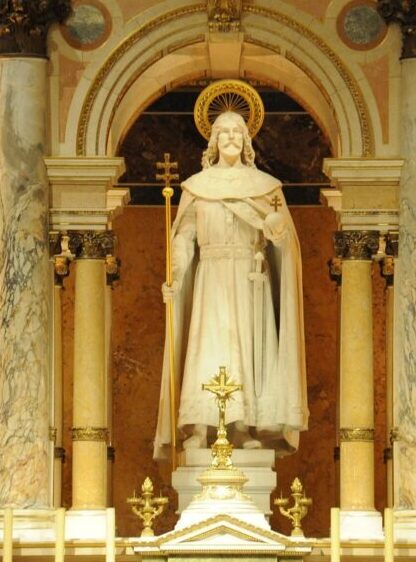
- Back to St. Stephen. The name presides over magnificent cathedrals in Passau, Germany, and Vienna as well as the basilica in Budapest. The latter was supposed to be named after Leopold, patron saint of Austria, but, being constructed amid the rising nationalist fervor of the mid-19th century, it took the name of the founding king of Hungary instead. The St. Stephens of Vienna and Passau instead honor the first Christian martyr, though Hungarians perhaps enjoy the ambiguity.
- St. Stephen’s in Budapest earned its basilica status because, right there in the reliquary, is said to be the hand of King/St. Stephen himself. Observing it was a little creepy for me but not as troubling as seeing a giant statue of the man towering over the main altar. A golden invitation to sacralize the nation.
- If its basilica and grandiose Parliament are the official big draws in Budapest, people vote with their feet to visit the remarkable string of iron shoes embedded in a promenade along the Danube River. These memorialize the thousands of Jewish Hungarians who were murdered by the fascist Arrow Cross party that collaborated with—actually, outdid—the German Nazis who took over the city in 1944. They brought their victims to the riverbank, forced them to step out of their shoes (which could be recycled), and shot them so that their bodies toppled into the river.
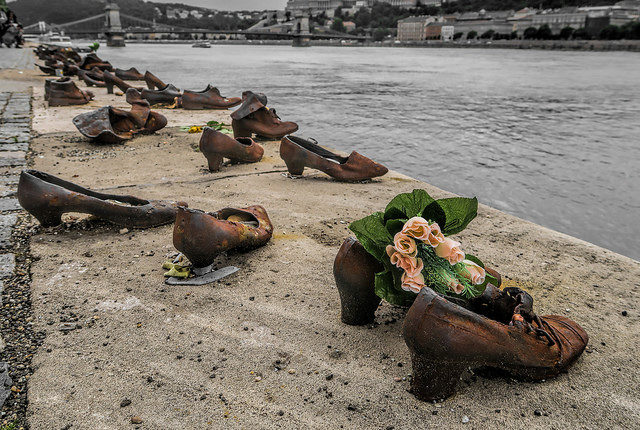
- The shoe memorial means that Hungarians acknowledge what the party-line long denied, that it was not just German interlopers but their own fellow citizens who helped promote the Final Solution. And that despite—or out of resentment over?—Budapest’s longstanding reputation as a “Jewish Mecca.” In 1900 they constituted 25% of the city’s population, offered a wide array of institutions—including Europe’s largest synagogue, still standing on Dohány Street—and an amazing roster of talent. Hungary’s authoritarian regime, though playing nice with their Nazi neighbors, resisted deporting its 825,000 Jews, leading some to hope they could ride out the storm. That made the German takeover in 1944 all the more shocking: over 400,000 were sent to Auschwitz in just two months. Most of the rest disappeared, one way or another, by war’s end, many shoeless into the river.
- Walking by the shoe memorial, we came upon a touring group of Israelis displaying their flag and singing what I presumed to be resistance songs. My impulse was to ask them about Gaza and the West Bank. The angel on my other shoulder told me not to ignore the meaning of the shoes. F. Scott Fitzgerald wondered if I—we—could “hold two opposed ideas in the mind at the same time and still retain the ability to function.”
- We came upon the Israeli group again the next day at the Dohány Street synagogue, chanting prayers around a replica of a weeping willow whose leaves each bear the name of one of the disappeared. I wandered across the memorial garden to the placards honoring Hungarian Jews who had gone on to do great things in exile. Jozsef Pulitzer and Robert Capa, headlining journalism’s hall of fame. Adolf Zukor and William Fox, film studio magnates. Michael Curtiz and George Cukor, directors; Tony Curtis, Bela Lugosi, and Zsazsa Gabor, actors; Gene Simmons, Peter Falk, Paul Newman, and Paul Simon, of the second generation. No Hungarian Jews, no Hollywood and less good music. Edward Teller and Leo Szilard—no Hungarian Jews, no American atomic bomb. Maybe a good thing, but then again, maybe it would have been produced
for the other side.
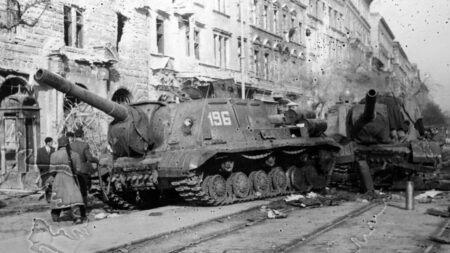
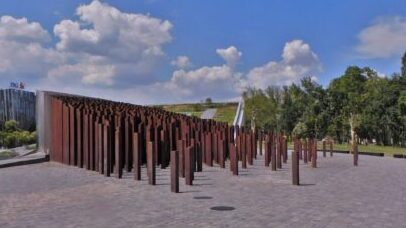
- Things got most personal for me when we encountered memorials to the 1956 uprising—“Revolution,” the signage proclaimed it—against Soviet occupation. There’s a small museum beneath Parliament Square detailing the bracing days between October 23 and November 4 when the regime was deposed only to be reimposed by 17 divisions of the Soviet army, replete with tanks. Some 2,500 Hungarians were killed in the process, and another 200,000 fled the country.
- One family wound up in my neighborhood; one of their sons attended my Christian school and played softball with our neighborhood gang at the local playground every morning, summer after summer. Alex was lean, wiry, and flinty, never backing down from disputes over balls and strikes and safe or out at first base. He certainly had athletic talent, but being a couple years older than I, I don’t know how well he did in school. In any case, he opted for the Marines rather than college.
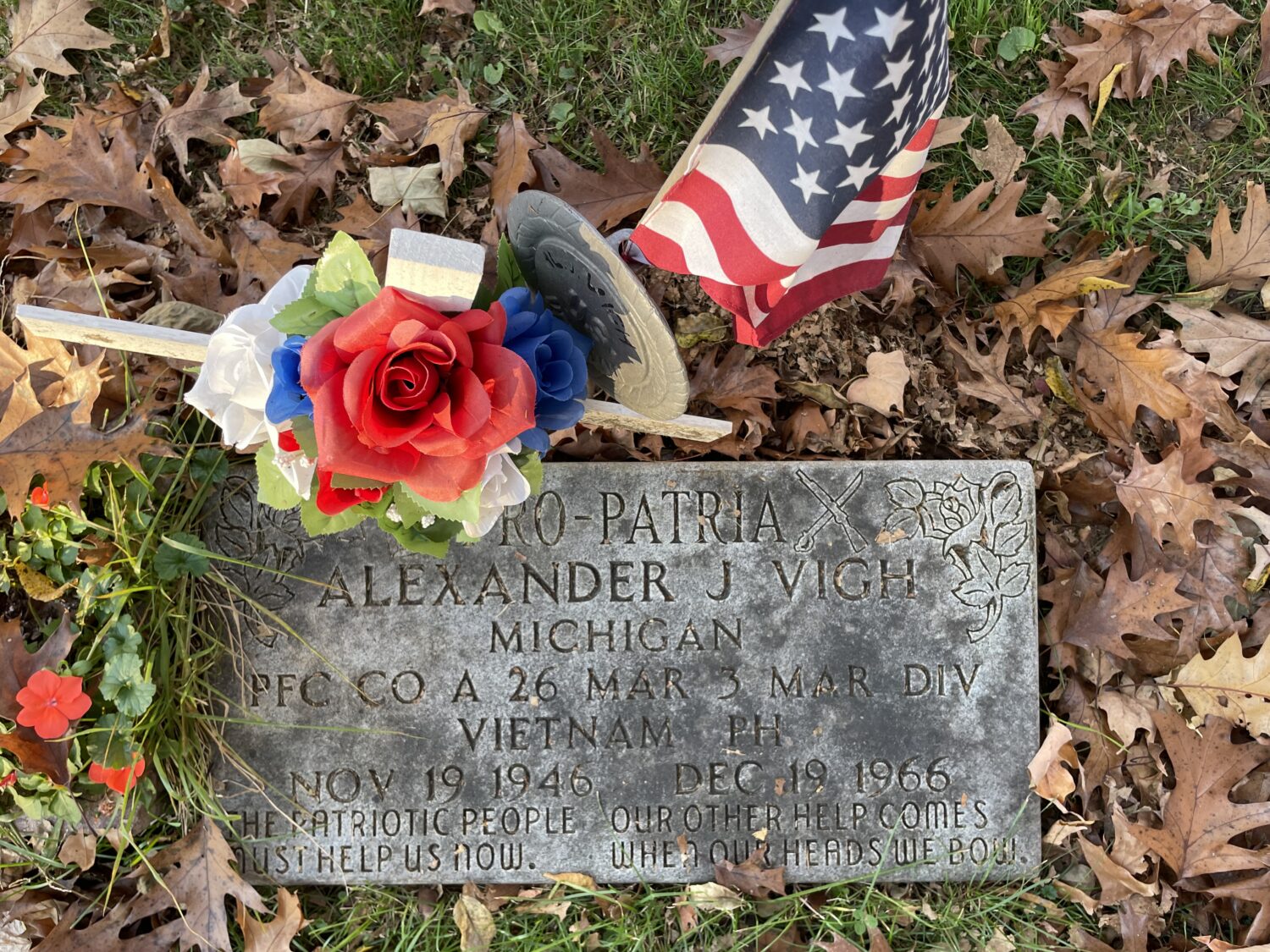
- I was still in high school when Alex died in Vietnam, 19 December 1966. He was one month past his 20th birthday and, as I heard it, had re-upped to serve a second tour. I pass his gravestone every so often on my daily walks. “Pro Patria,” it reads; “the patriotic people must help us now; our other help comes when our heads we bow.” A conventional sentiment, perhaps. But I can’t help but think that the ten-year-old who had fled Communism was taking it back to the foe ten years later in what turned out to be a lost cause. And I wonder if King/St. Stephen’s ghost hangs over Alex’s grave: Pro Patria, Pro Deo, as a redundancy.