
When I stay in my authorial lane, I write about grief. And sadness. And death. This makes sense. I’m a Four on the enneagram. According to Enneagram Certified, “While other types develop strategies to avoid pain, Fours often move toward it — believing that suffering holds the key to authenticity, depth, and self-understanding.”
Yup! And I also believe suffering holds the key to our connection to one another. Grief is the most common and inevitable human emotion, and we find hope and solidarity when we connect with each other in the midst of grief. And so, my writing grows out of that.
In fact, for many artists and writers, their craft emerges from their shadowlands – their creativity from their pain. Light writes white, as the old saying goes (i.e., happiness leads to a blank page).
The Jewish poet, Yehuda Amichai, notices that words fail when we try to describe deep happiness. “… I’ve heard people say / after nights of love and feasting, ‘It was great, / I was in seventh heaven.’ Even the spaceman who floated / in outer space, tethered to a spaceship, could say only, ‘Great, / wonderful, I have no words.’” *
So, even though it is apparently more challenging for many of us to find the words we need for a conversation about happiness and joy, that is what I’m inviting you to today.
And that invitation is what a pastor friend of mine extended to me the last time I guest-preached in the congregation he was pastoring at the time. I asked him, “What message do your people need from me?” He said something like, “Preach a message that comes from whatever you find delightful. Whatever is bringing you joy.” And so, I did. (And I’m glad I did. I’m glad the last message I offered in that Christian Reformed congregation was my Joy song and not my Anger song or my Despair song. When that church made it clear that they would never open their pulpit to me again, I found myself hoping that they would remember me for my Joy song.)
I preached from John 20 that Sunday. I talked about how – when Jesus came into the locked room where his friends were hiding and showed them his wounds – the disciples were ecstatic with joy.
And then I shared with them one of my joy-moments.
It happened right before my middle daughter’s birth.
I had just begun pushing and a nurse spread a hospital receiving blanket on my chest. Readying me to receive her.
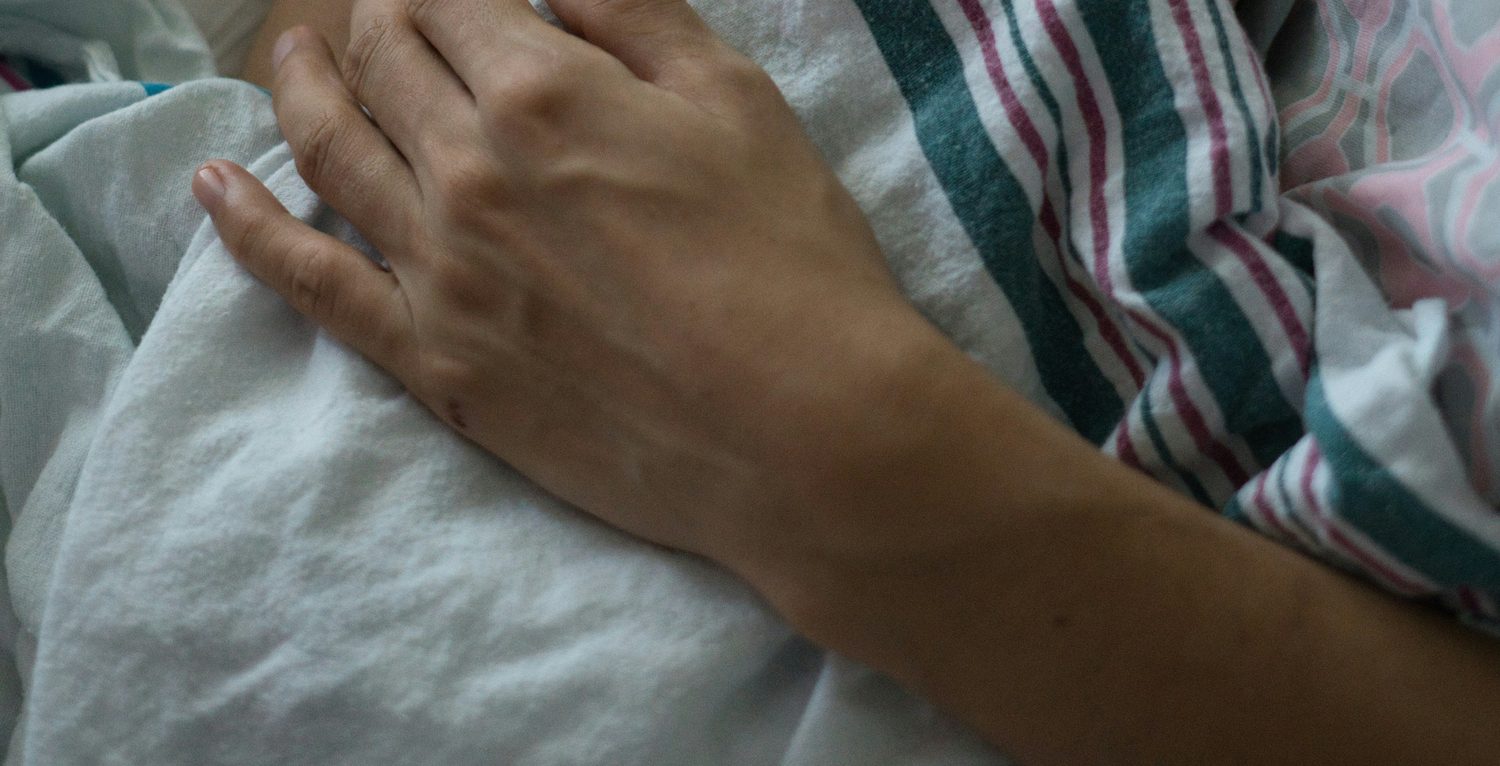
There. That’s it. That’s when joy happened to me.
Can you feel it? The longing? The anticipation? The unknown? The fear? The softness? The plainness? The emptiness? The fullness? How can I possibly describe what overtook me in that moment? It was great! Wonderful! I have no words!
I, with Yehuda Amichai, “want to describe with a sharp pain’s precision, happiness / and blurry joy,” but “I learned to speak among the pains.”
Yes, Yehuda! Me, too. The pains are my Lane! How do I speak and write in the Lane of Joy?
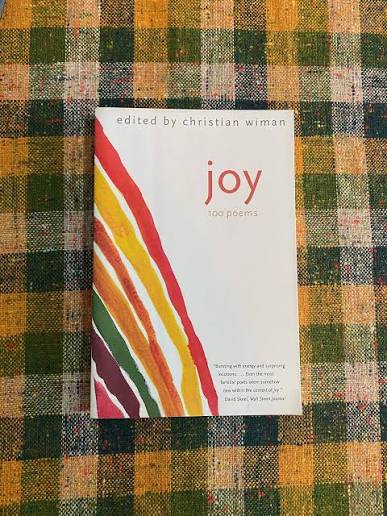
I found Amichai’s poem about the blurriness of joy in Christian Wiman’s edited collection: Joy: 100 Poems. In his forward to the collection, Wiman takes a crack at contrasting happiness and joy (as we all must do when chipping away at a definition of this second fruit of the Spirit):
Happiness is a disposition or evaluation: we are happy when we experience pleasure, when things go our way [e.g., the BLUE WAVE], and so on. Joy, by contrast, is an emotion: there is always an element of having been seized. Happiness involves enlarging or securing the self: you’re happy when you pay off your mortgage or get a raise. Joy, by contrast, always involves some loss of self, from the parent reveling in the autonomous existence of her child to the contemplative lost in religious ecstasy. (xxviii)
Kate Bowler enters the conversation with Wiman in her new book, Joyful, Anyway: “The poet Christian Wiman once said, you can’t make yourself joyful any more than you can surprise yourself.” Right? I mean, when you think of your moments of deep joy, do you not recall being the recipient of it? The direct (or indirect) object of it? Do you remember the force of it acting on you? Scooping you up and out and swirling you around before setting you back on your feet?
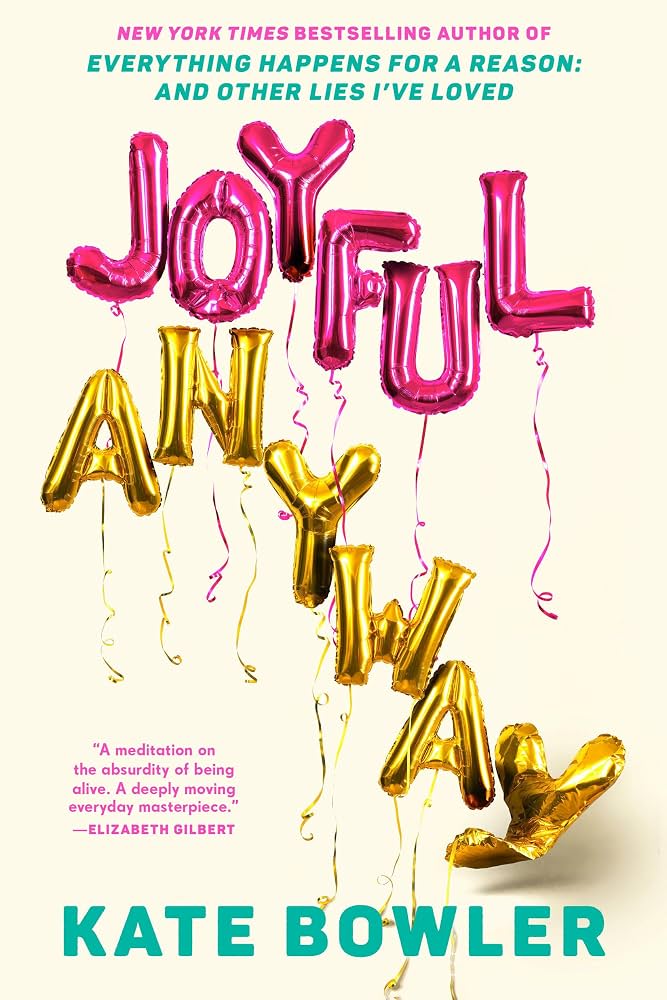
Kate writes in the introduction to Joyful, Anyway that joy is “a kind of transcendence. Joy is a glimmer of love and forgiveness and wholeness that lifts us out of reality for a moment and gives us back to ourselves anew.”
The experience of joy is transcendent, yes, but simultaneously immanent – tethered to very real and corporeal things like receiving blankets and scars on a resurrected body. With a similar paradox, joy catapults us out of time, even as we feel held by joy in the present moment. Wiman engages Kierkegaard:
“Joy is the present tense, with the whole emphasis on the present,” writes Kierkegaard. This is accurate insofar as it accords with the feeling of joy which can banish all the retrospective and anticipatory mental noise we move through most of the time. But to define joy as present tense is to keep it fastened to time, and that doesn’t feel completely right. It might be truer to say that joy is a flash of eternity that illuminates time, but the word ‘eternity’ does sit a bit lumpishly there on the page. (xiv)
Perhaps to un-lumpify the word ‘eternity,’ one might say that in the moment of joy, time and eternity spatter each other with foam.
Another joy moment in my life happened six years ago this past Wednesday: right before my mom breathed her last breath. After her last breath, I was plunged into horror and despair. I am sure that I screamed, “No no no no no!” But before. Before.
My siblings, our dad, and I crowded close around her bed.
A breath.
A pause.
A breath.
A single tear left her eye and rested on her cheek.
And I was seized – completely joy-seized – as I yelled (did I yell? I think I yelled) as though I were her doula and she, about to give birth: “You can do this, Mom! Just a few more breaths! You’re almost there!”
Can you feel it? The longing? The anticipation? The unknown? The fear? The emptiness? The fullness?
I know not all last breaths are like this. Many vigil-keepers would not describe these moments as joy-filled. But my mom was (at the least) ready and (at the most) eager to die. And that readiness readied me to be scooped up and surprised by Joy – even during one of the saddest moments of my life.
And there you have it. I’m back in my lane where I belong. Or perhaps I never left my lane. Perhaps sorrow is a wide lane that leaves room for joy to rush through. As Kate says, “Joy is the great mixed state emotion, meaning that all at once you can feel joy and sorrow and fear and pain and basically everything else, unfortunately (and fortunately).”
This lane where everything happens – it’s a good lane.
Stand at the crossroads and look,
and ask for the ancient paths
where the good way lies; and walk in it
and you will find rest for your souls. (Jeremiah 6:16)
________________________________________________________________
*Yehuda Amichai’s poem excerpts are from: The Precision of Pain and the Blurriness of Joy: the touch of longing is everywhere.
Receiving blanket image – cropped from a Photo by Brian Wangenheim on Unsplash
Road Header image – Photo by Patrick Tomasso on Unsplash

4 Responses
Most excellent, clarifying, and very stimulating, thank you. It’s all like this in the Psalms too.
Hi Heidi, thank you for this beautiful reflection on finding the lane of joy — I was especially moved by your two joy-moments, the hospital receiving blanket just before your daughter’s birth and the single tear on your mother’s cheek after her last breath, and by the image of joy seizing us in the midst of grief.
“The pain now is part of the joy then…that’s the deal.”
Joy Davidman Lewis in movie
Shadowlands.
There is another line in the same movie, “We read to know we are not alone.” Your writing Heidi, does that for me. Thank you.
Yes. Yes. Yes.