I don’t write quickly or easily about God. Over the years I’ve written essays about childhood religious formation, about faith and parenting, about art that illuminates something of the sacred, but when it comes to naming the divine directly, the words get stuck.
Maybe it’s a misguided fear of being labeled a “Christian writer.” Even more than that, I’m struck by words of Barbara Brown Taylor to the effect of this: Preachers use religious words as if they are made of stone, when in fact they are made of air. We want to believe those big words have fixed, shared meanings. That they’re made of stone. What if they’re made only of air, or ink, or bytes and pixels? I worry the wrong words will convey a certainty I don’t always feel. I worry they will assume a shared belief with readers, when what I want to invite is a shared wondering. The words get stuck.

1956-2017
This is a piece about things that help them get unstuck. The topic leapt to mind, as so many good things in my life have, while reading the late Brian Doyle—essayist, novelist, magazine editor, devout Catholic, and a hero of mine. “The Coach of all things” is his name for God in a short little prose poem, “Prayer for Dads Enduring the Epic Winter Rains Along the Muddy Sidelines at Pee Wee Soccer Games.” The piece is pretty much what it sounds like: a playful, tender prayer for parents on the sidelines of youth sports everywhere, enduring crummy weather and missed referee calls and forgotten snack duty and hilariously low-level play. (I have two athletic-minded sons; I spend a lot of time on sidelines.)
There is humor and affection in the piece as young footballers “surround the ball like wolves around a deer and happily kick each other in the shins”—an ode to the beautiful game if there ever was one. And there is a sharp twist near the end that caught my breath: “this cold wet hour is a great hour, for you are with your child, and your child is happy, and the Coach of all things gave you that child.”
It caught my breath because it reminds me this stage of life is fleeting, and I’ll be missing those rainy mornings at the park before I know it.
And it caught my breath because it shows that naming God doesn’t have to be a somber thing. We can address the divine with affection as we would nickname a lover or friend.
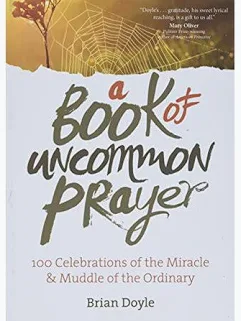
That got me thinking about other places I’ve found help naming God. There’s so much in Doyle’s writing. In one book alone—A Book of Uncommon Prayer—there is Coach and Composer and Dreamer and Breath and Manager of all Bands, each lodged in a tender idiosyncratic prayer-poem.
Beyond Doyle, I think of campfire praise songs I haven’t sung in years. I think of my parents at the dinner table, using everyday language, always situating our lives in a web of relationships—family, church, nation, creation, petitioning for the health of all. I think of my aunt teaching Sunday school to a table of fifth graders. Using some worksheet lost to time, she walked us through a series of grainy black-and-white pictures that offered metaphors for God. There was a high-walled castle lined with turrets. There was a shepherd in close-up, somehow more vivid and tender than typical stock art, cradling a lamb in his arms. I can’t remember the rest.
Our table of 10-year-old boys was drawn to the mighty fortress. My aunt guided our attention to the shepherd, asking us to consider what it said about God.
Why do I remember this, three decades later?
The worksheet may have held a judge looking down in accusation. It was certainly one of the images for God I picked up as a child. Names for the divine can be misleading, harmful, or just severely limited. There is a place for caution and precision in how we give language to the sacred. There is a place for taking off one’s sandals as we approach. But there’s a place, too, for playfulness. In a culture that prizes efficiency over friction and texture, it’s the weird and surprising names that I find life-giving.
A few more of Doyle’s: the Imagination, Forgiveness, Coherent Mercy, Bus Driver, Publisher of All Things, Breath Who Drew Everything into Being.
It’s “Coach” that I’ve been drawn to lately. I love being a parent on the sidelines. This fall, with another neighborhood dad, I coached my younger son’s team, preaching the gospel of give-and-gos (learn that elemental move and you can beat anyone) to a crew of talented and squirrely ten-to-twelve-year-olds.
I’d drive home with a hoarse voice and a happy kid. I’m grateful for every minute of it. But the truth of the matter is that I want a Coach too. I want a coach who offers unconditional support as well as instruction and critique. I want a coach who helps me see my place on a team.
Like any metaphor, “Coach” has its limits. A coach might help you access potential you didn’t see in yourself. A coach also might bench you or underestimate you. But the image speaks to my desire to keep growing and find a sense of camaraderie.
Like a modern-day Psalmist, Doyle helps us understand our longings more clearly. It’s one of the coolest things that language can do: Become a form of connection and a form of prayer.
Header photo by Debra Brewster on Unsplash