If Martin Luther had not been such a hotheaded young monk and the pope and his cardinals had been better listeners, all of us Western Christians might be Roman Catholics today. This past Reformation Day – the name that we schismatics apply to All Hallows’ Eve – I pondered whether it’s time to swallow our objections to Catholic Eucharistic theology and doctrinal authority and come back to the fold.
I am not finding fault with my vibrant and supportive Protestant church families, both in Michigan and in Arizona. But I have been moved and inspired by the extraordinary vision and courage of both the current occupant of St. Peter’s throne and his predecessor in addressing the impending climate catastrophe that we have brought upon ourselves. Many Protestant church leaders have furrowed their brows and wrung their hands and offered vague admonitions to take better care of creation. Others have spoken out more forcefully, from the pulpit and in the streets. But Rome has outdone us all, pulling no punches.
The first words of the papal encyclical, Laudato Si’, promulgated by Pope Francis in May, 2015, are drawn from his sainted namesake’s “Canticle of Creation.” Addressing a long list of topics in theology, politics, and science, citing a wide range of Catholic and other theologians in 265 numbered paragraphs and 175 footnotes, the Holy Father addressed his urgent plea for greater awareness and more effective action not just to his own global flock but to people of every faith and every nation.
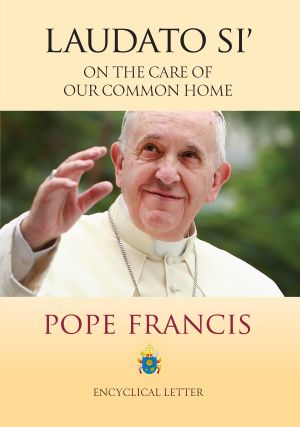
“Praise be to you, my Lord”. In the words of this beautiful canticle, Saint Francis of Assisi reminds us that our common home is like a sister with whom we share our life and a beautiful mother who opens her arms to embrace us. “Praise be to you, my Lord, through our Sister, Mother Earth, who sustains and governs us, and who produces various fruit with coloured flowers and herbs.” (Laudato Si’, paragraph 1)
We must begin, Francis insisted, by confessing the grievous harm we have done to our “sister mother” by our neglect and exploitation of the natural world. We must join an “integral ecology” with each other and with the natural world, taking bold action as individuals, as churches, and as nations.
This sister now cries out to us because of the harm we have inflicted on her by our irresponsible use and abuse of the goods with which God has endowed her. . . . The violence present in our hearts, wounded by sin, is also reflected in the symptoms of sickness evident in the soil, in the water, in the air and in all forms of life. This is why the earth herself, burdened and laid waste, is among the most abandoned and maltreated of our poor; she “groans in travail” (Rom8:22). (Laudato Si’, paragraph 2)
The pope’s impassioned plea helped shape the Paris Agreement on Climate Change of December, 2015, a binding international treaty setting out ambitious but attainable targets for limiting global warming. On the tenth anniversary of Laudate Si’, Francis’s successor Pope Leo XIV called attention to the nations’ failure to meet the goals they set and to some politicians’ denial that there is a crisis. Addressing the Pontifical Institute of Science, the Pope renewed his predecessor’s plea to open our eyes to the damage we have done and work for the healing of our mortally wounded planet. After all, he added, “the climate question is not merely an environmental challenge, it is fundamentally a question of justice, human dignity and solidarity between peoples and generations.”
On our side of the ocean another leader, in the political rather than the religious realm, has worked tirelessly to repudiate and reverse his own predecessor’s climate actions and policies. Global warming is a hoax, declares US President Donald Trump. Our priority must be to prop up the fossil fuel industry and rescind any impediments to the prodigious profits collected by its owners, who by a surprising coincidence are among his most generous donors. By dismantling environmental science labs, firing inspectors, reversing fuel standards, opening national parks and forests to oil and gas production, and appointing oil tycoons and their lobbyists to regulatory agencies, the Trump administration has reversed decades of progress toward environmental healing. The rate at which environmental regulations are discarded is likely to accelerate in the months following the stunning repudiation of Trump’s party on November 3. The President and the lame duck Congress will probably do all they can to prevent future restoration of environmental protections.
But in September 2026, a year after the Pope’s urgent plea, Trump’s efforts to impede climate healing suffered a surprising reversal. A US Court of Appeals declared that the Trump administration’s “emergency order” 15 months earlier to reverse the shutdown of the J. H. Campbell coal-fired generating plant in West Olive, Michigan, had been both illegal and unconstitutional. Already a year into a long-planned decommissioning process, Consumers Energy had been ordered to shovel in the coal and burn, baby, burn.
Environmentally, generating electricity by burning coal is the worst way to produce electricity still in use, increasing the rates of lung disease and asthma in every community near a plant. The utility had determined years earlier that the plant was no longer viable after 50 years of service, and in any case was no longer needed as other sources came on line. These sources – solar and natural gas – are less toxic, but the decision was driven more by cost than by environmental concern. (Natural gas is not as environmentally benign or as inexpensive as photovoltaic panels, but many utilities will continue to use it in the short term.)
For the Department of Energy under President Trump, however, neither a cleaner environment nor a reduction in energy costs outweighed the profit margins for fossil fuel interests. In June 2025, the plant was ordered to re-open for 90 days, the longest allowable period. Another edict was handed down 90 days later, and another and another – five “temporary” emergency orders so far. Compliance with these senseless directives has cost the utility $295 million already, increasing our home energy costs for years to come.
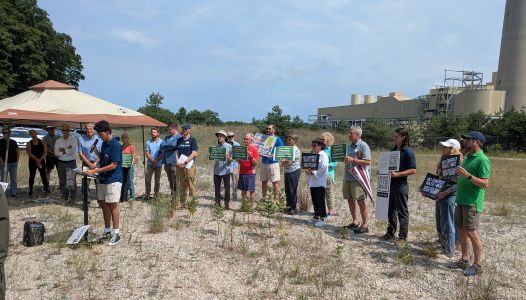
I have lived in West Olive since 2006. I pass the Campbell plant on my favorite cycling routes, and from the bridge that crosses its rail line I used to see endless strings of freight cars piled high with coal from the Powder River Basin on the Montana-Wyoming border. My wife and I live three miles to the north, and when the wind was out of the south, gray soot would coat our windowsills. Levels of large particles have been reduced over the years by better scrubbers, but Campbell remains one of the two largest sources of pollution in Michigan, sending more than 9 million tons of carbon dioxide and 5.4 thousand tons of sulphur dioxide into the air we breathe each year in addition to large and small combustion particles. The Global Energy Monitor project, where I found these figures for 2024, estimates that these pollutants cause 140 deaths and 2300 asthma attacks annually.
Early in 2025 the line of coal cars became shorter and shorter until all of the fuel had been burned. But now the line stretches far down the track once again. We have participated in a number of protests and press conferences near the site of the plant, organized by the Michigan chapter of the Sierra Club in cooperation with other environmental organizations. Michigan’s governor and members of its Congressional delegation have lodged their objections as well, to no avail.
Utility representatives have told us they understand our concerns and assured us that they will continue to build their renewable energy capacity, but they have no choice but to follow the Energy Department’s orders. The forced extension of coal-fired power has attracted media attention in the US and beyond. My wife’s comments at one event were reported in the Wall Street Journal, while observations that I made appeared in a news story in The Guardian. But the Trump administration continues to order one after another “temporary” order, guessing correctly that by the time legal cases worked their way through the courts the coal barons would have pocketed millions in profits. When all three Campbell units are in operation they burn about 10 thousand tons of coal, the content of 100 rail cars, each day.
The federal appeals court did not mince its words in declaring the order to restart Campbell both an illegal abuse of executive authority and a violation of state authority under the Constitution. But its ruling referred only to the first order in June 2025, not to the four others. So the plant continues in operation today, polluting our air and hiking our utility bills.
It is difficult to imagine a greater gulf, in behavior and in spirit, between the Trump Department of Energy in Washington and the Holy See in the Vatican on matters of creation care. What would the world be like if Pope Francis’s appeal had catalyzed a fundamental shift in both attitudes and policies with respect to global warming? The Paris Agreement has been honored more in rhetoric than in action, but when national governments have had the courage to act the results have been encouraging. A climate tracking website reports that 11 nations have essentially achieved their targets, from Norway to Nigeria, from Chile to Morocco. Twelve more are nearly there, among them the UK, the EU, Japan, Peru, and South Africa. Australia has moved so quickly to bring solar sources on line that electricity is now free for three hours each day in Sydney and across south Australia. Vatican City expects to be entirely self-sufficient in renewable energy within a decade or two. But the United States is one of just eight nations judged “critically insufficient” in meeting its commitments, along with Russia, Turkey, and Iran.
The legally binding commitments to cleaner energy and lower carbon emissions contained in the Paris Agreement were approved by all 195 voting members of the United Nations General Assembly in 2015. In 2026, although many of them have made “insufficient progress,” only four openly defy its requirements. Iran, Libya and Yemen voted for the measure but failed to ratify it. The United States voted for it, duly ratified it, and enacted laws and policies to work toward its goals. But President Trump renounced the treaty and withdrew US participation. President Biden reversed this senseless decision, but President Trump withdrew again in his second term.
Where can we look for courageous guidance as we face an ever-warmer world, with forest fires and tropical storms becoming more frequent and more destructive each year, mortality from polluted air and water mounting, and crop yields diminishing? Not to Washington, in the lame duck months of the current administration, and the environment is not likely to be at the top of the list for the new Congress. Our own local climate groups and our congregations can offer advice and help us organize. And we will all do well to listen to Pope Leo, even if he is not the head coach of our particular team. He is showing us all how to preach the Gospel to the powerful.
News articles mentioned: