
Spouse Ron and I have started watching the new season of the Lord of the Rings backstory series, Rings of Power. In the first episode of season 3, we witness rising Bad Guy Sauron consolidating his power, forging the One Ring, seeking ultimate control.
“I don’t get it.” I said to Ron as we watched. “Why would anyone want to be king? Sounds like a terrible job.” I felt the same way about Darth Vader in Star Wars series. Together we shall rule the galaxy. Why? What a hassle!
Yet something in us loves a king. Bad guy kings and good guy kings. Often the would-be tyrant character isn’t even provided with a motivation. A bad guy who wants ultimate power? That’s just a given. At least in this episode, Sauron undergoes a brief moment of psychoanalysis, courtesy of the sort-of ghost of the elf Celebrimbor: “The machinery of your soul is missing a piece,” he tells Sauron. “The [piece] that allows for a true bond, a true union with another being. So in place of connection, you seek control.”
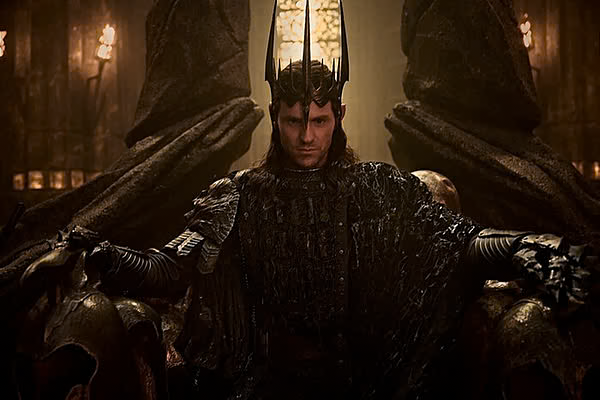
Yikes. Yeah, that explains a lot about certain public figures these days. In a way, though, the question of why some people become obsessed with possessing ultimate power is not that interesting: chalk it up to sin—in particular, the age-old desire to become as a god.
More interesting, I suppose, is why people would want to serve a king figure. Power is notoriously brittle, so that people with ambitions for power can’t have that power unless enough others want to give it to them. Why would anyone want to?
Carl Jung might say that the king figure exists in our collective human subconscious. We’re just wired for hierarchies; we’ve got a built-in king mode. Maybe that explains, even in aspirationally democratic societies, the ongoing fascination with monarchs in our fictions and entertainments. Lord of the Rings, for example, certainly warns against evil tyranny, but it also takes the heroic king-savior figure for granted. To bring peace to the land, of course you need a good king. And obviously, this good king has to defeat the bad guy through an elaborately choreographed, brutally violent cinematic battle. (Yes, the real defeat is about relinquishing the ring to destruction–a crucial point–but as the audience, we still want that battle and that good king.)
I worry about this need for a king-savior in our imagination. It’s a little like fantasizing about winning the lottery. Wouldn’t it be wonderful if a good king came along and fulfilled all my hopes and expectations? “You will fix our problems! Just run everything and we’ll do what you say! No matter what!” What a relief!
That’s it, isn’t it? What a relief not to have to discern or decide or navigate moral complexities. Being a mature citizen is hard and exhausting. How much easier to be a serf! Put someone at the top of the pyramid and we’ll just bow down at the bottom. So much easier. Whew!
Thus my ambivalence about Christ the King Sunday, observed to conclude the church year before we begin again in Advent. The observance began in 1925, when Pope Pius XI sought a response to rising nationalism and authoritarianism after World War I. The point was: stop looking for earthly kings! Christ is king over all kings! Yes. And there’s plenty of beautiful biblical verse and imagery to support this. So this week, we observe Christ the King Sunday, packed with king metaphors and thrones and bowing down. ‘King’ rhymes with ‘sing’ and ‘bring,’ which makes writing great songs about Christ’s kingship a cinch.
Of course, Christ is not like earthly kings. That’s the point. So in our worship, we’re supposed to land emphatically on Christ’s kingship as distinctly different from earthly kingship: Christ as lamb and shepherd, healer, defender of the helpless, the righteous judge. We’re setting up for the infant in the manger. And we’re supposed to honor Christ as king precisely in order to obviate all earthly kings.

Unfortunately, I don’t know if that’s what happens in our spiritual imaginations. Instead, with our minds full of king imagery—probably more of it from our fictions than from scriptural Christ-images—we remain drawn like magnets to earthly instantiations of power. Centuries after modern political theory set aside a divine-right-of-kings ideology, we still conflate the mysteries of Christ’s kingship with our preferred earthly analogs.
Thus I wonder if too concentrated a dose of king-language forms us in a kind of passive, immature discipleship. I worry that we can fall into “infantile authority fantasy,” in which we become vulnerable to earthly powers who set up hierarchies and authority structures and promise to take care of everything if we just surrender to them. (You’ll recall that when the Israelites beg for a king in I Samuel 8, God is not a fan of the idea.)
To address the obvious modern example, this week’s essay in Sightings, the newsletter of the Martin Marty Center at the University of Chicago Divinity School, offers a concise, sober examination of how kingship imagery gets twisted to justify Christian nationalism. The author, Charles Hawkins, considers the question of how people of faith rightly participate in the larger political life of a nation. “The problem is not that Christians bring theological convictions into political life” he writes. “It is that the authority of Christ can become indistinguishable from the authority Christians seek for themselves.”
Those with a will to power can easily justify themselves by claiming to be Christ’s chosen authorities, God-ordained to rule over others. And because some part of us loves the idea of a king, we can fall for this. I just finished Kristin Du Mez’s new book, Live, Laugh, Love, which explains in astonishing detail how White evangelical women have been formed to cheerfully (cheerfulness being required) submit to male authority. I spent the whole book thinking, But why put up with this? Evidently, I would make a lousy “fascinating woman.” Nevertheless, we are now reaping the bitter fruits of these intricate control structures in the form of Christian nationalism. It’s all based on a form of infantile authority fantasy: if you submit, you will be blessed. Everyone else: the enemy.
Worried about our tendency to distort Christ’s power into human control structures, Hawkins concludes his essay with this warning about Christ the King observance: “The question is whether proclaiming Christ as King requires Christians to seek supremacy over their neighbors—or whether that proclamation places their own ambitions for power under judgment.”
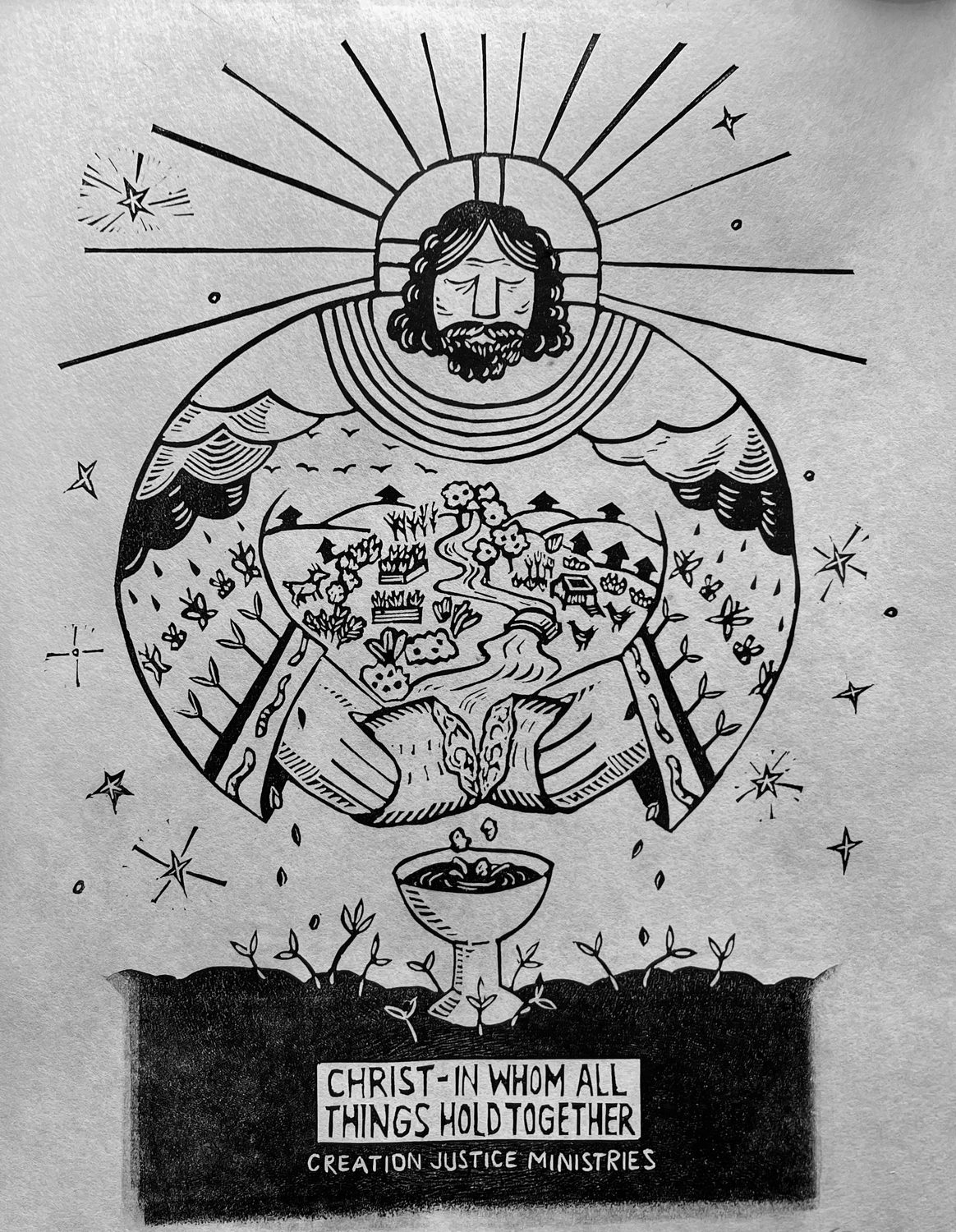
I understand the reasons for Christ the King Sunday. But I hope our worship services will double down on the gospel’s radical re-imaginings of kingship. We can’t let our desire to serve God turn us into easy servants of earthly powers. Ultimately, I don’t think God wants serfs bowing down at the bottom of a power pyramid. God wants to grow us into responsible and loving citizens in a resurrection community. In other words, Christ turned that pyramid of power into a circle, gathering his disciples around him and assuring them: “I have called you friends.” The distant throne and an iron scepter become, instead, the embrace.

9 Responses
This is packed with wisdom. So relevant. Thank-you.
I was excited to see the Spiral Speak art – you showed it at our church during Refugia class but couldn’t put a finger on the artist. Lots to mentally chew on again. Always look forward to your articles.
Yes! Sam Brown. And I should point out that we have purchased one of his prints, so I hope he won’t mind if I use this image in the post!
Thanks for bringing out what has bugged me in my subconscious about this Sunday but I never bothered to examine. At least the RCL gospel is Matthew 25 with the sheep and the goats, which has its own problems, but at least it emphasizes the Son of Man’s preference for compassion over power.
So much to ponder!
“I (also)worry that we can fall into “infantile authority fantasy,” in which we become vulnerable to earthly powers who set up hierarchies and authority structures and promise to take care of everything if we just surrender to them.”
It fits with my —along with many others, wondering if I/we are losing our ability to critically think. A late-in -life awareness that because I admire a persons “wisdom”, doesn’t mean they are ALWAYS right. It takes effort on my part, as you point out, to do my own research, courage to listen to another point of view, use the brain and conscience I was given to think for myself.
Timely. Thank you
Of course, to move away from the male-centric word “King,” many churches now observe Reign of Christ Sunday tomorrow. Thing is, it’s still Christ the King doing the reigning so . . .
Yes, we could definitely go into the gender reasons to be cautious about all that king language. I’ve written whole chapters on that in the past. As you suggest, though, the issues go deeper even than gender.
“God wants to grow us into responsible and loving citizens in a resurrection community. In other words, Christ turned that pyramid of power into a circle, gathering his disciples around him and assuring them: ‘I have called you friends.’”
Yes – let that be the pulpit theme tomorrow as we worship.
Thank Debra. When I participated in a No Kings event, I carried a 2×3 yardstick cross that had the words, “We have no king but Jesus.” When writing my systematic theology, I noted that Jesus did not meet the people’s expectations of a king, but he did meet the Father’s expectations of what kings were to do: meditate on and follow God’s will, protect the people and bring justice to those who are marginalized (based on Deuteronomy 17 and Psalm 72). Jesus is not an aloof king, but a king who is in our midst (Zechariah 3:15). Tellingly, Jesus talked mostly about the kingdom of God, instead of himself or his Father being a King. He did not highlight his own royal power and prestige, but was a servant kind of king who empowers his people to also serve. Thanks for warning us against portraying Jesus as if he were only a larger version of today’s power-hungry politicians.