
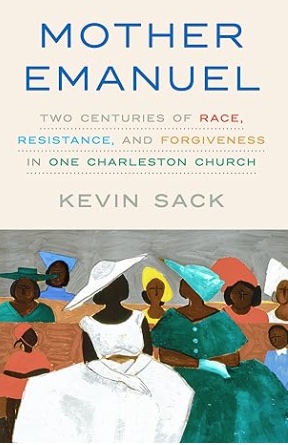
For New York Times journalist Kevin Sack, one thing led to another. In 2015, he covered the mass shooting of a Black pastor and eight Black parishioners participating in a Bible study at Mother Emanuel Church in Charleston, SC. As Sack followed the prosecution of Dylan Roof and the aftermath of this tragedy, he dug deeper into the context of this terrible event and this resilient church.
As Sack explains so well in Mother Emanuel: Two Centuries of Race, Resistance, and Forgiveness in One Charleston Church, this shooting did not happen in a vacuum. To understand why a mass shooting at this particular church was significant, it helps to know the history of Charleston, how Black churches were established in the South, and the background of Mother Emanuel’s denomination—the African Methodist Episcopal Church (AME). Sack covers all this ground based on thorough research, including over 100 interviews.
My husband, Jerry, and I visited Charleston in the fall of 2024. It’s a city of contrasts, with its beautifully preserved 18th- and 19th-century architecture and the 2023 International African American Museum, built at Gadsden’s Wharf, the disembarkation point for almost half of the enslaved Africans brought to the U.S.

International African American Museum
Sack’s book added much to what I learned in Charleston. Early in the city’s history, the white population found every way possible to control Black access to opportunity. Enslaved persons could not be taught to read. They needed passes to move beyond their plantation, and even then, they could be murdered with impunity.
Still, enslaved persons were taught Christianity. A key justification for capture in Africa and slavery in America was that these “heathens” could be eternally saved from their ignorance. Sacks explains how, somehow, enslaved Blacks found comfort in the religion of their oppressors and adapted Christianity for themselves, taking special hope from the biblical stories of deliverance.
Sacks reminds us that not all White American Christians supported slavery. At a 1784 conference, the Methodists called for abolition, correlating this call with Black freedom and the fundamental rights of man. Unfortunately, Methodism seesawed on the issue when a hard-nose position would limit its denomination’s growth in the South.
Even in northern churches that opposed slavery, racial discrimination was pervasive (such as seating segregation and leadership ceilings). After reform efforts failed, Black preachers such as Richard Allen determined they needed their own religious body, which led to the formation of the AME. Though it started in Pennsylvania, the AME exploded in the South following the Civil War.
One day, walking back to our hotel from a restaurant, Jerry and I passed Mother Emanuel (Emanuel African Methodist Episcopal) Church. Signs told us that this was not only one of the oldest Black churches in the South, but also where the 2015 shooting had occurred. Hoping to step inside, we found the door locked. However, a kind custodian allowed us to look around. At that time, I had little understanding of this church’s legacy. After reading Mother Emanuel, I do.
Here’s more of what I learned from Sacks. Mother Emanuel has been a hub of liberation proclamation and resistance to oppression since its predecessor, the “African Church,” was formed in 1817. After the Civil War, churches from the north helped fund a building dedicated in May 1866, at which time the congregation was called Emanuel.
In line with the AME, Mother Emanuel’s proclamations involved not only freedom from sin but also freedom from discrimination. Church leaders were often also politicians and activists, advocating for equal rights in property ownership, public education, and other areas. As they argued for these reforms, they often kept the rhetoric “soft,” even expressing forgiveness for past injustices so as not to alarm the white people they needed to convince.
As time went on, Mother Emanuel hosted a range of speakers, some calling for a focus on Black self-improvement (e.g., Booker T. Washington) and others advocating more forcefully for an end to oppression (e.g., W.E.B. Du Bois). Under their fearless leader, Rev. B.J. Glover (pastor from 1953-1965), Emanuel was on the front lines of the Civil Rights Movement, with Glover leading boycotts of stores with segregated lunch counters and the integration of public schools.
In 2015, Emanuel’s pastor, Clementa Pickney, felt the weight of his congregation’s legacy—existing not only for the salvation of souls but for the betterment of the world. As a member of the South Carolina General Assembly, he argued for reforms such as police body cameras; from the pulpit, he encouraged parishioners to register to vote.
Sadly, Rev. Pickney was one of the individuals killed on June 17, 2015. One wonders how he would have viewed responses to the tragedy. The day after the shooting, the teenage son of a victim said to a journalist, “We already forgive [the shooter] for what he’s done.” And at the sentencing hearing of Dylan Roof, several family members of victims voiced forgiveness—forgiveness to a man clearly motivated by white supremacy and lacking any remorse. In the second term of America’s first Black president, Roof’s goal had been to stoke fear and motivate the white population to resist “what [Blacks] are doing to white people every day.”
So, forgiveness without repentance? Sacks explains that for some African Americans, for centuries, forgiveness has been a necessary discipline for survival: without it, the anger and bitterness of forced removal, enslavement, Jim Crow, lynching, profiling, and discrimination would destroy them.
Some in the Black community criticized this “easy” forgiveness, saying that it gets society off the hook for White supremacy and systemic injustice. Given how tolerant America has been of our current president’s less-than-subtle racism, this criticism seems warranted. Even after the Black Lives Matter movement calling out police brutality, we still returned power to people who disparage and discriminate based on race and country of origin.
As Sack writes, “Black Charlestonians [and Black Americans more generally] have had a lot to forgive” (p.337). This book’s Epilogue, “On Forgiveness and Grace,” stands on its own as worth reading; it includes perspectives on forgiveness from Dietrich Bonhoeffer, Isabel Wilkerson, and others. At a time when the federal government is removing historical signs and webpages pertaining to Black history, this book seems particularly important. When pastors are being critiqued for being too political or not political enough, perhaps this book can help. To continue our journey toward a more perfect union (and a more perfect Church), we benefit from accounts such as Mother Emanuel.
9 Responses
Thanks, Kim, for this strong reminder of the deep roots and current manifestation of racism in America.
Thank you for this review. Sounds like a book to order!
Hi Kim: Thanks for this review. I understand why people might question the wisdom of quick forgiveness. Joseph took his time forgiving his brothers. But I have found Lewis Smedes helpful on this matter in his book, The Art of Forgiveness. Briefly, he says “I worry about fast forgivers. They tend to forgive quickly in order to avoid their pain…we’ll have to come to forgiving, but not while the boot is still on our neck…But if it is risky to forgive too quickly, it is even more hazardous to wait too long—when our rages settles in…Forgiving is something good we do for selves…We should not be kept from healing by the muleheadedness of a heel who wounded and wronged us and will not even own up to it…When we forgive someone who is not sorry for what he has done, we do not forget, and we do not intend to let it happen again.” I’m sorry that the Black community has had to deal so often with forgiving oppressors.
Thanks for this review. Jesus said that forgiveness is not just necessary for survival, but also for salvation. This American Black community is showing the world how to do it.
Kim, I too appreciate your review of a new book. I became a advocate for Black people who were put through American slavery with such literature. I was also largely helped by the 60’s which was the Civil Rights decade. My eyes were opened up to such terrible and sinful treating of a part of God’s creation. I do wonder if we have learned anything today with the atrocious actions of the current administration. I feel some pain and anxiety for this generation of Black people facing the world.
My wife and I visited exactly one year after the shooting. We simply wanted to experience their worship service and meet them. The service was deeply moving both musically and emotionally.
Their new pastor was installed that morning who was so kind to us. We met a couple who ended up sending their daughter to Awakening. We are still friends. Their conscience acts of forgiveness has been an example to the world and to each of us personally.
Great review, Kim. I need to add this book to my list!
Thank you Kim.
Thank you, Kim.i am adding this book to my reading list.i appreciate your thoughtful reflection on it, made even more meaningful by your personal experience of visiting the church. I’m always amazed by the black people I get to know in anti-racism work in St Louis who have forgiven so much (released, as they often put it). Many say they make efforts to frame the memories of the wrongs committed against them and their people in past and present to energize them for the work at hand.