
In 2008, I moved to Ottawa, Ontario for work. New city, new province, new job!
A well-intentioned family member suggested I connect with distant relatives who lived in Ottawa. They could introduce me to others at their Christian Reformed Church. It would be an ideal way to build connections in a new community. I flatly refused.
The church should be a place to find community, and I had decided I would find an affirming church. I was starting to let a few people close to me know that I was gay. I had had some negative experiences with unsupportive Christians. As I started a new chapter of my life and moved to a larger city, I knew I could find a welcoming community.
I am thinking back to this because last month I wrote a blog here about the possibility of a church without homophobia. A few readers asked about getting there. Imagining a world without discrimination is one thing. It’s much more to think about how we get closer to it. It seems so far away.
Let me tell you what finding an accepting church meant to me.
First, some context. I grew up attending an evangelical church that believed being gay was deviant and sinful. As I was finishing high school, a few innocent people mentioned reparative therapy as a possibility. Thankfully, I never participated in any such program. Still, I saw being gay as something needing correction.
Then, as a university student, I became increasingly aware that my sexuality was an innate part of who I was. Perhaps being gay was something to appreciate rather than hide. At the same time, I was deeply involved in student life at the Christian university I attended and I worked part time at a church leading youth programs. The university had a clear stance against gay marriage and the church’s senior pastor was known within his denomination for his opposition to same-sex relationships. It was stressful to come to terms with my sexuality and then slowly start to come out to others while working and studying in an unwelcoming context.

At a particularly poignant moment during this time, I attended a large Christian convention (Urbana 2006) where anti-gay messages were shared in a workshop and prayer service. The message from the faith community was that I had to be straight. The conclusion to the convention was to be an ecumenical Communion service for all 22,000 people in attendance. As I reflected on the incongruence between what I heard and my own experience, I felt I didn’t belong. I was unsure if I should participate in the service. After praying and reflecting, I decided to take communion but told myself that I would find a faith community where I was loved for who I was.
A year and a half later, when I moved to Ottawa, it was time to follow through.
Upon arriving in Ottawa, I started looking at different churches. As Allison Vander Broek describes, church websites are a great resource to discern the leanings of a congregation.
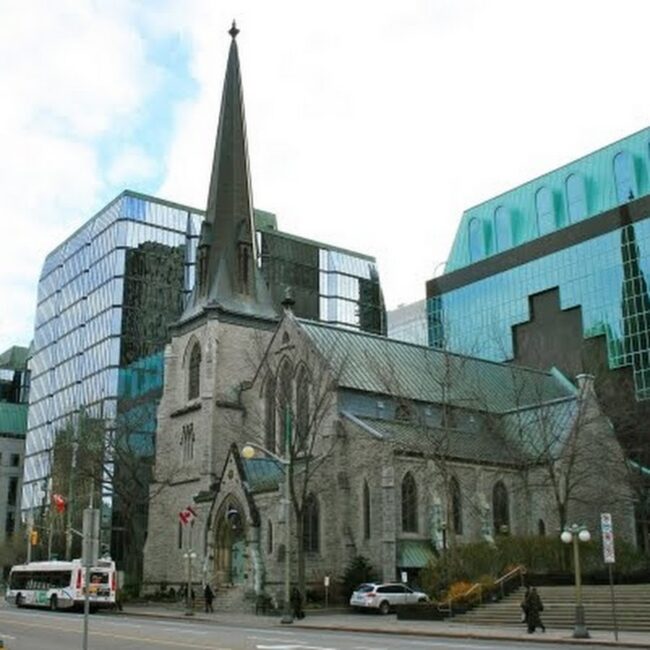
Ottawa, Ontario
My research led me to St Andrew’s Presbyterian Church, a downtown church across the street from the Canadian Supreme Court. St. Andrew’s website mentioned a group called the Rainbow Circle. When I attended worship, the bulletin noted the group’s monthly meeting was coming up soon. This could be the opportunity to find the community I was looking for. It seemed ideal, yet daunting.
I nervously set out for my first Rainbow Circle meeting, curious what the group would be like. I quickly realized most were older than my parents. The core members had long advocated for an inclusive church, motivated by their deep care for gay or lesbian family members.
Though I was younger than most, the Rainbow Circle meetings became a welcoming place to understand my faith and sexuality. The group would gather each month to watch a film or documentary, discuss a short article, hear about someone’s life experience, or celebrate the holidays. Occasionally, gatherings included shared meals at a local restaurant or someone’s home. About ten to fifteen people attended most meetings.

One of the leaders, Sheila, had long been involved in PFLAG before helping found the Rainbow Circle. From her broad network, she would invite interesting people to join us. Through them, I gained new perspectives, including conversations with an openly trans person, authors of books and resources about faith and sexuality, and parents discussing their journeys of understanding their gay or lesbian children.
Sheila would also send encouraging emails, updating us on news about the church and LGBTQ inclusion, as well as personal messages that I still value today.
The group demonstrated compassion and solidarity while seeking to learn and advocate. We had good discussions and I learned from older members of the group. I was shocked to discover some had worked for the Canadian government when it was expected that women would resign their jobs once they were married. I was inspired by their involvement in other justice movements, including food security and interfaith relations.
As I felt at ease with the Rainbow Circle, I became more involved in the broader congregation. I remember how welcomed I felt when Judy, an Elder who knew I was gay, called me by name as she served me communion. Later, I was touched when I was asked to read scripture in worship, even though the pastor knew I was gay. In my previous church, coming out would have excluded me from participation.
There were also tricky moments. Though I was comfortable in our Rainbow Circle, I was not out in all spaces. One Sunday, a friend from high school, to whom I was not out, was visiting Ottawa and came to my church. A woman, who had recently shared at Rainbow Circle about her teenage son coming out, came up to greet me. As she started talking to me, I nervously glanced over my shoulder and whispered that my friend didn’t know I was gay.
And not all in the broader congregation were affirming. The pastor discussed family diversity from the pulpit and the church advocated for same-sex marriage. Some Elders, however, were not convinced. A few of them came to a Rainbow Circle meeting to learn more. Diverse views were shared and the discussion was rich, as the group leaders maintained their commitment to inclusion.
Once, at a congregational meeting, a person loudly criticized the church’s advocacy for same-sex marriage within the Presbyterian Church in Canada. I was grateful when Billie, another group member, reached out to me afterward to see how I was doing.

Given my previous experiences in unwelcoming churches, my involvement with the Rainbow Circle was deeply meaningful. I also met LGBTQ members of the congregation who did not participate in the Rainbow Circle or only joined occasional social events. This surprised me at first, but I realized they already felt free to be themselves. Not everyone needs a support group.
After two years in Ottawa, I moved abroad for work. I cherish how I grew during my time at St Andrew’s. I learned the value of the faith tradition I was raised in. I was inspired by their bold commitment to acceptance. Upon leaving Ottawa, I was more confident and had a stronger sense of self than when I arrived.
Each community and congregation is at different stages in how they respond to sexual and gender diversity. To get to a world without homophobia, intentionally inclusive spaces are important. Rainbow Circle is an example that starts with leaders like Sheila, Judy, and Billie who make it happen and invite others to join.
4 Responses
I appreciate hearing that even within our recently disaffiliated CRC churches, intentionally inclusive spaces are important. Our work is not finished. Thank you for sharing your experiences with us!
Ian, thank you for sharing your often painful story, especially using the word “innate”. My daughter shares your journey. It was my belated understanding of her being inately gay that helped me understand her often painful journey.
Good for you in not giving up on religion and church. This world is so divided on so many things and we are all in need of bridges to cross over and learn acceptance
Thank you for your perseverance, Ian. It feels particularly sad that the church, which is commissioned to love, is so often the source of pain. I hope that all of us will work to provide intentionally inclusive spaces in our churches and beyond.