
The power of this holy night
dispels all evil, washes guilt away,
restores lost innocence, brings the mourner joy;
it casts out hatred, brings us peace,
and humbles every earthly pride.
Heaven is reconciled to earth, and we are reconciled with God!
-from the Exsultet
A New / Old Experiment
In a staff meeting during the COVID-weary spring of 2021, we were puzzling over what to do about Easter. It was my first year at the congregation I presently serve, and we were trying to figure out how to gather safely while trying to accommodate the numbers of folks who we anticipated might join us. A couple people proposed adding more Sunday morning services, but that didn’t seem feasible.
So I threw out a different idea: “What if we tried doing an Easter Vigil service on Saturday?”
One team member’s face scrunched in confusion: “An Easter what?”
She wasn’t alone. The Great Vigil is — of the services in the Triduum, or the “Three Great Days” that also include Maundy Thursday and Good Friday — the least familiar service to Protestant Christians. Myself included! I’d never even been to an Easter Vigil before we decided to try one. And if Cyril of Jerusalem or Gregory of Nyssa could visit us as we gathered on the evening of Holy Saturday, they’d surely call what we tried “Vigil Lite.” We didn’t attempt all twelve or more of the Scripture readings from Genesis, Exodus, the Psalms, and the Prophets; we gathered at 5pm, not midnight; the service lasted one, and not three hours; and those baptized didn’t strip off their clothes in a dark cave.
But, since that first experiment, the Vigil has become a new/old tradition at my church, and five years on, the “Night of Radiant Splendor” has become my favorite part of Easter.
Light, Word, Water, Table
Beth Maynard, an Anglican priest, describes attending a Vigil service for the first time, shortly after she’d become a Christian, and experiencing its elemental power:
I came into the Episcopal Church 30 years ago from an atheist background, and my first Easter liturgy as a believing Christian was the Vigil. No surprise, then, that I have always loved it. But especially since that extraordinary experience. . . I have also longed to see more churches with the chutzpah to confront people with the sensory extremes this liturgy makes possible. . . Night and light, silence and sound: honor these contrasts and they’ll do their work on the soul with very little help from us.
The four movements of the service — Light, Scripture, Water, and the Table — narrate the story of Christ in richly sensory fashion. A couple weeks ago, on Holy Saturday evening, people shuffled into the sanctuary and waited in the expectant dark. Annabelle, the woman leading in the service, began:
On this holy night
when our Savior Jesus Christ passed from death to life,
we gather together in vigil and prayer.
This is the Passover of Jesus Christ:
through light and Word,
through water and bread and wine,
we recall Christ’s death and resurrection,
we share Christ’s triumph over sin and death,
and with invincible hope
we await Christ’s coming again.
In the beginning was the Word,
and the Word was with God, and the Word was God.
In him was life, and the life was the light of all people.
The light shines in the darkness, and the darkness has not overcome it…
And then, as she lit the large, white Christ-candle:
The light of Christ!
Thanks be to God!
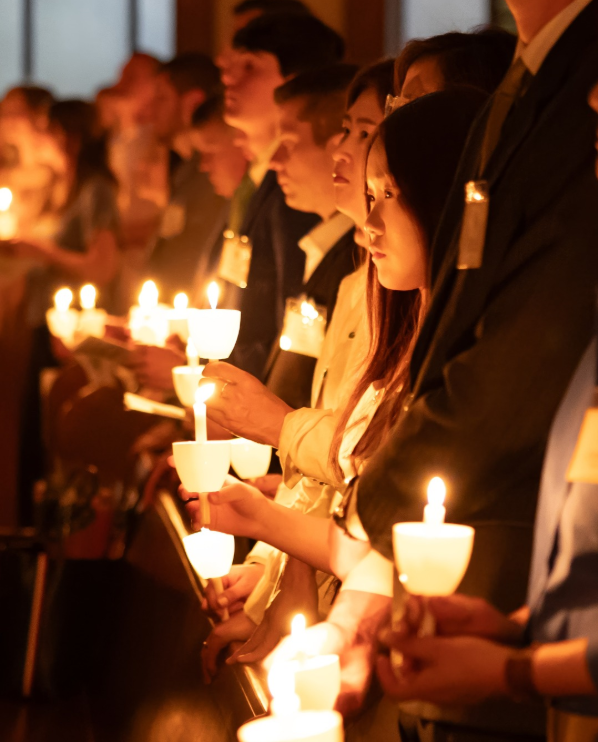
As we sang the Exsultet, an ancient Easter prayer, (Exult, let them exult, the hosts of heaven…) multiplying points of candlelight spread through the sanctuary. The candles in that darkness were carrying on a tradition that dates at least to the fourth century. The historian Eusebius, for example, records that Constantine “transformed the night of the sacred vigil into the brilliance of day by lighting throughout the whole city [of Milan] pillars of wax, while burning lamps illuminated every house, so that this nocturnal celebration was rendered brighter than the brightest day.” Gregory of Nyssa, in one of his Easter sermons, spoke of “this glowing night which links the splendor of burning lamps to the morning rays of the sun, thus producing continuous daylight without any darkness.”
We then listened together to the capacious story of God in creation, Exodus, the Prophets, and Christ. We welcomed new members into the congregation, and splashed the promises of grace into their lives at the baptismal font. And we tasted the grace of the risen Jesus at the Table.
What I love about the Vigil is how those elements — light, Scripture, water, bread and wine — narrate the Resurrection news in a way that my sermonizing on its own just doesn’t. They proclaim the victory of Christ to our whole, embodied selves. In a time that’s still all too dark and violent, I need to see and sing and hear and taste that reality — and maybe you do, too.
“The light shines in the darkness, and the darkness has not overcome it.”

6 Responses
I love the Vigil. Three of my churches let me introduce it (and then gave it up after I left). We’ve experienced miracles in the service, in Hoboken, Grand Rapids, and Brooklyn. I love the baptisms and confirmations, water, oil, and bread, and of course, as you say, the Light.
I was raised a conservative Baptist. Like many in your congregation, Jared, I never heard of the Great Vigil until I became Episcopalian 25 years ago. This year, amidst the present American darkness and my own temptations to despair, I needed the flickering symbols of hope–candles in the night. It was windy and rainy this year as we lit the fire outdoors, and the Paschal Candle had to be shielded so it wouldn’t flare out. And, amidst the present American chaos, the whiplash of every news cycle, I needed to hear the record of God’s great acts in history. l needed to be reminded that history has a direction: that it came from somewhere past (creation and a garden) and is going to something future (new creation and resurrection in a garden).
So glad to learn of your use of the Easter Vigil, Jared.
I’ll be getting in touch with you about music I’ve created for the Saturday Vigil.
Bless you, my colleague.
I remember my first introduction to the vigil, or a version of it. I was a seminary intern. We gathered around 4 am or so. Went the story of God you mention along with all the symbols. We ended at sunrise on Easter Sunday morning. It was quite the experience. The folks who came for Easter morning cooked breakfast, so the vigil folks and the Easter folks ate breakfast together, and then we all went to worship together and celebrate the resurrection. I once described this service to my current church and the meaning of it for me. They responded, “What time do you want us to get up?” I think a 5/6 pm start might work better for them.
Thanks for sharing this, Jared. I’m intrigued and will definitely file it away for possible use in the future.
I’m finally reading this several weeks after the Easter weekend. Thank you for something to look for next year.