
Some of my conservative Christian friends have been trying to justify their support for President Trump by comparing him to Cyrus, the Medo-Persian ruler, mentioned in the book of Isaiah.
I understand their desire to make this move. For a long time, my instincts have also been to look for biblical parallels whenever I encounter something that needs assessing. But caution is always in order. Some parallels don’t match as well as we might think.
Cyrus the Great (c. 600-530 BCE) was a pagan ruler who defeated the hated Babylonian Empire. His most significant act in biblical history was reversing Babylon’s method of dealing with captives and conquered peoples.
Babylonian practice was to deport the people of a conquered nation, especially those in leadership positions. The elite of the conquered would then be far from home and too demoralized to organize a revolt. And those back home would drift aimlessly until sucked in by imperial propaganda.
In contrast to the Babylonians, Cyrus was known for his tolerance of local cultures. He realized that the Babylonian approach resulted in an empire full of discontented people. When he conquered Babylon, Cyrus allowed the people to return to their homeland to worship the gods of their choice, fostering a more stable empire.
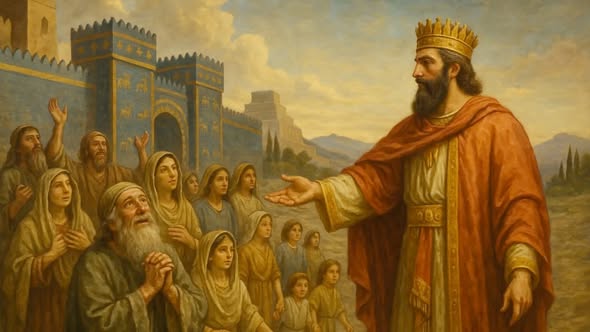
Through the prophet Isaiah, the Lord gave a ringing endorsement to Cyrus and his new policy. “He is my shepherd and he shall carry out all my purposes” (Isaiah 44:28). Even more stunning, Cyrus is called “anointed” — “Thus says the Lord to his anointed, to Cyrus, whose right hand I have grasped to subdue nations before him…I call you by name. I surname you, though you do not know me” (Isaiah 45:1, 4).
God calls this pagan king to be an anointed one, that is, God’s messiah. Cyrus does not know the Lord, but he will accomplish God’s redemptive purposes.
This is where some of my Christian friends find a parallel between Cyrus and President Trump. Most of the Christians I know are willing to concede that the president is not a Christian. But just as God used Cyrus, a pagan ruler, so God is using Trump, they claim, to accomplish good things.
Let’s consider this proposed parallel to see if it justifies enthusiastic support for the president.
First, it’s true that God uses pagan rulers to accomplish his purposes. There are many examples in Scripture: Pharaoh in Joseph’s story, the Persian king is Esther.
Second, when God uses pagan rulers, it’s not always for immediately redemptive purposes. Sometimes rulers are instruments of God’s judgment—even, or especially, on God’s own people. In Isaiah 10, Assyria is described as “the rod of my anger.” Babylon, with Nebuchadnezzar, is similarly said to bring judgment on Israel (Jeremiah 34 and Habakkuk 1).

It could then be argued that God might be using the president as an instrument of judgment on the US, more than, say Venezuela or Iran, for example. Perhaps God is using President Trump to bring judgment on the American Church for the way we bow before the golden calf of political power.
Third, the rulers God uses are never exempted from facing their own judgment. Right after the Lord said he was going to use the Assyrians to judge Israel, God also says Assyria will be punished for their haughty pride (Isaiah 10). God decreed the same fate for Babylon (see Isaiah 47 and Jeremiah 50-51). Those who cheer on the president as an instrument of God should remember that God judges the very rulers used for God’s purposes. Being used for God’s purposes does not equate with God’s approval.
Fourth, just because a leader is anointed as a messiah does not automatically mean that everything they do is God’s work. David was anointed, that is, a messiah, and he had a mixed record as a leader. Solomon’s record was worse. Most of the anointed messiah-kings in David’s line did not walk in the ways of the Lord. Some were very evil.
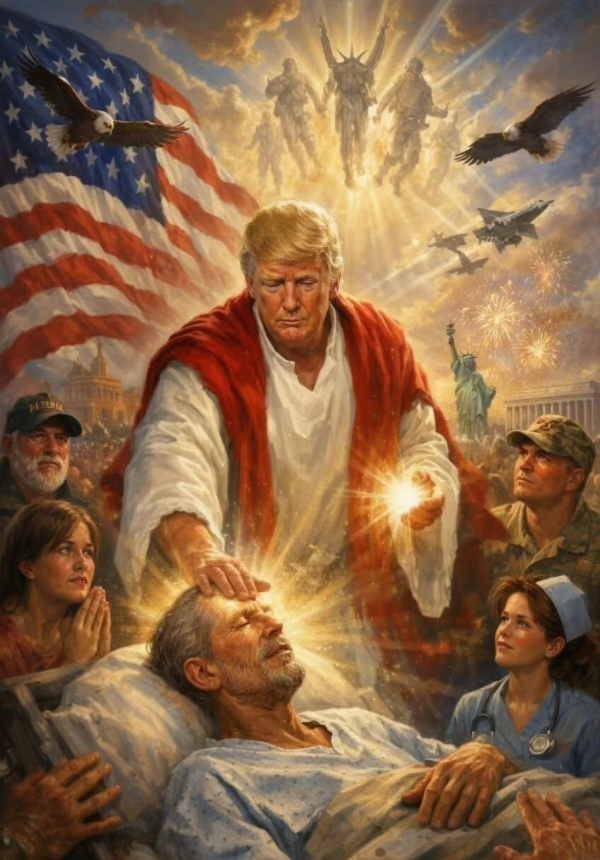
It was the prophet’s task to stand against many of the “mini-me” messiah-kings of Judah. Likewise today, the people of God need to stand against the wrongs and evils of mini-messiahs, and especially against those who claim an inflated role and authority. The AI illustration recently posted by President Trump appears to make such a claim.
Fifth, Cyrus was a good messiah inasmuch as he fulfilled the redemptive purpose for which God had anointed him: announcing good news to the captive and release to the prisoners. His was a messianic mission because it aligned with and anticipated the mission of the even greater Messiah to come. In Luke 4, Jesus confirmed that he was this messiah when, quoting from Isaiah 61, he says of himself, “The spirit of the Lord GOD is upon me, because the LORD has anointed me; he has sent me to bring good news to the oppressed, to bind up the brokenhearted, to proclaim liberty to the captives, and release to the prisoners; to proclaim the year of the LORD’S favor, and the day of vengeance of our God”
In contrast, I am deeply skeptical that President Trump’s goals and policies to forcibly send refugees back to their oppressive homelands align at all with the mission of Cyrus. And they are especially unlike the ministry of Jesus.
Sixth, after Jesus declared himself to be the anointed one, he warns against looking for other messiahs to come — for they are only false messiahs! Jesus warned, “then if anyone says to you, ‘Look! Here is the Messiah!’ or ‘There he is!’—do not believe it. For false messiahs and false prophets will appear and produce great signs and omens, to lead astray, if possible, even the elect” (Matthew 24:23). For Christians, this should instill deep caution about attaching messianic significance to any political leader.
Seventh, the New Testament says that Christians share in Christ’s anointing. However, we are not messiahs, but participants who share in Christ’s anointed work (see 2 Corinthians 1:21-22). The Heidelberg Catechism, Q&A 32, says, we share in Jesus’ anointing to be prophets, priests and kings. Like prophets we speak God’s truth to the powerful and the powerless. Like priests we intercede for our world and its leaders. Like kings we live out the reality of God’s kingdom in the midst of this world’s kingdoms.
Comparisons between Cyrus and President Trump are strained and inexact. But more importantly they are a distraction from our primary calling — to follow Jesus, the true and only Anointed One who calls us to share in his liberating ministry of good news.

12 Responses
Thanks for writing this. It should be shared widely in our churches.
Amen and amen.
For sometime, I have agreed with your friends that Donald Trump is a biblical scale figure. .However, if we are looking for parallels, we are better to look at Moloch or Manasseh. If that seems over the top, just consider the estimates of all the children worldwide who will die because of the Trump administration cutting of USAID funds. Given the image presented above, is it too far to say that Trump in some ways plays the antichrist? Or, given the way he has slapped his image here there and everywhere, is it too much to suggest that he is the abomination of desolation? All of these biblical parallels seem far more fitting.
Ahab, Nebuchadnezzar could also fit the bill.
Thanks for this article.
I’ve yet to have anyone explain to me what purposes of God Trump is supposedly accomplishing, other than-as you note-perhaps judgement on what the American church has become.
Thank you David.
I really appreciate this. I would add a very significant difference that Christians seem to ignore is Cyrus was an emperor or King. We don’t have kings. I know, my liberal “No Kings” bias is showing, but when we make comparisons to biblical kings anointed by God for redemptive purposes, we fall victim to twisting the Word in ways to make our point. We don’t have kings. We elect leaders, so our leaders reflect our character, vision, and desires. I think we forget that, and its hard of course, because no one we elect is perfect. We don’t get to choose between good and bad, but bad and worse, never an enviable position to be in.
David, I think you’re designation as messiah is helpful in this regard. I do think that Trump moves to make messiah like proclamations, “I alone can fix it.” Pictures of him as a messiah who heals with orbs of light and power designated by military might surrounding him. What are we to make of this? Is he claiming to be Jesus? I doubt it. Is he claiming to be a “messiah type” figure? This feels more likely.
Paul, I find designations of “anti-Christ” less than helpful most of the time, but slapping your name on everything, including a new passport and your signature on money, plus creating new dollar coins, seems to echo “anti-Christ” behavior, especially when you combine it with the SAVE Act which leans to requiring a passport to vote (I know any form of government ID, but a passport is what the SAVE Act desires). So we need a government ID to vote in a democracy, and money to buy food, and TrumpRX for medication (for those who do not have adequate insurance), and Trump accounts to ensure our young children get a leg up on retirement, all with Trump’s signature. It’s just icky. They say history rhymes. There’s a lot of crappy poetry going on here.
One last thing, what is the attraction? I think it’s power. I’ve said it before here, but it’s worth thinking about. How does one bring the redemptive action of God. Many of our siblings who have searched the pages of Scripture have decided it is power. It’s why no one wants to vote for the widow and her mite, who gives all she has. Who would ever want a politician who gives all s/he has for their country in service of the people? It’s why Christians never ask, which of these candidates is Amos or Jeremiah or Ezekiel, those who call the powerful to account for the poor and oppressed. It’s why no one seems to look for a leader who tries to embody Luke 4, which David references. Who would want anyone to declare Jubilee or put the oppressed, the poor, the blind, and the imprisoned first?
I could go on. Thank you David. This was very well done.
Rodney, you are exactly right to identify “power” as the issue. Jesus’s own preference for the powerless is relevant. Too many of us who proclaim the Kingdom of God and the Kingship of the Ascended Jesus forget that Jesus’s kingly power is nothing like the powers of human governments, whether monarchies or republics. Jesus’s current reign gives his followers the power to serve others, the power to be faithful under persecution, the power to heal the weak, and the power to have compassion on the weakest and least influential of the world’s people. Until Judgment Day, there is no power of Jesus other than that. This is the very opposite of the Christian nationalism of the evangelical Republicans who worship Trump’s agenda.
More about Cyrus from Bradley Jersak today:
God, speaking to Cyrus, reveals that the new king will fulfill God’s mandate and mission, even as a foreign emperor commissioned to serve Jerusalem’s best interests. Again, how can this be?
It is because even secondary causes, which include personal and global events, blessing or calamity, all happen within God’s sovereign consent to the universal flow of natural law and human agency. As Creator, God is ultimately responsible for all that happens in our universe but we refer to people’s choices and the basic laws of nature as secondary causes because God does not violate them through coercion. Whatever influence God exerts comes through what Socrates called “the wise persuasion of love,” which we see fulfilled ultimately in the Incarnation of Jesus Christ and the sovereign reign of love through the Cross and Resurrection.
All of the messiahs mention unknowingly carried out God’s plans by His will. Now that Jesus, the True Messiah, has appeared are any others necessary?
What good is a type of Christianity that erases the difference between right and wrong? That’s what the Trump as Cyrus analogy is really about.
So how do you rate leaders like Winston Churchill? I don’t for a moment think he was right about everything yet some people want to put Cyrus on a pedestal.
How many more people would have the Nazis put to death if Churchill had followed Chamberlain’s policy of appeasement and yet many innocent people lost their lives to the Allies assaults on Germany – particularly in Dresden.
Is there such a thing as a just war or does a leader just open a country’s border to all and sundry in the name of humanitarianism and ignor the threat in the name of compassion?
I’m Lebanese and my wife is Jewish. Most of her parent’s relatives perished in the Holocaust.
I lost relatives in the Lebanese Civil War that was largely precipitated by Yasser Arafat and his Muslim cronies.
I also lost a cousin recently, thanks to Hezbollah.
I ask again, is there such a thing as a just war? I think there is and so I applaud leaders like Netanyahu and Trump even though they might not be as righteous as some theologians think themselves to be.
For those who have a problem with fighting just wars, I point out that one of God’s names is Adonai Tzavaot which means ‘God of Armies’.
If that’s hard to swallow then take a look at Zecharaiah 14:2-3. God will make war on His enemies. He isn’t just Jesus – meek and mild – He is also the “Judge of all the earth” (Genesis 17:25b) as is also detailed in Revelation 19:11-16.
We must “…behold the goodness and severity of the Lord…” (Romans 11:22)
Your questions are valid. When someone, anyone, is doing good, I think they are acting in alignment with God’s will / the Bible. When someone is doing evil, no matter who, no matter what, they are not acting in alignment with God’s will / the Bible. It’s a pretty simple measure. And I don’t think anyone is calling Trump “a messiah” but they certainly called Barack Obama that, and there were no objections.