
Walter Brueggemann hardly needs an introduction to students of the Hebrew Bible. He was a celebrated lecturer at Catholic and Protestant seminaries throughout North America. I first encountered his ability to transfix an audience as an instructor at Gettysburg Theological Seminary. At the time, I was teaching introductory classes on both the Old and New Testaments. I was working late into the night to stay five minutes ahead of my students, thinking I would survive my first year of teaching with some dignity. After his lecture series, my students knew they were not getting their money’s worth.
Walter Brueggemann was a rock star in the field of Biblical Studies. Early in his career, he helped pioneer the methodology of rhetorical criticism first introduced by James Muilenburg at Union Theological Seminary, where Brueggemann received the first of his two doctoral degrees (the second was from St. Louis University). I remember reading Brueggemann’s early work on form criticism and on the social implications of Hebrew rhetoric. These studies placed him at the forefront of innovative research in the guild. But groundbreaking methodology was never an end for Brueggemann. He always kept his eyes fixed on the life of the Church. He fashioned rhetorical criticism into a resource for exploring the biblical language of faith, particularly in the forms of praise and, especially, lament, for the contemporary Church.
Brueggemann could penetrate the lived experience of the individual’s journey of faith, but he always steered that journey back to the corporate Church, emphasizing the need for the Church to be a critical counterculture to the materialism and exploitation of our modern age. Brueggemann wove together our individual and corporate life of faith in countless books (over fifty) that probed such topics as Hope within History, Journey to the Common Good, Hopeful Imagination, Cadences of Home: Preaching Among Exiles, and Sabbath as Resistance. Even at the age of 90, he turned his prophetic voice to the infestation of Christian nationalism into the Church with Ancient Echoes: The Fear-Filled, Greed-Driven Toxicity of the Far Right.
Throughout his career, Brueggemann also wrote prayers as an extension of rhetorical criticism. The merging of the Hebrew Bible and prayer was forged in his important book The Message of the Psalms, in which he explored the transformational language in the Psalter as a resource for the faithful through times of well-being (praise in times of orientation), crisis (lament in times of disorientation), and transformation (thanksgiving as new orientation). My students devoured this book in countless Psalms courses. But Brueggemann also extended his knowledge of rhetorical criticism beyond the study of prayer in the Hebrew Bible to fashion his own prayers. In Awed to Heaven, Rooted on Earth, he states that praying is a dangerous act of rhetoric, in which we face God, confess as a form of truth-telling, and lament at times of divine absence. Prayers for a Privileged People provides an illustration: in it, Brueggemann explores the power of prayer as a counter to the quest in our contemporary culture for the religious endorsement of entitlement.
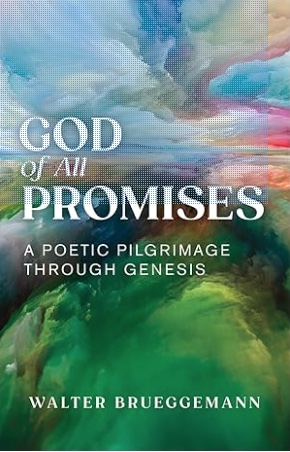
God of All Promises: A Poetic Pilgrimage through Genesis is Brueggemann’s last contribution to the merging of Hebrew rhetoric and the life of prayer. He died on June 5, 2025, in Traverse City, MI, at the age of 92. We should thank publisher Westminster John Knox for issuing this unexpected gift, in which Brueggemann rewrites the book of Genesis as prayer. The rewritten Bible has a long tradition among ancient Jewish and Christian authors. It describes the practice of retelling a biblical text with interpretive expansions and modifications, resulting in a new narrative. God of All Promises is Brueggemann’s contribution to this ancient tradition through prayer. He explains his motivation as follows: “I have found possible and useful, in my own practice, to pray back the Bible to God, who dwells therein.”
The two opening chapters in God of All Promises on Genesis 1-2 model Brueggemann’s method of re-writing. The majestic third person language of the creation story in Genesis 1, “In the beginning when God created the heavens and the earth, the earth was a formless void and darkness covered the face of the deep, while wind from God swept over the face of the waters,” is re-written as a direct address to God and reinterpreted as a story of love: “At the outset there was you, only you; only you in your majestic splendor; only you ready in your generative love. And then from you heaven and earth as your domains, night and darkness as your zones of governance, chaos turned to ordered life.” The change in voice transforms the more distant third-person narrative into intimate second-person prayer, concluding with doxology, “Giver of life abundant we are on the receiving end of your dazzling gifts.” Genesis 2 begins with the quotation of the concluding verse of the chapter (2:24), “Therefore a man leaves his father and his mother, and clings to his wife, and they become one flesh,” as a prelude to the rewriting of this creation story as doxology, “How great though art! … You give us companions, a woman for a man, a man for a woman, a lover for a lover.” The chapter concludes with Brueggemann’s prayer, “You are the God of companionship, and you will us to live in trusting relationship.”
Brueggemann continues his poetic pilgrimage through Genesis, stopping along the way to comment on unusual biblical genres like the genealogy (10:21-31), or to overlay our own experience into Genesis, such as the hubris of superpowers in going to war (Genesis 15), family conflict (Genesis 32), and divine providence (Genesis 45). We thank Walter Brueggemann for his final gift in writing God of All Promises. Requiescat in pace.
7 Responses
Thanks Tom for this piece on a book that many of us didn’t know was in the pipeline.
And thanks too, for your valuable contribution to the field of OT studies. Your work is a gift as well!
Marc and David, I think that this book would be a great study guide. The freedom with which Brueggemann rewrites the texts can be a catalyst for other to undertake the same process. I am thinking about using it myself in a class.
Your comment about being five minutes ahead of your students brought back memories of my first year of teaching at Central College in Pella, Iowa. I suspect, however, that your students got their money’s worth. When I look back now on my ministry, I remember those early years fondly. I was raw and vunlerable, but I was also very open and present, learning so much as I went along. I think that the students felt that and responded by also being more open to learning. I am wondering whether you had a similar experience.
Tom, we have shared the same rite-of-passage. The experiencing of working through material with students early on in my career was transformative.
Many thanks for this review. Your long-time acquaintance with Brueggemann’ scholarship is a precious gift to us, and your review tells me to get that book!
Ditto, David. Thanks, Tom, for another note of profound appreciation for Brueggemann.
Thank you Tom. This fits. In my Liturgy courses I have assigned students to recast the opening sections of many of the Epistles as Berakoth prayers. Ephesians 1 could be a Eucharistic prayer. What you are advising, via Brueggemann, brings out how much the Word of God is a conversation, a “talk.” PS, great to see you here.