
Increasingly, I’m aware of spending more and more time prayerfully thanking God for authors that have enriched my life. The downside is that too often my thoughts of these dear folk arise somewhere between 2 and 4 am.

Some of these writers are living and some are dead, although my theological perspective suggests that those with completed obituaries may be more alive than those of us still on the green side of the sod.
My appreciation has been enhanced in recent months by having to painfully “downsize” my library. Gratefully, I’ve been able to retain such luminaries as Wendell Berry, Ellen Davis, T. F. Torrance, Diogenes Allen, Eugene Peterson, Simone Weil, George Herbert, Frederick Buechner, Marilynne Robinson, and many others. I’m sure you have your own blessed array to celebrate.
Of this wondrous company, I want to focus on Eugene Peterson, an author I’m inclined to return to again and again. To the best of my recollection, my first awareness of Peterson emerged in the early 1980s through an article entitled “The Unbusy Pastor,” which he published in Leadership Journal. He was not advocating that a pastor should fail to work hard, but that the work be focused on the essentials of biblical exegesis, preaching, the administration of the sacraments, teaching, and pastoral visitation, rather than the relentless programmatic “busywork” many denominational leaders seemed to advocate.
At the time, I was a pastor in Bergenfield, New Jersey. The Ministerial Council was given a grant to bring in a guest speaker, so I suggested we invite Peterson. Eugene told us he wouldn’t come since driving his car from the Baltimore area to New Jersey would take too much of his time. We countered that he could take a train to Newark, where we could pick him up. He accepted.
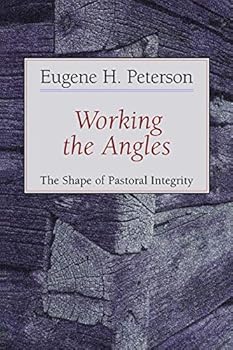
In our meetings, he expanded on the insights offered in the article he had written, which he later developed and expanded to comprise his book Working the Angles: The Shape of Pastoral Integrity. This work focused on the pastoral tasks of praying, reading scripture, and spiritual direction.
Learning from him saved me many hours of feeling beholden to laboriously justify my existence through detailed synodical denominational reporting. Each year, when asked to fill a page detailing the programs, initiatives, and accomplishments of congregational life, I gave the same simple answer: “The preaching of the Word and the administration of the Sacraments.” It was never challenged or questioned.
A few weeks after his encounter with us, Peterson sent me a bibliography of his library. I realized I had been reading many of the same books as he, but obviously he had been able to assimilate them and set them to use in ways beyond my abilities. Still, I felt we were on the same page.
Subsequently, at various conferences over the years, I had the opportunity to spend time with Eugene, comparing our experiences, discussing our theology of ministry, and sharing authors and ideas. I was strangely heartened by his scratchy voice and unprepossessing manner. He must have flunked Motivational Speaking 101, which reminds me a bit of someone we know of as St. Paul.
On one occasion, Eugene spoke at the Reformed Church Conference center in Warwick, New York. After the evening meeting, six or eight of us went out to a nearby bar for beer and their not-to-be-missed pizza. A rather troubled woman customer realized that we were ministers and began to engage Eugene in conversation about her concerns. Peterson turned his chair towards her and gave her fifteen minutes of his undivided attention.
I thought about how I would have handled the situation. I would have told myself that I was away from the parish and did not need one more tug on my sleeve. I would have politely, but firmly, declined to enter into conversation with her. I was making a perfectly reasonable case to myself that I deserved and needed to be “off-duty.”
I must admit that I have no recollection of what Peterson spoke about at the conference center that evening. I do, however, remember his attentiveness to a person in need. For me, that awareness added another stamp of authenticity to his writing and speaking.
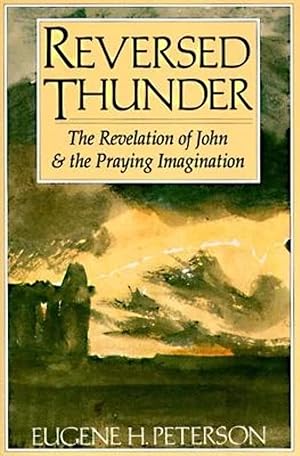
My favorite of the dozen plus books he wrote is Reversed Thunder: The Revelation of John and the Praying Imagination. I think of this work as the bountiful harvest of a thoughtful, wise, able, and mature pastor.
Peterson is not seeking here to provide an exegesis of the text of Revelation. Other fine sources accomplish that important task. What he seeks to do is identify big picture themes this theological poem offers us. The themes are set in the framework of “Famous Last Words,” as in: The Last Word on Scripture, Christ, Prayer, Heaven, etc. He reminds us that this final book of the Bible offers us no new information that has not already been set forth in the Old and New Testaments. What it does offer us are fresh and imaginative ways of living into biblical-incarnational realities. It “shows how all of scripture is put to work in the church and the world” (p. 24).
I noted earlier how adept Eugene Peterson was at using sources. In his short introduction to Reversed Thunder, he cites George Herbert, Henry Adams, Wendell Berry, Reinhold Niebuhr, and five others. Yet these sources are neither over-bearing nor intrusive. Too often footnotes function in a text like a toxic weed killer or conversely as an artificial fertilizer. For Peterson, the footnoted material is more like a natural organic seedbed from which life-giving growth can spring. He invites us to enjoy the superb company of those whose contributions stimulate us to give thanks to God day or night.
7 Responses
Thanks, Norm. I also have been blessed by Peterson’s words.
Thank you for this. I especially appreciated the true-life example of Peterson pastoring a stranger. I have some new titles to read!
One of my all-time favorite things to watch is the video Fuller Seminary produced of the conversation between Gene and U2 lead singer Bono, who was a big Peterson fan! It’s just a lot of fun.
Ditto to what Scott says. The Fuller video is a lovely complement to Norm’s tribute. Fun and luminous with such wisdom and grace.
Thank you for this good post. I too finally read Reversed Thunder after hearing a sermon series on it, plus another recommendation by a friend who she said if she could take only two books with her to a desert island besides the Bible, this book would be one of them. It’s that rich.
Thank you for this delightful reading experience. Isn’t it wonderful at our ages to look back and reflect on all the marvelous saints who entered our lives in unexpected ways? It reminds me of Acts 2:17 “In the days to come, it is God who speaks — I will pout out my Spirit on all humankind. Your daughters and sons will prophesy, your young people will see visions, and your elders will dream dreams.” Tis the time to dream. Many thanks for your reflection. Greetings to Joyce.
Miss you and your insights, Norm. Thank you for this and so much more!