
Within a year of my own ordination as minister of the Word and Sacrament in the Reformed Church in America (RCA), the second edition of On Being Reformed: Distinctive Characteristics and Common Misunderstandings, written by I. John Hesselink, was published. The first edition had been published just about the time I was finishing my undergraduate education and entering Seminary. I mention this because, for much of my parish ministry, this was a book I used in adult education classes built around the question of what it means to be Reformed. It worked well, as even the misunderstandings which Dr. Hesselink used to organize the book led to positive spins on what being Reformed meant and could mean to people who were often bound by historic assumptions.
Still, there were challenges to the book, some of which were inherent in its writing. To be clear, John Hesselink never, in my experience, spoke down to anyone, and I truly believe he never deeply considered the thought that he was smarter than anyone, even if he had more education in certain subjects. But anyone who listened to him speak or who read his writing knew they were in the presence of a huge intellect. When I used the book to teach adult education classes, a significant amount of each class went toward unpacking terms and concepts in the chapter.
Also, Dr. Hesselink was a white male of Dutch background. All of those whom he credits with helping him in his writing were white, male, and at least part Dutch. This was, in part, a product of teaching at Western Theological Seminary in the 1970s and early 1980s. But, as the twentieth century moved toward its conclusion and the church became better at embracing its multicultural, multi-ethnic nature, with differing genders, this became an impediment.
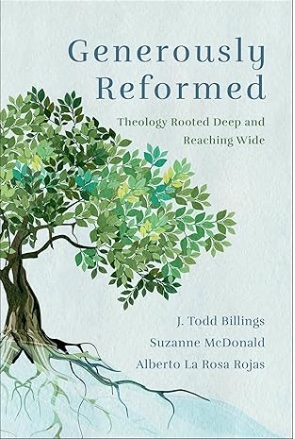
In Generously Reformed: Theology Rooted Deep and Reaching Wide, we have a book that can help a new generation—and several generations, one hopes—discover what it means to be Reformed. While Hesselink began with “I am bullish on being Reformed” even as he acknowledged its shortcomings, the three authors of Generously Reformed, something we will get to in a bit, work from a more introspective, vulnerable position:
This book is not an apology or defense for belonging to a Reformed denomination or network or inhabiting a particular polity. Denominations and structures matter, of course. But for too long, they have been confused with something quite distinct: inhabiting a historic theological tradition. It is possible to be part of a Reformed or Lutheran or Methodist or Baptist denomination and to inhabit those traditions in reductionistic ways. In some contexts, theological points can quickly become weapons in warfare, meant to secure the fortress against the onslaught of “the liberals” or “the fundamentalists.” In other contexts, due to exhaustion from years of denominational bitterness, a congregation tries to hide its heritage under the rug…
. . . We authors of this book believe that, even with is flaws and shortcomings, the Reformed tradition can be a fruitful pathway for growing deeper into maturity in Christ, for hearing the testimony of the whole counsel of Scripture, and for strengthening our witness—in word and deed—to the good news of Jesus Christ in a hurting and often cynical world (xx-xxi).
In the seven chapters that follow, the authors go on to describe what they have found along those pathways, the ditches and summits along the way, and the places where good spiritual fruit can nurture our souls, not to mention the possibilities for better planting and richer harvests in the future.
Now, about the three authors: Todd Billings, Suzanne McDonald, and Alberto La Rosa Rojas all teach at Western Theological Seminary, as did John Hesselink. I am a fan of all three of them, and I have had the opportunity to work with Suzanne through the Reformed Church Center and with Alberto on the RCA Commission on Theology. I know Todd mostly through social media and reading his writings; all of them are great gifts to the church.
While one might be tempted to say something about needing three of them to do what Hesselink did by himself four decades ago, one would miss the point. Dr. Hesselink would, I believe, be delighted by this approach and wish he had had the opportunity. These three have been able to transcend his limits of background, ethnicity, and gender. While they cannot represent all the possibilities, they can speak more fully to being Reformed and being together. Their differing voices do come out along the way, and they freely acknowledge such, but they are, for the most part, harmonizing with one another and improvising off each other’s theological worldviews and approaches. Here, the Reformed tradition isn’t a classic strophic hymn tune so much as it is a jazz session, a musical conversation picking up from one begun before, leaving a place for another yet to come, and picking up where this leaves off.
And the book does leave off, ready for the next conversation, more than it concludes. At the end of the chapter on Eschatology, we find something that speaks to the whole of a generously Reformed tradition:
While we might not be able to fill in all the details or answer all the questions, we know that it will be indescribably glorious, that it will mean being drawn into infinite and ever-new depths of love and wonder, and that it will draw out of us ever more ecstatic love and adoration (158).

4 Responses
There is, according to the author, “an impediment” attaching itself to Dr. Hesselink’s work: he “was a white male of Dutch background. All of those whom he credits with helping him in his writing were white, male, and at least part Dutch.”
We aren’t told whether this “impediment” was one afflicting Hesselink’s capacity for understanding his subject, or if it’s simply one of optics. It might be that a decent understanding of the Reformed tradition (like a decent understanding of anything) requires a broader appreciation of the kinds of perspectives gained by different social locations (often associated with one’s demographic markers). Or it may be that in today’s context, teaching something that has originated from such a limited location on the demographic map tends to put some learners off. Both are plausible arguments.
But, to the degree that these are factors that simply by force of their formal inescapability “impede” the effectiveness of Dr. Hesselink’s book, they would seem to attach themselves to this review, also.
I had the wonderful opportunity to get to know Dr. Hesselink during the year he served as President of General Synod and I served as VP. Getting to spend significant time in his presence was an incredible gift. A brilliant man. A distinguished scholar. A well-traveled gentleman. A missionary. A professor. A seminary President. The one who brought Emil Bruner and Karl Barth together after their 30 years of estrangement over theological differences.
Yet Dr. Hesselink clung to the simple, rural, Iowa values of his childhood in Leighton, near Pella. He was a great man with incredible stories to tell, yet his highest attribute in my experiences with him was his genuine humility. I should have felt small, intellectually inferior, in I. John’s presence, yet it was so easy to be with this one I considered a giant of a man. I was NOT his equal, except in his eyes.
Haas comments that “we are never told [by Brumm] whether this ‘impediment’ affected Hesselink’s capacity for understanding his subject.” This comment challenged me to re-read the review more closely. My own sense is that in the relevant (and connected!) two paragraphs, Brumm may in fact be making reasonably clear what he means–and does not mean. Brumm clearly credits Hesselink with a superlative capacity for understanding his subject. His point was, firstly, that Hesselink’s specified book, when used in adult education with ordinary laypersons, required a good deal of supplementation.(That Hesselink never imagined “talking down to anyone” was, as I read him, Brumm’s way of putting a virtuous spin on this.) I see Brumm as then extending this point. In no way faulting Hesselink’s capacity for understanding his subject,Brumm’s point (as I read it) is just that the present trio of writers (J. Todd, Suzanne, and Alberto), between them, bring backgrounds and communicative gifts of a sort we may now sorely need to help us newly “discover what it means to be Reformed.”
Let me clarify, please. Yes, Dr. Hesselink was white, male, and at least part Dutch. That, and being General Synod Professors may be all to the favorable comparisons that can be made between the two of us. He was also a phenomenal writer and thinker. But being white, being male, being Dutch are all limitations, because neither of us can truly rasp what it is like to be Reformed and female or Hispanic. We cannot truly imagine what it would be to grow up as anything but children of the RCA. I love this church with all its flaws, just as I believe Dr. Hesselink did, but it is a limiting factor as much as it is a gift. Had he the opportunity to write with colleagues who would bring multiple perspective into this subject, I have no doubt that he would have jumped at it. Multiple ethnic and gender perspectives make both of our seminaries richer and the education we give students stronger. This is a great gift that these authors and this book give to a Reformed apology for a new generation.