
For Mother’s Day this year, my youngest daughter made A Map of Mom. In it, she charted some of the territories of me: the Mountains of Instagram Reels that I send her and her sisters, the Late Night Nap Forest, a whole island for Mister Rogers’ Neighborhood, and another whole island for a town called Coffee, complete with its own church. She’s speaking my love language.
I’ve made maps to explore my grief over people who have died in my life and my anticipatory grief for one who may die before me, maps to name the realities of aging and the complexities of my current callings in life. Most recently, I asked my oldest daughter Samara, who’s great with watercolors and had some time on her hands, to help me make a map. I wanted to surface the things I currently find to be most true in my relationship to God and my understanding of how God moves in this world.
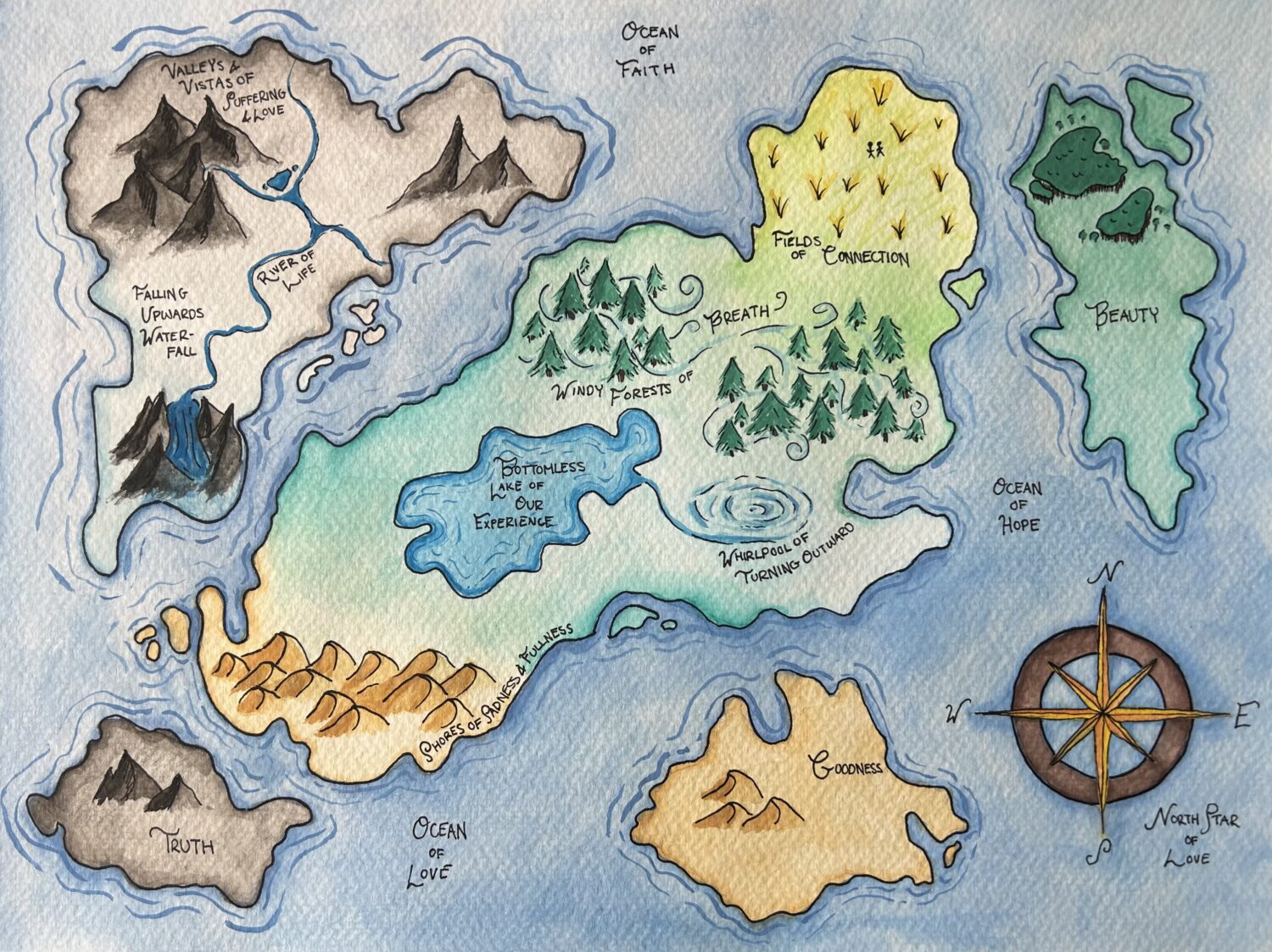
This map served multiple purposes. It helped me to distill some of the learnings from my recent read of Richard Rohr’s The Universal Christ. I also used it to assist me in giving a talk at my church during a series about living in the new creation.
Though the Falling Upwards Waterfall or the Bottomless Lake of Our Experience may warrant future blog posts or conversations, I want to focus on the bright spot in the northernmost region of the map: the Field of Connection.
For the last decade, I’ve loved these lines from Rumi’s poem:
Out beyond ideas of wrongdoing and rightdoing,
There is a field. I’ll meet you there.
I just realized in writing this post that I unknowingly wove these lines into my 2021 doctoral dissertation on engaging conflict. I wrote about how we engage conflict in the field of our minds, in the field of our actions, and in the field of our affects. But then I talked about the ‘field of fields’: the field of our hearts. This is the field that somehow includes, but also transcends, orthodoxy (ideas), orthopraxy (doings), and even orthopathy (emotions).
In my dissertation, I sum up the energy of this Rumian field with the philosophical concept of poieisis, a Greek word which comes from the word poieo, meaning ‘to do’ or ‘to make.’ Poiesis is sometimes said to be what emerges from the relationship between a sculptor, a block of marble, their tools, and transcendent inspiration. Nestled into a heavily footnoted couple of pages about art and science and poetry and philosophy and Ephesians 4, I defined poieisis (for my purposes) as the “co-creative, convivial and disarming work of God and a diversity of humans, through which emerges the phenomenon of a transformed community of shalom.”
God helping me, I have tried to engage, receive and be part of a poieitic life with other followers of Jesus throughout my twenty years of ministry. Perhaps because I am now untethered from any denomination that will police my beliefs, actions, or displays of emotions, my current poietic life feels particularly Rumian. I am in the Field Beyond.
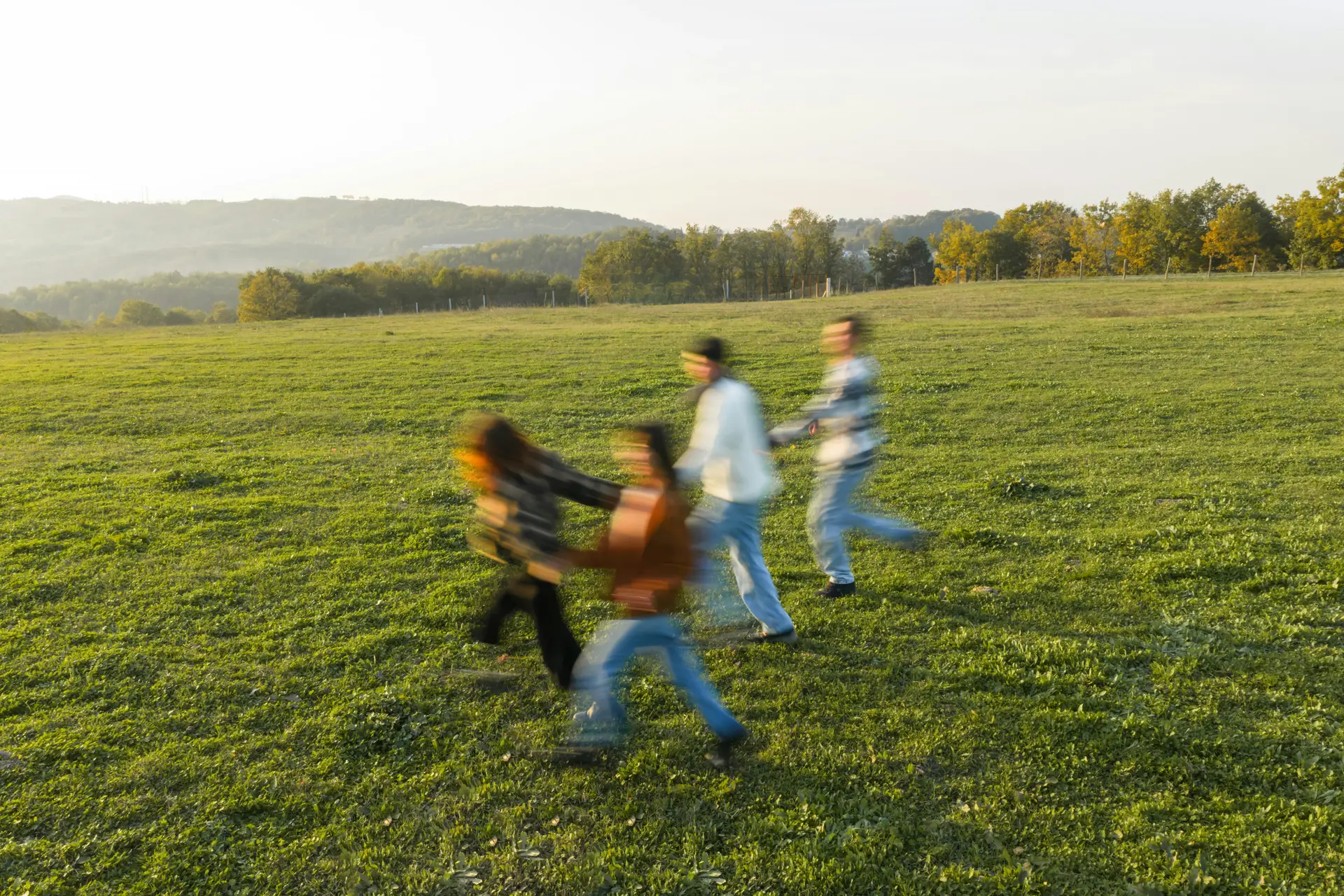
But the Field Beyond is not a place where I can walk alone. It is a meeting place.
Many (if not all) of us are working through deconstruction and reconstruction – or, as Rohr names it, cycles of Order, Disorder, and Reorder. According to Rohr, those who are “liberal” and those who are “conservative” work through this cycle in different ways. Conservatives, among other things, “must let go of their illusion that they can order and control the world through religion, money, war, or politics.” And liberals
must surrender their belief in permanent disorder, and their horror of all leadership, eldering, or authority, and find what was good, healthy, and deeply true about a foundational order. This will normally be experienced as a move toward humility and real community. They must stop reacting against all authority and tradition, and recognize these are necessary for continuity in a culture along with basic mental health–which allows them to belong to something besides themselves. (p. 246, italics mine)
All this to say, I need conversation partners. And so, my best friend and I are going back and forth – sending each other 20 minute video messages of our current wonderings. And my church family graciously received the talk I gave this past Sunday, engaging in a half an hour of dialogue afterward. They asked questions, pushed back, shared their hearts. They let my “I don’t know”s and “I’m not sure”s gently hang in the loving quiet. And we sang together:
Jesus, Savior, pilot me
over life’s tempestuous sea:
unknown waves before me roll,
hiding rocks and treach’rous shoal.
Chart and compass come from Thee:
Jesus, Savior, pilot me.
In an early chapter of The Universal Christ, Rohr reflects on Paul’s writings – especially the mysticism he sees in Colossians. Rohr invites us to see one another and God in a “radiant” and “expansive” way. The seeing he describes is
a relational and reciprocal experience, in which we find God simultaneously in ourselves and in the outer world beyond ourselves…. Presence is never self-generated, but always a gift from another, and faith is always relational at the core. Divine seeing cannot be done alone, but only as one consciousness interfaces with another, and the two parties volley back and forth, meeting subject to subject. (p.52-53)
Or, as Bonhoeffer writes, truth happens between two.
The only way this happens – the only way subjects meet or truth emerges or shalom grows – is in the presence of trust.
Charles Feltman, in The Thin Book of Trust, defines trust as “choosing to risk making something you value vulnerable to another person’s actions” (as quoted by Brene Brown in Solid Ground, p. 254).
And so today, as I continue to reorder (or repaint!) my theological, spiritual and ecclesiastical map, I am thankful for places and relationships where trust lives and grows in my life.
I am thankful for my church family, where we speak and listen to the voice of the Spirit from within and from beyond many traditions. I am thankful for my family and friends who listen and challenge and wonder with me. I am thankful for this Reformed Journal community, where we take what we value and make it vulnerable to the actions (and comments!) of known and unknown readers.
And I am thankful to God. My prayer for myself and for all of you is Paul’s prayer for the Ephesian Christians (a few verses from the third chapter offered here from the First Nations Version):
I pray that as you trust in him, your roots will go deep into the soil of his great love, and that from these roots you will draw the strength and courage needed to walk this sacred path together with all his holy people. This path of love is higher than the stars, deeper than the great waters., wider than the sky. Yes, this love comes from and reaches to all directions.
Field Image by Yunus Tug on Unsplash
7 Responses
Love your map! What a great tool for group teaching and reflection….and for organic evangelism as well. I also love the career-path description in your attached bio. As St. Francis might say, ours is a gospel of imitation more than exhortation.
And I am thankful that Heidi DeJonge writes in RJ. This was great.
Thanks for those thoughts. They seem to hit me where I’m at; particularly how faith is relational. T
Thanks Heidi. Since I see myself on the conservative end of the theological spectrum, I particularly liked your section on how God calls conservatives to let go of trying to control the world with religion, money, war and politics. I am grateful to Jesus that my field of connection in the counter-cultural Jesus movement showed me early on to be wary of that path. I found that warning right there in the Sermon-on-the-Mount (a good mountain for on any map). 🙂
So good, Heidi, that I felt compelled to listen to it twice to make sure I caught everything. Thank you!
So much goodness. Thank you for all of it!
Thank you Heidi. I enjoyed reading your thoughts. May God be with you each day.