
It is up in the air what will happen to Classis Red Mesa, a largely Native American Classis of the Christian Reformed Church. Since COVID and the mandatory closing of all gatherings on the Navajo reservation—including churches—reservation churches have had a difficult time rebounding. Most of these churches struggle with numbers due to aging congregations, lack of finances, and the rather universal trend of younger people not valuing meeting together the way their parents and grandparents did. For those reasons and more, many congregations have dwindled and are a remnant of their former selves. Many are being led by an extended family or two with elders and itinerant pastors preaching and leading worship.
As far as the denomination is concerned, these churches fly below the radar. This is not always a bad thing, especially when it comes to recent decisions concerning human sexuality and the demand for total compliance. Perhaps because this classis is small and the denomination has lots to think about, there is not a lot of denominational focus on Classis Red Mesa. Bethany Church has disaffiliated—I believe the only congregation in Classis Red Mesa that has—but continues to be engaged with the other classis churches and assists them in various ways. I would like to focus on one of these churches in particular, Tohlakai CRC, a congregation my family and I once were members of.
Tohlakai church is located just off the reservation in a rural, fairly populated area north of Gallup. When we attended some years ago, Mike Harberts was the pastor, and the church was going well. On an average Sunday morning there were probably 100-120 congregants. We had to expand the sanctuary by unfolding doors and extending seating into the fellowship hall. Services were in English and Navajo, and Pastor Mike’s family and my family were the only white people in the church.
I wasn’t sure how this congregation was faring and visited Tohlaki recently. I was pleasantly surprised. There were about 40 people in attendance, most elderly, but not all. The pianist was a friend whom I have known for more than forty years. I remember that her mom taught me Navajo in her little hogan. We met once a week to speak Navajo for an hour or so (until I would say something stupid and she would be in a giggling fit). I knew many of the other attendees as well, including two people I had previously worked with in the CRC Home Missions Leadership Development Program. One of them brought the message that day and the daughter of the pianist did a beautiful job leading worship (I hope she plans to get a seminary education).
This time worshiping at Tohlakai brought back memories of when I was on the church council and we formed a diaconal volunteer group to address needs in the congregation and community. It was a little unconventional to call ourselves diaconal volunteers, but there were about 15 or 20 of us, and we would get firewood for elderly folks, hold food drives for special needs, and try our best to address emergencies as they arose.
During this time an elderly couple in the community lost their home due to a fire. Mind you, I had been hired as a leadership trainer by Home Missions in conjunction with Calvin Theological Seminary to serve the classis, and I was pretty excited to have a group of volunteers to share all my knowledge and wisdom with. (Turned out that mostly what I shared was my lack of experience.) In my mind, in spite of the fire being a devastating event for the elderly couple and their family, this was a perfect opportunity for me to demonstrate how to evaluate and discern the couple’s needs while simultaneously training members of the diaconal volunteer group. Four of us visited the family, including Harry Belone, an elder and a founding member of the church. When we arrived on the scene, the couple was staying at a neighbor’s house. They only spoke Navajo. So much for my excitement about how I was going to model leadership. I simply looked at Harry, the senior member of our little group, and he took over. I had been excited about how I was going to demonstrate evaluating imminent and future needs as we supported a family in grief. I would demonstrate how to discern how our church could help provide food and clothing and show the family how to apply for Tribal and Chapter assistance. I was ready! But I could never have done anything better than Harry did that day. He naturally and effectively evaluated the situation with the family, discussed what the church could do, determined what immediate needs we could address, and how we might help with the long-term need for housing. He did all of this with a spirit of love, compassion, and grace.
Which left me wondering, what am I doing here anyway?
I would discover the answer to that question was “learning.”
Early in our time worshipping at Tohlakai, we were invited to a family’s spring sheep shearing event. Clipping wool off an uncooperative sheep with hand shears is no easy task, but I tried desperately not to let my limited abilities show. (It would have helped if I was ambidextrous.) Plus, you have no idea how many ticks there can be on sheep. We just picked them off and put them in a can of kerosene. When we were close to being finished, there was one sheep left in the coral and the family’s grandmother handed me a rope. She did not offer one word of explanation but there was a definite twinkle in her eye. Not having a clue how to handle a rope, I nonetheless went after that sheep with determination and gusto. I had no success. Meanwhile, the entire family rolled in laughter. Finally, grandma moseyed on over to the middle of the corral with a handful of hay and dropped it. The sheep immediately walked over and started nibbling. Grandma simply grabbed the sheep by the wool and dragged it over to the shearing station.
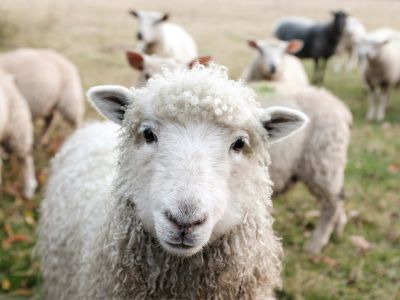
I didn’t mind being the object of their humor—it was a kind of rite of passage. After the work was done there was an obligatory cookout: a feast of mutton and home-made tortillas cooked over a fire. That is when the family announced they were adopting me into the Tachiinii clan, the “red running into the water clan,” or, according to some interpretations, the “red war paint over the forehead clan.” (I liked that interpretation better.) I was taught how to introduce myself as Tachiinii dashinaisa, which means adopted into the Tachiinii clan. To this day, I introduce myself among Navajo as Tachiinii dashinaisa. One of the women leading the singing at Tohlakai on the Sunday I visited was at that event and is also a member of my clan, the Tahchiinii clan. Her sister and husband were also in church that morning.
I loved my job working with the Navajo and Zuni people. I remember sitting in on my first committee meeting, where the group was planning the summer’s Cottonwood Pass camp meeting. Only Navajo and Zuni pastors/interpreters were on the committee. They choose a topic, dates, youth leaders, and special speakers. I watched carefully to see how they did this, never voting once but making decisions through discussion and consensus. I remember how in one of the seminary classes for pastors I was leading, the participants volunteered to bring refreshments. We found out that when it was Sampson Yazzie’s turn, he pawned his rifle in order to buy donuts. I remember helping set up the camp meeting tent for the Cottonwood Pass Conference way up in the mountains—I was helping Johnny Harvey set up the electrical wiring. Johnny was a trained electrician. A volunteer who was visiting from back East came up to us and asked if I was training Johnny on how to wire the electrical. Johnny and I just looked at each other and cracked up. I knew nothing about hooking up electrical stuff, but our visitor’s assumption was that because I was white and Johnny Navajo, I must be training him.
I was the designated trainer/teacher during most of my time working in Red Mesa. In actuality, I was the student. Navajo and Zuni people are very capable—and often I was not—and I had much to learn from them.
As I consider where the Classis Red Mesa churches will end up, I simply don’t know. I hate to say it, but some will certainly die. But some are worth saving. Tohlakia, for example, is worth saving. What is holding them back? Having a regular pastor/preacher and enough finances. Classis Red Mesa churches are small congregations with not a lot of resources. For years we have talked and explored bi-vocational leadership as well as shared pastorates. Those are options but it still takes people willing and trained to do that. For the past ten years, we have had a leadership program to train people to interpret the Bible and preach. This has been mildly successful but, again, I hate to say it, kind of second class to having the proper education and training to lead and preach. I am not sure what the solutions are or where they will come from. But I pray that God will continue to bless the Navajo and Zuni churches in such a way that they will continue to serve people on the reservation and continue to share the gospel.
13 Responses
Thanks very much for this.
Thanks for this glimpse into your servant-ministry and into the reservation churches. A fragile and uncertain time for all of us.
Thanks Tom. Sure hope this finds you doing well. T
It is also worth noting that Navajos are matrilineal and according to AI, in addition to traditional men and women, the Navajo recognize two fluid gender categories: the nádleehí (a male-bodied person with a feminine nature) and the dilbaa (a female-bodied person with a masculine nature). [Source was ict news and othwisechristian.com] So, I can’t help but wonder if they may have a different take on the whole LGBLT+ debate than the leaders of CRCNA.
Don, I honor you for your candid admission of your impulse toward White Saviorism. Sometimes our best contribution is to simply observe, stand down, and get out the way of empowered indigenous knowledge and expertise. Perhaps your sensitivity had something to do with your being adopted into the clan.
Thank you for this timely article. I just read a recap of discussions at the RCA General Synod meeting, which include how the RCA can better serve our Native American population. It is admitted that inclusivity requires understanding that diversity is both good for the RCA and forces all of us to open our minds to different perspectives. The way that we have always done things often does not work when the community becomes more diverse. Watching, listening and learning as you relayed in this article are good starts.
Honestly, I hope and will do what I can, that the bulk of our Native churches disassociate and move to the RCA. The church I am a member of is already disassociated and leaning towards the RCA as a landing place. T
My grandfather (Floris VanderStoep) served as pastor in Shiprock (I think it was Bethel but all of the relatives who could confirm have passed and I’m embarrassed that I do not know). Sampson Yazzie was his interpreter.
Yup, Bethel Shiprock. Spent a ton of time up there teaching and working through issues. Thanks. T
This was the first Navajo church I visited as a Calvin student in 2005.
I remember the Polinders visiting the same day. I’m pretty we sang Victory in Jesus.
Today at Synod we heard a report from Caleb Dickson on Classis Red Mesa speaking at this link https://www.youtube.com/watch?v=_HT_cjGFyHQ at approximately the 2:52:00 mark.
Love this article, T! Perfect timing for our Neland Youth Group trip to serve and help lead VBS with, drumroll… Bethlehem CRC in Tohlakai! Thanks for showing us the ropes, in more ways than one (Mentmore!). We come to learn and follow their lead.
I will make this article required reading for our trip!!
Thanks so much, Don, for your updating us on the status of Classis Red Mesa, and on your emphasis on being a student even as you came to train. Recently someone asked me what was most helpful to me in my ministry in Gallup 58 to 42 years ago, and I recalled how the Navajo elders at Bethany not only became precious friends but were my tutors with cultural and theological insights that not even veteran missionaries had figured out. When our fellowships is truly diverse, we are all so much wiser and richer!
We were thoroughly welcomed at Bethlehem Tohlakai CRC being invited not just for coffee after the service but also for a meal in their fellowship hall with a fire in the fireplace. Many of the members greeted us and introduced themselves to us! The Spirit is at work at that church!
Thank you for sharing with us and teaching us in the short time we’ve been in Gallup. This piece adds to that list!