
It isn’t often as a reader that I can pinpoint the exact spot where I decide, “this is a book for me,” but that was what happened while reading Garret Keizer’s new book Starting from Paterson. The first chapter is about his paternal grandmother, “Florence of Paterson,” and the book begins with a line saying she was a “stout, mercurial woman.” A page later, he calls her “my little tugboat of a grandmother.”
The word “tugboat” did it. I was hooked. It only got better when he said she loved to watch Gunsmoke and Rawhide, which for inexplicable reasons she called “Cowhide.”
Garret Keizer is one of America’s great creative non-fiction writers, who, like so many great writers, toils away in relative anonymity. His work has appeared in countless literary journals and he’s been on All Things Considered and even The Colbert Report, but chances are you’re unfamiliar with him and his work. That’s unfortunate. Starting from Paterson, which will officially be released on June 16th, is his tenth book.

Keizer is an essayist and Starting from Paterson is a book of essays. The theme they share in common is Keizer—they’re his take on an array of subjects. I once shared a meal with Scott Russell Sanders, another great American writer few people have heard of, and Sanders impressed upon me that composing a compelling essay is the fundamental skill writers must have. Yet books of essays rarely dominate the bestseller lists. Don’t let that hold you back. Consider this my attempt to tug on your shirtsleeve and say, “You’re going to love this book.”
Here’s why readers of the Reformed Journal should pick up Starting from Paterson. The second chapter is titled “Reformed.” Keizer was born in 1953 in Paterson, New Jersey, and was raised in nearby North Haledon. He grew up attending the Rea Avenue Reformed Church in Hawthorne and lovingly recreates his days there. His great-grandfather was a Dutch dominee who moved from the Netherlands to Michigan. As a child, Keizer decided to follow in his great-grandfather’s footsteps. Later, though, as a teenager, Keizer—still in a Reformed church but not at Rea Avenue anymore—decided he could not in good conscience make profession of faith. His concerned Sunday school teacher sent him to the church’s pastor.
“Uh oh,” I thought, “here’s where this book is going to take a bad turn.”
But it didn’t. The Reverend Beckering, smoking a pipe in his book-lined study, was wise and kind and gentle. He didn’t try to force Keizer into anything and surprisingly agreed with some of Keizer’s reservations about the Bible. The story could have been so different. Keizer writes, “A step so formal would have left me with something I might have had to renounce later on, whereas now I’m left mainly with memories of occasions like my chat with Rev. Beckering, for which I can allow myself simply to be thankful.”
I am conditioned, these days, to expect a story of religious trauma. The story of Keizer’s treatment at the hands of kindly old Reverend Beckering was refreshing and, like Keizer, I am grateful. The fact that Keizer identifies as an Episcopalian today felt like a bonus. Would he be in a church today if he’d been forced to confess what he didn’t believe back then? I have my doubts.
The essays meander, from considering Marvin Gaye and the music of Motown to the search for the Northwest Passage. In an essay called “Grub,” which on the surface is about food, Keizer writes, “Capitalism is about betrayal,” a zinger that stopped me in my tracks. The context was how an A & P supermarket put his wife’s grandfather’s small grocery store out of business. Former customers would hide their faces with their shopping bags as they walked by. Capitalism, Keizer writes, is “about the irrepressible suspicion that you can get it, whatever ‘it’ might be, sex or cereal, faster, cheaper, and in greater bulk or quantity than where you’re getting it now. Fidelity is for suckers.”
Amen!
My mind immediately went to the Wal-Marts and Amazons of the world crushing small businesses and then leapt from mom and pop stores to how so few of us get to retire on our own terms these days. The money saved by institutions and corporations when they employ younger, less expensive workers is more important than the wisdom and institutional knowledge older workers possess. We are all in on the conspiracy and willingly ignore the human costs of capitalism because so much wealth is generated. I couldn’t help but say a little prayer of thanksgiving that the consistory of Keizer’s former church didn’t send kindly old Reverend Beckering out to pasture before he met with Keizer.
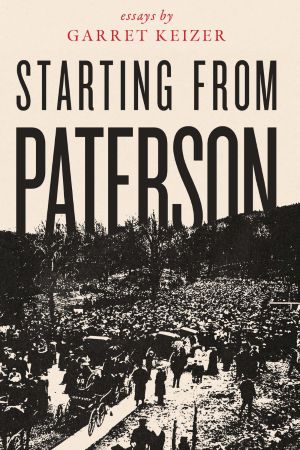
The joy of Starting from Paterson is in serendipitous discovery. You start reading about food and wind up thinking deeply about capitalism. I found myself more than once putting the book down just to sit and think for a while.
And then there’s this: in an essay about the famous people Keizer has had brushes with (beginning with a memorable encounter with Colonel Harland Sanders), he concludes by drawing a comparison between the Emperor Caligula appointing his horse to the Roman Senate and Donald Trump appointing Robert F. Kennedy Jr. as his Secretary of Health and Human Services. The only difference Keizer can see is no children were in danger of contracting polio when Incitatus did what horses do on the Forum floor.
Oh my! That one made me set the book down again.
The combination of memorable stories and deep insight makes Starting from Paterson a gem. It will take some effort on your part to find this book. It’s not going to be in the grocery store or the airport. It may not even show up at your local Barnes & Noble. You’re probably going to have to order it. In the spirit of the book, please resist the temptation to order it on Amazon. Go to an independent bookseller and have them get it for you. If enough of you ask, they’ll start stocking it. You won’t be sorry.

8 Responses
I am hooked. And I remember Domine Beckering, from Union Reformed, I believe. One of the old-fashioned non-judgmental conservatives of the RCA.
I’m going to order that book right now!
I read everything Garret Keizer writes and have never been disappointed. He always moves me and makes me think. Frequently, he makes me laugh.
Thank you Jeff. I’ve ordered the book. Also found this article:
https://vtdigger.org/2026/06/14/a-former-teacher-and-preacher-vermont-writer-garret-keizer-seeks-hope-amid-the-headlines/
What you write is interesting to me. I actually was born in a Paterson hospital. My home was however in Fairlawn, NJ. I also went to the North Haledon CRC while my husband taught at Eastern Christian High School. You should keep in mind that I am not Dutch and started my life as a Catholic but did switch to the CRC when there were no Orthodox Presbyterian churches in Connecticut. This is where we moved after my husband graduated from an engineering school. We eventually made it to Dordt University and we both, Charlie and I, taught and Charlie started the Engineering program. This is the very indirect path in the CRC.
Very good to hear from you, Pam. I was a member of the English Department at Dordt from 1970 to 1982, and very much appreciate the significant contribution Charlie made over the years at Dordt. As you say, he started the Engineering Department, and―without my typecasting engineers―also had very strong interests in Reformed philosophy and worldview. I was deeply saddened by his passing.
Thank you. I do remember you and your family.
This is fresh! Thanks, Jeff. I look forward to the book.
Like you, I am intrigued by the capitalism thought- process. It is a great motivator, utilizing universal greed/ sin as the fuel for an upstart nation’s economy. I am not opposed to capitalism. It works. But it has become an American idol that supercedes shalom, loyalty, and love-of-neighbor when left unrestricted. The free-market works far better for the haves than the have-nots.
But, we hear, “It is the economy, stupid.” Since when does the economy rank higher than humanity itself?